One cannot ignore the importance of ecology – of the question how to position ourselves in relation to nature – within the contemporary societal field. Do we produce and consume in accordance with the vicious demands of the capitalistic system or should go beyond this capitalistic demand and rethink the instrumentalization of our lack?

Given the importance of the ecological riddle in times of climate change and the increase of natural disasters, it is not a surprise that various directors have creatively represented this riddle on the silver screen. While most cinematographic products concerning this pressing problem have been documentaries, some directors have choses to approach it in a more evocative way. Yet, the aim of all these narratives is the same: utilize a fictional envelope to confront the spectator with an uncomfortable truth concerning the ecological real.
With Six Singing Women, Yoshimasa Ishibashi establishes himself as one of the first Japanese director to utilize the ecological problem as his narrative core to spin a fictional story around. Ishibashi’s narrative begins when Shinichiro Kayashima (Yutaka Takenouchi) learns that his estranged father has passed away. While the body of his father has already been taken care off, Shinichiro must return to his secluded parental home to deal with his father’s house. Yet, his return confronts him, once more, with the mystery of the forest his father was so obsessed with.

At first glance, Six Singing Women merely explores the simple opposition between those who ravage the natural world by assuming it is theirs to exploit – the capitalist – and those who hear the cries of nature and decide to protect the faunal and floral diversity – the ecologist (Narra-note 1). This contrast is, strongly, emphasized by the contrast between the two last shots of the narrative, the aerial shot of the forest and the shot of a sprawling city.
Yet, the strength of this erotic mystery-thriller lies in the fact that this simple ecological opposition explores the ongoing relational struggles between male and female subjects, the conflictual contrast between male phallic and female Other jouissance. To trace the way Ishibashi’s narrative exploits the ecological framework to trace out the cultural and subjective clash between two kinds of jouissance, we need to start at the very beginning of the narrative.
The sole aim of the opening sequence of Six Singing Women is to introduce an object that does not fit within the mundane societal field, a mysterious element that ripples the pedestrian fabric: the traditional-clothed woman who consumes bugs in the middle of a forest road. The gothic-like musical accompaniment does not merely foreshadow her estranging appearance on the societal stage but also strengthens the unsettling nature of her elegant presence.
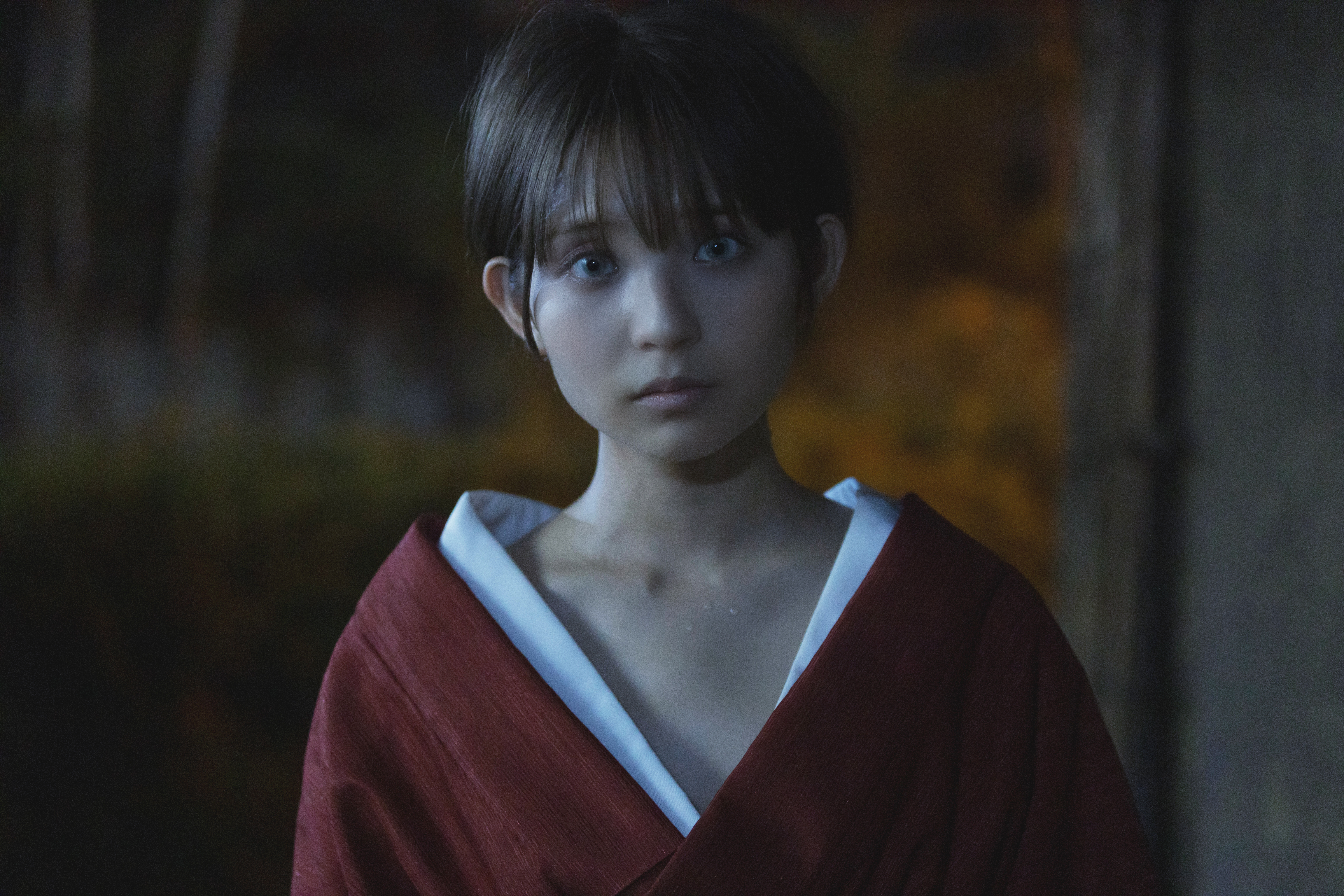
In the same opening sequence, Shinichiro Kayashima is introduced as a subject who has attained a form of social normality by repressing the unsettling intrusions that marked his childhood and by demonizing, rehashing the signifiers of his mother, his father. Yet, by physically returning to his parental home and encountering disturbing visual signifiers, he unwillingly perforates his own defensive shield, i.e. his ego as photographer, and gives the repressed its cathexis to burst forth, albeit fragmentary, to the surface of his consciousness.
What bursts forth? What has Kayashima repressed? Nothing other than the trauma of female sexuality – the Other jouissance. His unconscious childhood experience, which plays an important role in the film’s denouement, fell under repression because it essentially introduced the disruptive nature of a woman who enjoys outside the phallic boundaries.
The world that Shinichiro Kayashima and real estate developer Ryo Uwajima (Takayuki Yamada) enter is, in other words, the world of that Other jouissance. This space, radically repressed within the Other and its subjects, is a space radically marked by an enjoyment that refuses to inscribe itself in the mundane societal field, the phallic Other. Yet, let us be clear, this jouissance is not, as some might assume, perverse or animalistic. It only attains a perverse and animalistic shine because the male subject cannot reduce it to the logic of the phallus and stays outside the field of language. The seductive nature of these women might tickle the phallic desire of the male subject, but the strange animalistic acts of these women leave no doubt that these women do not seek to obtain the phallus their male prisoners supposedly hold.

It is not surprising that Uwajima ends up subjecting the female Other to his phallic logic, the logic of his jouissance. Yet, in doing so, by raping one of the women, he does not merely ignore but radically erases her Otherness. One could even argue that the very reason why he commits these violent sexual transgressions is because he feels emasculated within this Otherworldly space. He rapes to re-anchor himself into the symbolic field determined by the phallus.
Yet, despite Ishibashi’s elegantly play with two thematical layers – an ecological and a sexual one, his narrative ultimately fails in hitting all the right notes and deliver a completely satisfying conclusion. In our view, this failure is caused by Ishibashi’s overly-strict focus on formulating his thematical message. It is due to such strict focus that Ishibashi’s narrative forces some narrative turns and that various narrative strings end up being only haphazardly sewn together (Narra-note 2).
The composition of Six Singing Women is dynamic and has a pleasant fluidity (Cine-note 1). Ishibashi is not afraid to use long takes to give space to his cast to breathe emotional life into their characters and to enliven the unfolding of their interactions, interactions that, quite often, echo what does not fit and what has not yet been discovered.

It will not take the spectator long to realize that Ishibashi structured his composition around mysterious but sensual imagery and visual fragments that, due to their state of isolation, arouse a mixture of unheimlich wonder and strange attraction within the spectator. With his imagery, Ishibashi seeks to tickle the spectator’s phallic gaze, while showing the Otherness that escapes such terror of sexual objectivation.
Ishibashi also elegantly plays with colour-schemes (e.g. blueish). With this play, he seeks to accentuate the edges within the frame, intensifying visual tensions, and interweave some visually pleasant moment within his visual fabric. When more naturalistic colour-schemes are utilized, for example during outdoor scenes, subtle intensifies the colour-contrasts to heighten the visual impact of his shot-compositions or the natural scenery within the frame.
Six Singing Women is a great narrative, yet one that stumbles over its own thematical fixation. While Ishibashi succeeds in creating an engaging contrast between the capitalist and the ecologist and trace out how differently they deal with the Other’s jouissance, the fixation of this contrast leads Ishibashi to create a story with forced turns and haphazardly connected narrative threads.

Notes:
Narra-note 1: As the narrative unfolds, the spectator will discover that each woman represents a specific faunal facet of the forest area.
Narra-note 2: One of the mysteries Ishibashi is unable to exploit is related to the following enunciation: “Eventually, humans won’t need to reproduce either. The sexes won’t matter. We humans will evolve with them. The answer is in the woods.”
Cine-note 1: The visual fabric is, furthermore, decorated with slow-motion shots and slow-zoom-ins. The latter is a common compositional tool in horror narratives.
 psychocinema