The figure of the spy has haunted the cinematic field ever since the release of the propaganda piece The German Spy Peril in 1914 and Fritz Lang’s genre-defining Spies in 1928. Yet, the director that popularized the spy film and cemented it as a genre was none other than Alfred Hitchcock – e.g. The Man Who Knew Too Much (1934), The 39 Steps (1935), Sabotage (1937) and The Lady Vanishes (1938).
In the 1960’s, under influence of fears surrounding the cold war, the popularity of the genre reached its peak, leading to a sub-genre of realistic spy thrillers and another of more fantastical spy adventure narratives. With the popularity of the genre in the west, it is not surprising that Japanese writers like Go Osaka and Michio Tsuzuki offered their own take on the genre and film companies like Nikkatsu adapted some of those narratives to deliver the Japanese spectator a more ‘localized’ version of the iconic figure of the spy.

[Black tight killers has been released on Blu-Ray by Radiance. It features many extras and a highly interesting audio commentary by Jasper Sharp. That alone makes the Blu-ray worth its price. Click the above banner to go to the product-page.]
In Yasuharu Hasabe’s Black Tight Killers, the main character, the war photographer Daisuke Hondo (Akira Kobayashi), might not be a spy in the traditional sense of the word, but, by successfully charming stewardess Yuriko Sawanouchi (Chieko Matsubara) at the airport, he finds himself in the centre of a puzzling but violent confrontation between gold-thirsty foreign gangsters and go-go dancing ninja’s. The only way he can rescue his love, the damsel-in-distress, is to discover what these ninja’s and gangsters so desire. Armed with a few gadgets, reminiscent of James bond’s narratives, he embarks on a tongue-in-the-cheek adventure full of car-chases, cold-blooded violence, kidnapping, and many surprising but dangerous ninja techniques.

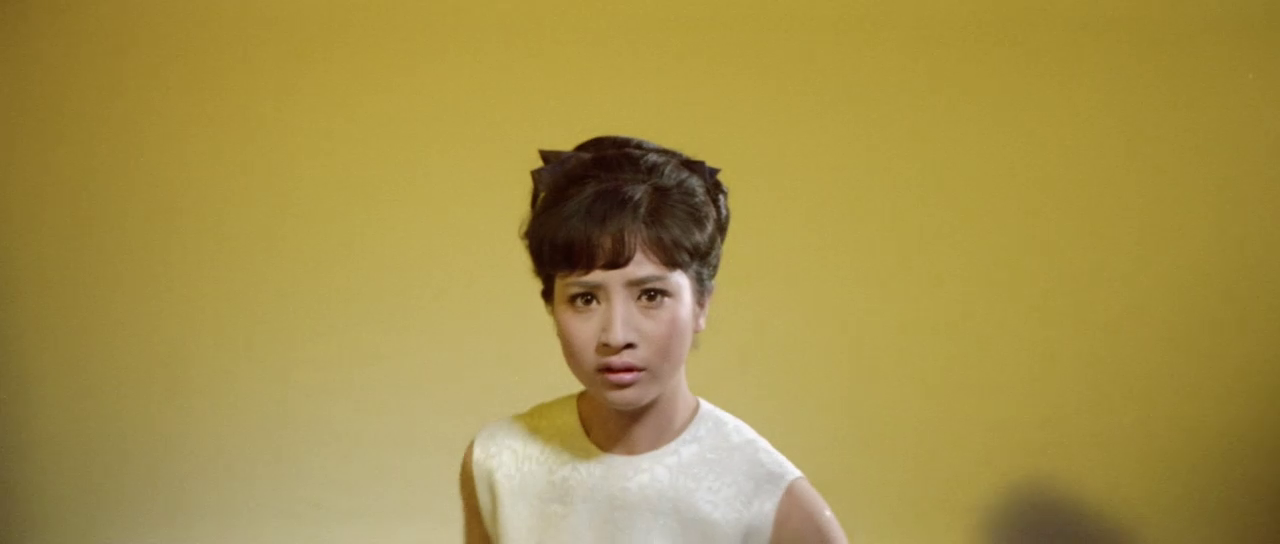
What gives Hasebe’s Black Tight Killers, a colourful narrative collection of gangster and spy film tropes, its power to engage the spectator is the composition and its stylish jazzy musical accompaniment. It is evident from every frame, from every image, that Hasebe seeks to satisfy the spectator’s gaze and dazzle him with ‘beauty’. He does so in a direct way with elegant transitions, striking colour-contrasts, refreshing shot-compositions, and pop-art-like colour-shifts and, in an indirect way, by utilizing dynamism and compositions to allow the spectator to savour the visual frame (i.e. the elegant costumes, the lush set-designs, the female body, … etc) (Cine-note 1).
The heavily stylized visual approach, however, does not stop Hasebe from giving many acts of violence in Black Tight Killers a realistic flair. Yet, as these moments are made overly dramatic, it is clear that Hasebe aims to keep his narrative, at all times, visually and narratively light-hearted. This is, in truth, already evident in the very opening sequence of the narrative. The fact that the war-scene is brought to life with a wild concatenation of fireworks, smoky explosions, and shifting colours proves that Hasebe is not interested in realism but that he, by creating stylistic impressionistic whole of visual excess, aims to call a war atmosphere to mind.
The similarities between the visual style of Hasebe and his mentor Seijun Suzuki begs the question as to how Suzuki influenced him. Rather than merely intimidating the master’s singular style, it seems that being around Suzuki granted Hasebe the artistic freedom to explore the potential of the visual dimension and develop his own style full of visual elegance, sensual and sexual accents, and gaudy excess.
As the composition turns around delivering visual beauty, it is not surprising that Black Tight Killers touches upon the lure of beauty and explores the subjective ramifications of having one’s desire imprisoned by an image of beauty. In fact, Hasebe’s narrative exposes the phallic dynamic that structures, for instance, the formulaic James bond series.
In Black Tight Killers, beauty is defined in a phallic way and the gaze that Hasebe aims to please with his composition is considered phallic in nature (Theory-note 1). The spectator is introduced to a simple relational structure: the male protagonist holds what the female other desires – Hondo’s acts and signifiers reveal his position of desirability – and the female other, who naturally lacks, comes to ‘sexually’ desire him. And in the few situations where Hondo’s position of male power is in jeopardy, a gadget or a female intervention is always ready to repair or affirm his position, hereby ensuring that the spectator can retain his identification with fantasy of having ‘it’.
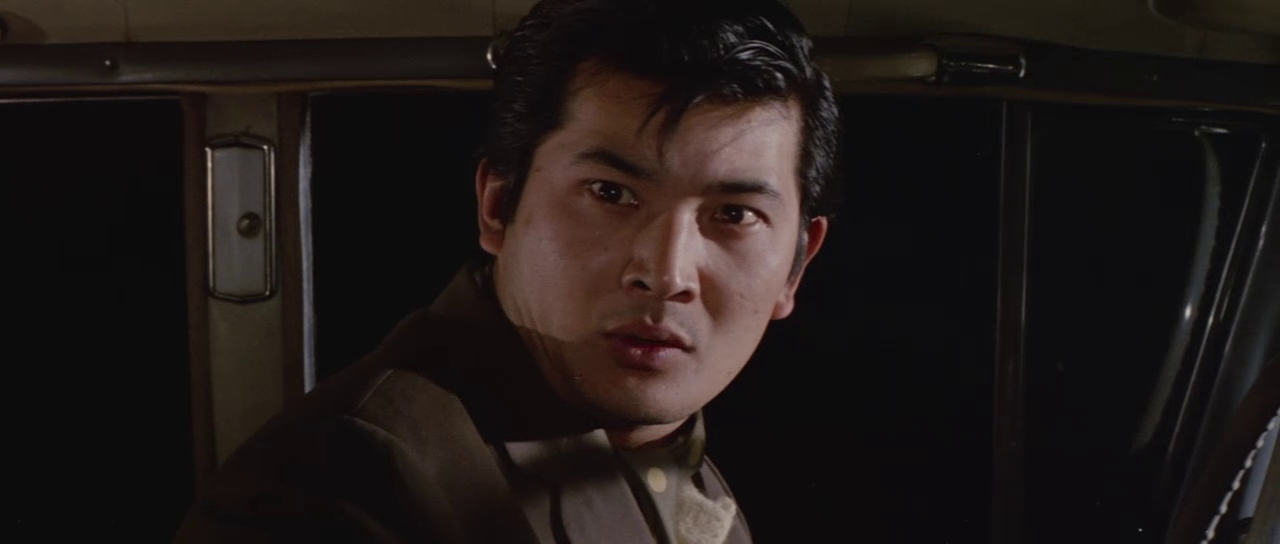
The fact that Hondo, after Yuriko’s abduction, continues his search for her does not mean, as some might argue, that he desires her. The way he talks about Yuriko makes it clear that, just like the quite decadent visual field is made to be ravished and treasured by the spectator, Yuriko is staged as an object to be treasured by Hondo. For him, she is merely an object of beauty, a shining presence a phallic man should try to possess and turn into his object-treasure.
The composition beautifully contrasts the decadence of the societal field – the lush splendour that surrounds the desirable Hondo – with Yuriko’s simple yet seductive elegance. Due to Hasebe’s thoughtful composition, the visual decadence of male desirability does not wash away Yuriko’s elegance, but ends up emphasizing it, singling it out as a thing that shines brighter than everything else. The spectator is meant to be dazzled by Hasebe’s visual extravaganza and, as he is invited to assume Hondo’s phallic position of desirability, to be bewitched by Yukiko’s elegant sensual beauty and duped by the sexual advances of others (Psycho-note 1, Narra-note 1, narra-note 2).
Black Tight Killers is not only a stylish and visually dazzling romp with lots of action and sensuality, but a narrative that, by playing with the tropes of spy and gangster films, ends up light-heartedly piercing through the phallic fantasy – of having what is desired by the female other – that many men hold dear. In short, Hasebe delivers a pop delight that dazzles visually and plays, tongue-in-the-cheek, with the desiring gaze.

Notes
Cine-note 1: There is one big continuity error in the finale. Suddenly, after showing Yuriko’s pristine body decorated and her simple white lingerie, black electricity cables adorn her chest area.
Theory-note 1: With this review, we want to introduce our argument that Mulvey mistakenly called the phallic gaze male. This coveted phantasmatic object does not simply guide the spectator’s gaze, whether male of female, but was and is exploited by movie studios to make profit and subtle guide the way men and women should desire.
Psycho-note 1: This narrative, once again, reveals that the very belief in one’s own phallic possession makes the male subject vulnerable to female deception – the female other plays as no other with the fixity of the male subject on what does not exist: the phallus. The possession of the phallus, which underpins the conscious sense of being desirable to the female Other, is but a fantasy that hides but not erases the male subject’s lack.
Narra-note 1: The narrative ultimately emphasizes, in a light-hearted way, that the assumption of the phallic position by a male subject is merely a fantasy and that women, much to the bewilderment of male subjects, can avoid the charm and seductiveness that emanates from a subject that believes in his desirability.
Narra-note 2: The plot of Black Tight Killers illustrates the uncomfortable truth concerning the phallus. The highly coveted phallic treasure, which is believed to be real by the gangsters and ninja’s, is when all is said and done worthless. The whole concatenation of violence that structure the narrative is caused by a belief in the existence of an agalmatic object and the possibility to posses it. Yet, the highly coveted object that dazzles the eyes of male subjects is nothing more than a heap of trash.
 psychocinema