What propels the subject into the societal field and forces him to interact with others is nothing other than the thing called desire. Of course, the way desire (for love) structures the subject’s presence can either hinder or facilitate his desirous journey.

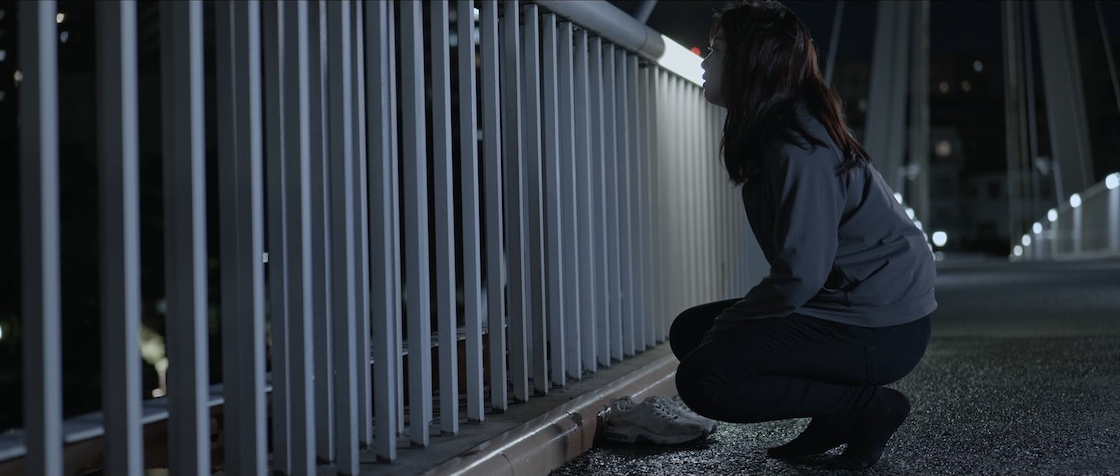
With their light-hearted narrative, director Taishi Oishi and screenwriter Hideto Tsutsumi introduce the spectator to the contradictory dynamic of secondary narcissism and the struggles of the subject to be loved by the Other. In Ask for the Moon, audiences follow the subjective trajectory of Tomoko Miura (Manae), a member of her university’s movie club. While she dreams of becoming a film director in the future, her crude attitude and selfish singular focus on her dream pushes the people she so desperately needs away. One night, her fellow student Kohei (-) refuses to acknowledge her complaints about the others. Having no answer to this crude confrontation with her own subjectivity, she decides to commit. Yet, the attempt does not end in death, but in a chance to rewrite her day and thus avoid her suicidal outcome.

Before the surprising supernatural twist in Ask For The Moon, Taishi Oishi beautifully traces out how a subject’s singular focus on one’s dream can become an obstacle disrupting one’s interactions with and within the Other. Yet, what turns one’s desire, which usually allows the subject to connect positively with others, so destructive is the very narcissism invested one’s dream (Narra-note 1). For Tomoko, the others are merely objectual supports for her desire – the subjectivity of others is of little importance. Their worth solely depends on how good they serve her strict creative vision and (desire).
Tomoko’s suicidal impulse – and this should not surprise anyone – follows a deeply narcissistic logic. Rather than accepting Kohei’s confronting signifiers and question her own subjective logic, she decides to answer him with an act that rids herself, a future director brimming with talent, from the Other. She merely bounces his signifiers off with her venomous ego to keep her logic safe. Kohei’s refusal to acknowledge Tomoko’s suffering is followed by a radical refusal by Tomoko to offer her talent to the societal field (Psycho-note 1).

After the supernatural intervention, Tomoko is suddenly surrounded by a camera-man (-) and a female director (-). In our view, these two figure function as a direct visualisation of the Other, of the field that aims to structure and tame the way the subject interacts with others (i.e. the social script) by subjecting her to a set of values, demands and rules (Narra-note 2). Can the surprising supernatural collision of Tomoko with her Other allow her to change her subjective logic and the role the eye of the Other plays in her psyche? And what will this spatial and temporal twist reveal about her older sister’s suicide?
The composition might be simple but the static nature of the composition, by emphasizing the emotional impact of the to and fro of the spoken signifier, allows the shifting dynamic of Tomoko’s interactions come to its full right. Yet, Oishi does express himself creatively in the sequences the link the various stages of the narrative together. Rather than quickly shifting, Oishi delivers a mix of evocative images that confuse and intrigue, that reveal and tease.
Manae, who portrays Tomoko, does an incredible job in bringing the different shades of her character to life. The narcissistically fuelled anger and disgust directed at the Other (who sabotages her dream), the sudden depressive decompensation caused by a lingering sense of inferiority, as well as the subtle shift within her logic are all brought convincingly alive.
The overall mood of Ask For The Moon is lightened by the slight comical touch that characterizes the performances of the cast and the way certain situations play out, yet it does not undercut the thematical exploration. The lighter mood of the narrative, in fact, allows the theme of inferiority and narcissistic decompensation shine all the more brightly.
With Ask For The Moon, Taishi Oishi delivers a satisfying narrative that illustrates how the subject’s ego is but a response to his complexes and struggles. While the narrative introduces interesting themes, it is Manae that ensures with her charming performance that the thematical exploration engages the spectator from start to finish.

[No Trailer]
Notes
Narra-note 1: The presence of narcissism in Tomoko’s subjective position can be heard in her self-righteous accusatory tone – how dare they? – as well as in the emphasis she makes on ‘watashi no (my)’ in her conversation with Kohei.
Narra-note 2: The camera man and the director (her internalized Other) suddenly discover that the subsequent pages of Tomoko’s script are blank. This dramatic revelation does not only mean that death, as real event, escapes the symbolic field, but that the subject, by dying, disappears as material support of the Other.
Psycho-note 1: The suicide attempt follows a deeply imaginary dynamic. Faced with the rejection by the Other – poor me, she radically tries to reject the Other – poor society. By , we can discern that Tomoko’s narcissistic infused presence is built upon a frustrated desire for recognition and unresolved feelings of inferiority towards the perceived perfection of her older sister. The crude way of using others was first and foremost to receive the recognition from the Other.
 psychocinema