Introduction
While Zom 100: Bucket List of The Dead is Yusuke Ishida’s first cinematic product, he already has experience with narratives with monstrous beings. He did not only work as a second-unit director for Shin-Godzilla (2016), but also edited the two Attack on Titan narratives released in 2015. Can he, with this experience, make a pleasant adaptation of Haro Aso and Kotaro Takata’s Zom 100: Zombie ni Naru made ni Shitai 100 no Koto?
Review
One early Monday morning, Akira Tendo (Eiji Akaso) walks energetically and full passion towards his first full time job at Master Shot’s commercial production division. While things seem homely at first, he is forced by Chief Kosugi (Kazuki Kitamura) to pull an all-nighter right after his welcome party.
Upon hearing his story, Kencho (Shuntaro Yanagi), Tendo’s best friend, tells him to quit the company. Yet, Tendo does not have the guts to do so. Months and months go by, then one day, a zombie outbreak occurs transforms the whole societal field. Tendo quickly realizes that there is no need to go to work anymore. After nearly escaping a dangerous trip to meet the woman he loves producer Ohtori (Yui Ichikawa), he decides to write a bucket-list, 100 things to do before becoming a zombie.
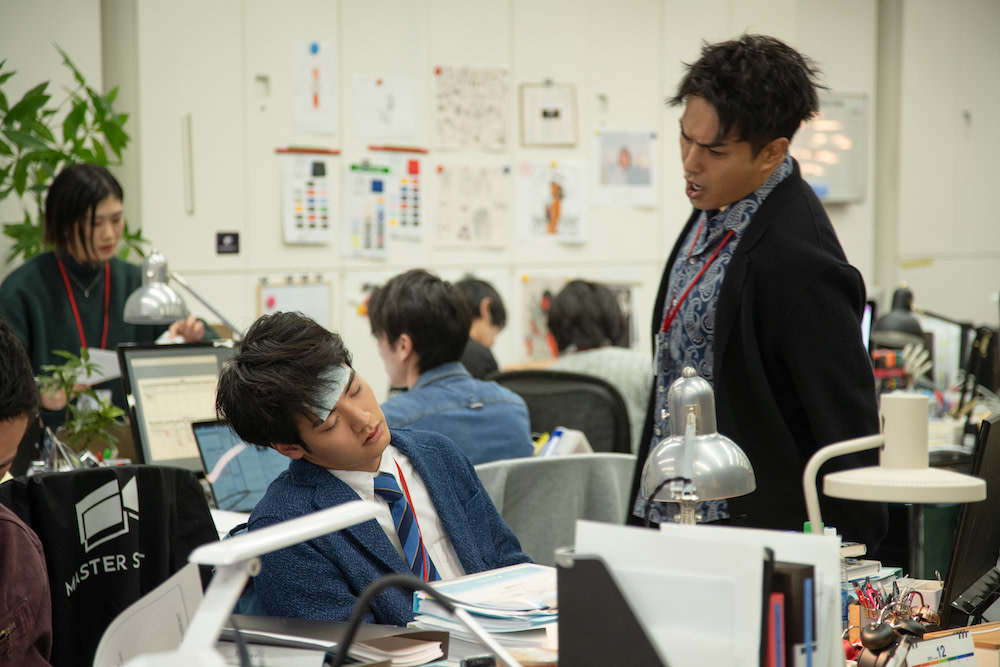
Zom 100: Bucket List of The Dead offers the spectator a dramatized but recognizable glance at the traditional Japanese work culture – work is your home – and the destructive inner-workings of ‘black’ companies (Narra-note 1). The unrefusable demand to do over-time and the endless stream on ‘urgent’ tasks creates a space where the subject is forced to efface his own subjectivity to become a more cog into the corporate machinery. In other words, the ‘black’ corporate demand, embodies by the chief of the department, causes the subject to work his subjectivity away and become an object that merely receives and produces. The blossoming of suicidal thoughts in such environment must be read as the final stance of the subject – the vicious demand of the Corporate Other cannot prevent the subjective want to perish from the societal field (Narra-note 2).
It is quite apparent that the film wants the spectator to perceive a resemblance between the zombies and the effect of the ‘black’ corporate demand on the subject. One could even argue that zombie symbolizes what is left after such vicious demand has sucked out all desire out of the subject. What remains is a mere sack of oral and anal needs, a walking sack of flesh of hunger.
Yet, the comparison also has its limits. In contrast to the de-subjectifying corporate demand, the zombification of society radically destroys the societal flow. It is thus not a demand of the Other that organizes society, but an excess of the real that annihilates the Other. The societal destruction, of course, frees Tendo from the demand that was murdering his subject and grants him freedom to express and fulfill his own wishes and dreams – i.e. the bucket-list.

Yet, the mere indulgence in his own wishes does not suffice to satisfy his subject or, to put it more correctly, his sexual desire. It is therefore not surprising that Tendo falls in love with the first female survivor he encounters. His desire, locked up within this zombified society, finally finds an object to lock on to and to be enraptured by.
Of course, one final question remains: is the Other truly evaporated? Does the collapse of the Other not give rise to small and hastily fabricated societies? Or to put it differently and somewhat more evocatively, can Tendo truly outrun and refuse the ‘secure’ corporate demand that suffocated him in this apocalyptic Japan?
The composition of Zom 100: Bucket List Of The Dead is highly dynamic and energetic. The energetic feel is not only due to Ishida‘s heavy reliance on dynamic shots but also due to his rapid cutting. Shaky framing is present, yet most dynamic moments in Ishida’s composition are fluid.
The visual pace, due to Ishida’s cutting, is quite high and the rapid shifting of imagery helps keeping the spectator engaged. The high visual pace goes hand in hand with Ishida’s use externalized inner-speech, offering a quick but fragmentary peak into the consciousness of Akira. The dynamic manga-like compositions to visualize the completion of Akira’s bucket-list further heighten the flow of the narrative, treating the spectator on a fast concatenation of imagery.
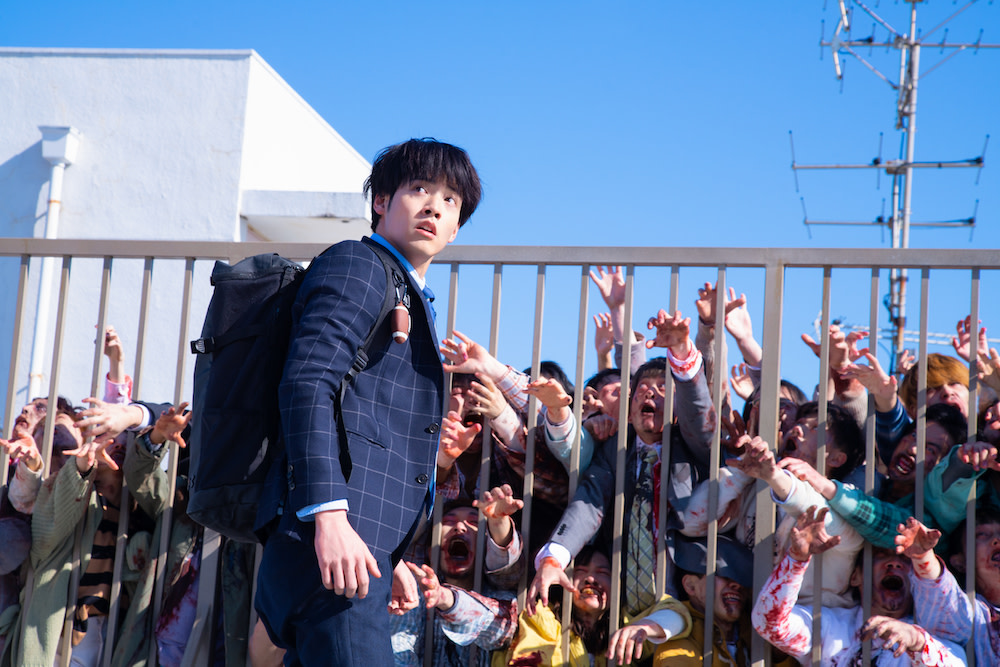
However, the high visual and narrative pace does come at a cost. There is little time for the spectator – especially for the one who has not read the manga nor saw the anime – to emotionally invest in the relationships between Akira and other characters, like Tencho. As a result, the narrative keeps missing its emotional beats and is unable to make the many pleasant visual and narrative moments truly satisfying. Tensive scenes are never tensive enough and touching moments, like when Akira and Tencho reconcile, always feels somewhat emotionally flat.
This loose emotional fabric also impacts the finale. Any pleasure the spectator derives from the finale is due to the rapid pacing and the pleasing and effective way the monstrosity our heroes face is visually brought to life.
For fans of zombie film, Zom 100: Bucket List of The Dead does not offer anything new – reiterating with little variation the themes that have been explored over and over again in narrative universes filled with walking dead. Yet, Ishida does succeed in confronting the spectator with the zombifying effects of Japanese ‘black’ work culture. A fun romp, yes, but also quite forgettable.

Notes
Narra-note 1: The sexualized ‘friendliness’ towards female colleagues is also an element that characterizes this traditional hierarchical corporate system.
Narra-note 2: Yet, As Tendo illustrates, the subject rather contemplates committing suicide than become fully emptied out by the ‘zombifying’ corporate demand. In a certain sense, the suicidal thought is a final defence against such demand; it is a subjective choice to which the endangered and disappearing subject clings to.
 psychocinema