Introduction
While Toichiro Ruto is more active as a director of dramas, he has directed some films as well (e.g. Ossan’s Love: Love or Dead (2019)). While, in many cases, those movies are follow-ups to his drama work, he also has some films that do not have their roots in previous drama series. One of those movies is Violence Action, an adaptation of Renji Asai and Shin Sawada’s webcomic of the same name.
Review
As the third Patriarch of the Denma-gumi (Jiro Sato) cannot avoid being incarcerated in the near future, he organizes a meeting with his executive members to introduce the rules that will decide his successor. He does not merely want the strongest person and the one who rakes in most cash as the fourth patriarch but also the person who proves to be most loyal to the clan.
Kinoshita (Katsunori Takahashi), one of the most important executive members, has already hatched a plan to take complete control over Denma-gumi and ordered Ayabe (Shunsuke Daito) and Kaneko (Win Morisaki) to take the necessary steps to successfully realize it. The Kunitsu-gumi, led by Kunitsu (-), another important executive member, also desires to become the fourth patriarch and decides to abduct Ayabe to sabotage Kinoshita. Not that much later, Kei (Kanna Sugimoto) from Supple ‘n’ Natural Gals Delivery Service is ordered by Kinoshita to wipe out Kunitsu and his goons. Yet, the success of her assassination job is not without its consequences. Moreover, unexpected adversaries, like safe-keeper Terano (Yosuke Sugino), rise up to challenge Kinoshita’s hunger for power.
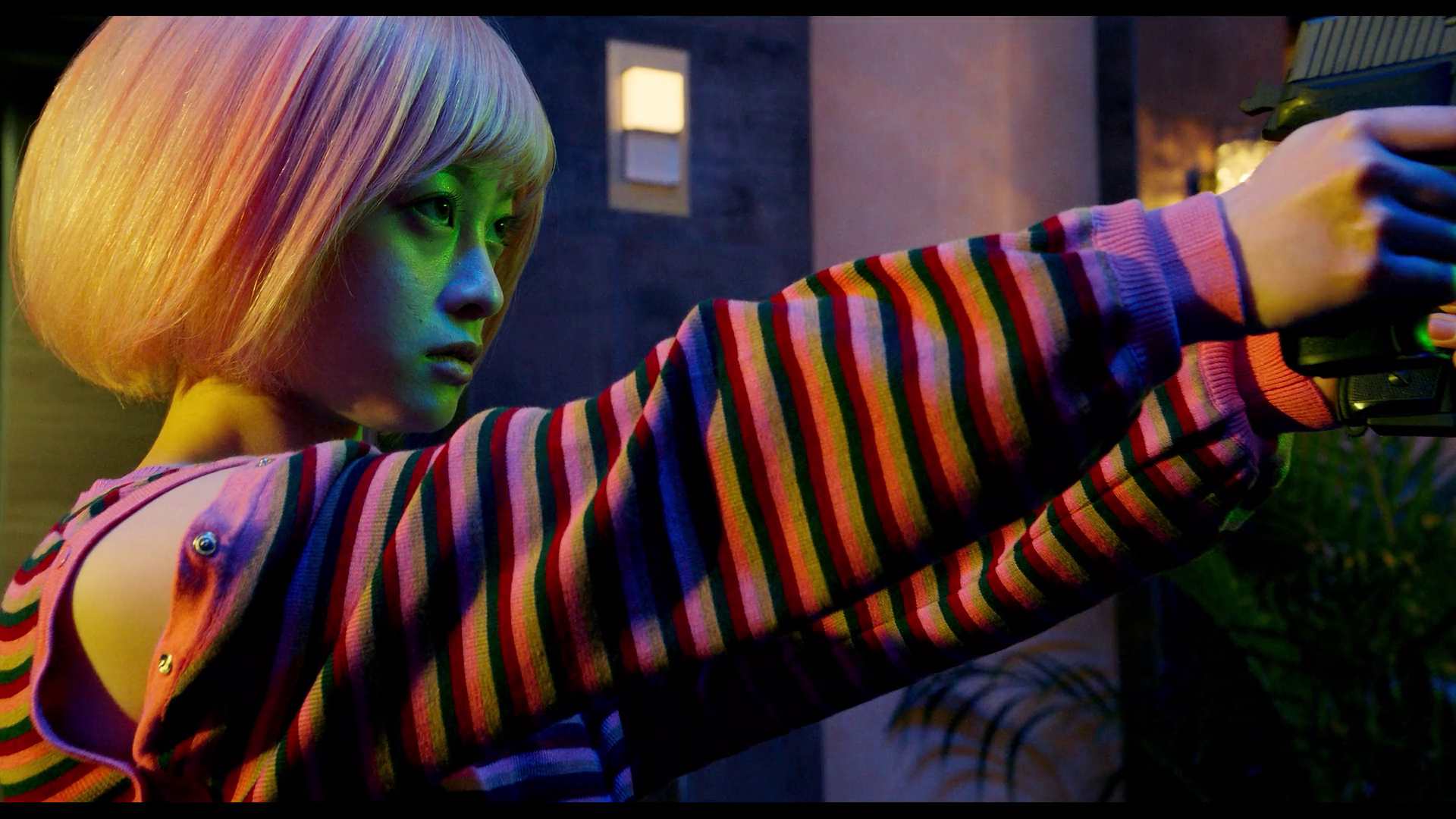
Violence Action is an action-comedy that affirms the importance of having a desire for the subject – e.g. Kei’s dream to pass the second level of the Bookkeeping Proficiency Test, as well as a comical exploration of the destruction inherent to the infatuation with phallic power. While the narrative balances the emotional notes concerning having a desire/dream and the surges of phallic comedy rather well, the emphasis on these two thematical threads ultimately leaves the action-element underdeveloped. Toichiro Ruto fails to give the spectator a sense of tension that would have made the unfolding of the narrative much more engaging.
Violence Action is full of slap-stick-like comical moments (Sound-note 1). The visual jokes that relentlessly attack the character of Zura (Takashi Okamura) (e.g. his hairpiece and his baldness, the kick in his balls, …etc.) have no other aim than to stage him as a manly failure. To put it more in psychoanalytic terms, what the narrative exploits is the simply fact that the bulletproof hairpiece that Zura so proudly wears as were it his phallus cannot hide the fact that he radically lacks what the female other desires.

The dimension of the phallic failure is also subtly highlighted by Ayabe’s abduction. The lack of reaction of the two hostesses that accompany him when he is roughly taken away underline that it is not his subject that is the object that attracts them, but his wallet full of money. In other words, it is only by throwing around money that he can buy the necessary female support to please his fantasy of being desirable for the other.
The third patriarch’s order to capture the female assassin, for that matter, is also motivated by the phallic dimension (Narra-note 1). For the patriarch, the murder spree by Kei is nothing other than phallic injury – the bastion of manliness cracked by a young women. The blood she spilled confronts him, in a certain sense, with the phantasmatic nature of the male yakuza ideal that the patriarchal hierarchal structure protects. It is therefore not surprising that the subject he entrusts with this task – ‘cleaner’ Michitaka (Yuu Shirota) – fully embodies the typical misogynistic maleness that marks the field of the yakuza (Narra-note 2).

All this should not detract the spectator from the fact that the very conflict between Kinoshita and Kunitsu is driven by the overly-investment of both in the meaning of this empty phallic signifier within patriarchal and hierarchal systems – i.e. the fantasy of power and desire. Yet, it is also evident that this conflict for power escalates by an act that cannot be in any way be considered phallic in nature. Let us just say that this disruptive act shows how the phallic power fantasy deflates without it material support and instigates reparative violence.
While the composition of Violence Action offers a balanced combination of static and dynamic shots, the narrative attains a dynamic feel due to what we would call surges of compositional playfulness. This playfulness is not merely function of the rich and fluid integration of visual decorations (e.g. slow-motion, …), but also the choice to compose certain sequence in accordance with the rhythm of the musical accompaniment, thus littering the narrative with pleasant pop-like visual moments. Of course, these bubble-gum visual splurges also derive their pop-like feel from the accompanying colour-schemes.

The eruptions of Kei’s violence are – unsurprisingly – brought to life with dynamic compositions. Yet, the source of this dynamism is not the increased use of camera movement – movement that tracks Kei as she inflicts violence on the other, but the combination of energetic cutting with fluidly integrated visual decorations. This energetic form of cutting is, sometimes, used to jump-cut the violence and deliver a kind of visual climax to the sequences of bloody violence (Cine-note 1, sound-note 1). In these sequences, the static moment is thoughtfully applied to give Kei’s acts of violence their feel of coolness. This coolness of her deadly violence is further highlighted by the up-tempo music that accompanies her violent dances (Cine-note 2).
Yet, despite this pleasant compositional energy, Violence Action’s composition suffers from two problems. First, the many visual decorations fail to realize the promise of delivering a truly stylish and fluidly flowing experience. Secondly, the overly reliance on fast-forward moves in action-sequences diminishes rather than enhances the spectator’s visual pleasure. The direct translation of the visual quirks of the manga (e.g Zura’s wig, the more comical fighting moments, … etc.) to the silver screen might put off some spectators, but, in our view, this does not hurt Violence Action as much as it does other live-action adaptations.
Violence Action is a mildly entertaining action-comedy that ultimately fails to fully satisfy the spectator. The many pop-like visual decorations do not result in a stylish and fluidly flowing experience. Rather than improving the flow, these moments of cute coolness end up emphasizing the problematic narrative structure (Structure-note 1). Moreover, despite the many pleasant action-moments in the narrative, the finale is butchered by the unfitting super-human action moments and the stern refusal to offer the spectator any kind of tension.

Notes
Sound-note 1: Comical moments are often decorated with sound-effects and the light-hearted mood of sequences is often dictated by the musical accompaniment.
Narra-note 1: Some of the patriarch’s jokes explicitly reference the phallic dimension, hereby light-heartedly echoing that such thinking still lingers within the yakuza-culture.
Narra-note 2: The contrast between Michitaka and the corporate-like others echoes the fact that while the idea of the phallic man still lingers within the yakuza structure, the ideal of the thug-like man following the letter of the Yakuza code has become a thing of the past.
Cine-note 1: The energetic concatenation of imagery is also utilized to ‘blend’ two sequences together. By offering quick flashes of imagery of another sequence within the current scene, Ruto does not only spice up his composition but also subtle teases the spectator – a visual trick that helps keeping him/her engaged.
Sound-note 1: There are also moments in the framing of the violence that the beats of punching align with the beats of the accompanying music.
Cine-note 2: The same style of composing is also utilized to stage Michitaka’s violence and give his character a certain coolish and dramatic stylishness.
Structure-note 1: The narrative lacks a great build-up and is devoid of tension. It would have been better if the time spend on delivering some emotional notes was used to evoke a sense of threat. Without any tension in the narrative, the action-sequences fall somewhat flat.
 psychocinema