Introduction
In 2017, Akira Nagai made a positive impression on international audiences with his comedy Teiichi: Battle of Supreme High. Since then, Nagai has not made that many movies. In 2018, he brought Koi wa Ameagari no You ni by Jun Mayuzuki to the big screen. Last year, he tried his hand at combining screenwriting and directing and delivered Character (2021).
Review
One day, aspiring manga artist Keigo Yamashiro (Masaki Suda) meets up with Makoto Omura (Akiyoshi Nakao), a famous editor. While he admires his drawing skill, he tells him that his characters lack personality and, as such, his story wont be able to give the reader a sense of reality or pull him into it.
Calling with his girlfriend Natsumi Kawase (Mitsuki Takahata), he informs her of his intention to stop chasing his dream and find a job. The same day, he informs Hayato Honjo (Tomu Miyazaki), the mangaka he works for, that he will resign by the end of today. As a kind of final gift to Honjo, he accepts his request to go draw a house filled with happiness. Yet, what he finds at the house he was sketching is merely blood and murder.
During the interrogation at the police officer, Yamashiro hides the fact that he has seen the murderer from Shunsuke Seida (Shun Oguri) and inspector Kota Makabe (Shido Nakamura). Upon returning home, he immediately starts drawing.
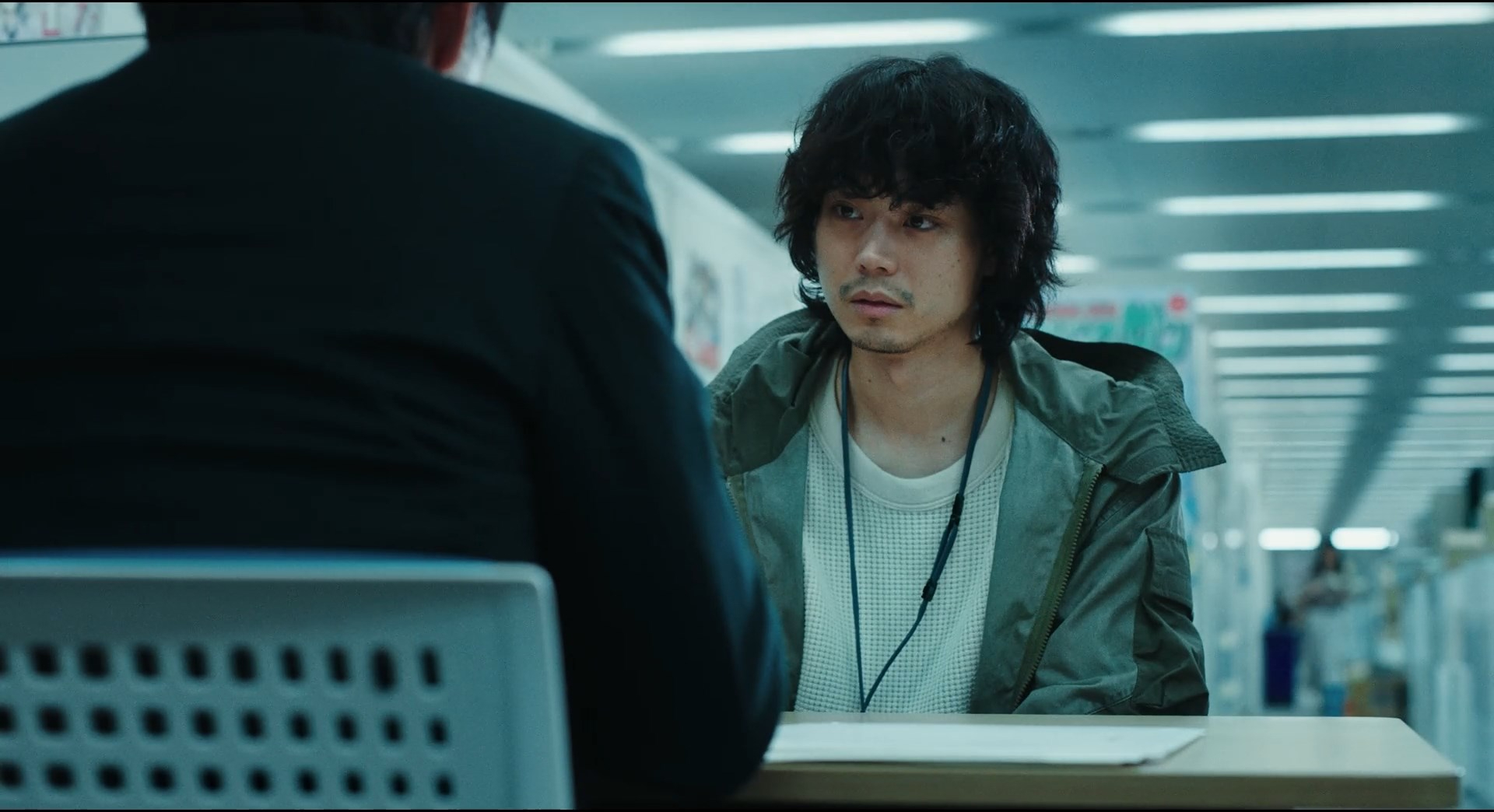
Character is a mystery thriller that delivers what it promises and satisfies with what it offers the spectator. Two thirds of the narrative is, like in any kind of mystery narrative, structured around lingering riddles. The first riddle concerns the murderer’s motive. The gruesome murders appear to have happened without any motive. Are these murders simply for thrills or is a desire for revenge in play? The second riddle, one soon introduced after the first, concerns the identity of the suspect. Henmi Atsushi (Yoji Matsuda), a man who committed a similar murder when he was 16 years old, admits to murdering the family of four, but the spectator knows, like Yamashiro, that he did not do it. Why does he confess to a crime he did not commit? Is there an unknown relationship between him and the real criminal? The third riddle is about the victims. Why is the murderer fixated on killing ‘happy’ families of four? What is the subjective dynamic that underpins the murderer’s repetitive act to annihilating such balanced family constellations? The fourth riddle concerns the fact that the subsequent murders (e.g. Harai family murder, Sugimura family murder, … etc.) faithfully follow Yamashiro’s manga chapters. What compels the murderer’s to utilize Yamashiro narrative as his godly guideline? Is a merely a way to get more enjoyment or does his ‘devotion’ have a deeper motivation?
Most of these questions receive some kind of answer as the narrative unfolds. In fact, the twists and turns that underpin the highly engaging and satisfying finale are, in a certain sense, function of these riddles. Character does not challenge the mystery-thriller genre, but its well-composed and well-paced narrative structure will keep the spectator engaged and offer him a thrilling and satisfying conclusion.

One aspect of the narrative we will analyse a bit more deeper: Yamashiro’s struggle to draw compelling characters. Honjo, the mangaka he works for as an assistant, explain Yamashiro’s problem with precision. If he is unable to create compelling villains, it is because Yamashiro has no understanding of evil and the immorality that drives a person to commit sins and find enjoyment in it.
The confrontation with the murder and the face of murderer seemingly gives Yamashiro an insight in the logic of evil. Yet, putting it like that, misses the mark. Yamashiro’s act of narrativizing and visualizing the traumatic event is not merely an opportunistic attempt to exploit this shocking experience for his own benefit. While he, without a doubt, utilizes his traumatic confrontation with the face of evil as an inspiration for his manga, the act of making a visual narrative of this event also functions as an attempt to work it through – an attempt to annul its hold over his subject. The ‘engaging reality’ of his narrative is, in this sense, function of his creative effort to transfuse the emotional excess of the event into the lines and signifiers of his manga.

The creative reworking of his bloody trauma, as one can easily guess, is an immediate success. Yet, the obsessional element that binds Yamashiro and his manga underlines that the initial traumatic encounter has not been properly dealt with. His drawing has becomes obsessional because he fails to undo the initial trauma of its unsettling impact. This failure is mainly caused Yamashiro, by obsessionally drawing his manga, merely refreshes the initial traumatic wound (Narra-note 1). How can Yamashiro undo the hold of the trauma that propels his creative endeavour forward but slowly consumes his subject? Can his repeated encounters with Seida enable him to find a way to finally suture his traumatic wound?
The visual pleasure of the composition of Character is function of his pleasant dynamism and Nagai’s shot-compositions. While the dynamism ensures that the narrative has a steady flow, the shot-compositions, which are not merely serviceable but also offer visually pleasing geometrical tension, deliver many satisfying visual moments.
What makes Character engaging and compelling is not merely the dynamic composition, but the atmosphere of the narrative as a whole. The atmosphere of Nagai’s narrative is dictated by an interaction between three different elements: music, colour-design, and acting performances.

The musical pieces – diegetic as well as non-diegetic – are thoughtfully applied. These pieces do not only support the dynamic flow of the composition, but also play an important role in highlighting the narrative importance of certain acts or choices and allowing a feeling of mysterious tension blossom in the spectator.
Yet, the thoughtfully applied music would not have been able to fulfill its function were it for the darkish colour-design and the performances of the cast – especially Shun Oguri and Masaki Suda. Both elements create a frame upon which the music can thrive. The darkish colour- and lightning-design echoes the darkness and mysteriousness of the narrative, while the cast, by breathing life into the subtle emotional complexity of their respective characters, ensures that they, who inhabit this darkish, noirish narrative space, feel human.
Character might not be a film that challenges or subverts the tropes and dynamic of the mystery and thriller genre, but it sure does deliver a satisfying and thrilling ride. While the enticing visual composition plays an important role in keeping the spectator engaged, it is the combination of atmospherics and effective performances that ensures that the spectator leaves the film satisfied.

Notes
Narra-note 1: The fact thatthe initial trauma has not been properly dealt with is subtly underlined by the subjective impact ofYamashiro’s encounter with the murderer at an izakaya. Yet, another factor that ensures that this encounter impacts Yamashiro is the fact that the murderer proves that he knows who witnessed his first murder.
 psychocinema