Introduction
Junji Sakamoto (Another World (2019), I Never Shot Anyone (2020), My Brother, The Android and Me (2022)) might not be as well-known by international audiences as other directors, but he has proved himself to be an incredible talent in Japan that deserves recognition for his often unique but always well-crafted narratives. Luckily, in recent years, more and more international audiences are able to enjoy the cinematic work of this largely overlooked master of Japanese cinema.
Review
In the Edo Period, Tokugawa Iemitsu decided with the Sakuko to shut Japan off from the outside world. Yet, after two centuries, the Japanese societal field started to destabilize. The following societal unrest coincided with the increased pressure by the outside world on Japan to open its doors.
1858, late summer in Edo, a sudden rain shower begins. A man with a bucket full of wastepaper called Chuji (Kanechiro) runs to shelter under the eaves of the toilet and starts chatting to Yasuke (Sosuke Ikematsu), a man who earns money from turning the toilet’s anal waste into manure for local farmers. A few moments later, a woman called Okiku (Haru Kuroki) joins them. Event though she first tells Yasuke that she doesn’t have to go to the toilet, she eventually chases the two men away. Not much later, Yasuke convinces Chuji, who earns little to nothing with his wastepaper, to become his partner.
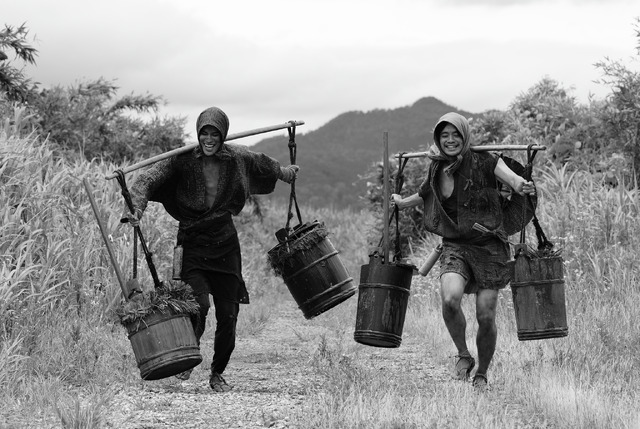
Okiku and The World is a jidai-geki narrative – the story’s setting is the late-Edo period, but its themes are quite unlike the commonly explored themes the genre is known for (General-note 1, general-note 1). Yet, even though the thematical framework create a somewhat unusual setting for the genre, the structuring arc of love that transgresses borders is less new – it is a trope of all times, cultures, and languages.
The narrative, which is divided into chapters, is built around a simple question that forms the title of the prologue: “Where does Edo’s poop go?”. Yes, the whole narrative is structured around the anal dimension of the Edo society. The prologue introduces the function ofwaste, be it paper or shit, within this societal field by showing how certain subjects are forced to exploit such waste-products to earn a living. In a societal system near the end of the Edo-period, nothing can be wasted.
Through Okiku, we can grasp the different transferential effects of being associated with a waste product has. The association of Yasuke with the signifier shit compels Okiku to forbid him from using her name near the toilet. Okiku’s order is not only given to hide her anal needs from the other, but also because she fears that the vocalization of her name by such a man might dirty it.
In contrast, the association of Chuji with paper has a different and more positive effect. Yet, the signifier paper only gives their interactions a minimal sense of agreeability because it is mediated with her love for studying reading and writing at the temple. Of course, Chuji’s sudden choice to become a manure man radically breaks this association. Will Okiku’s positive feelings for him change? Or will these feelings change the way she views the trash-object of shit (Narra-note 1)?
The other chapters – The invincible Okiku, the regretful Okiku, Okiku, fall in love, dumb and dumber, Foolish Okiku, And so Goes the Boat, and Okiku And The World – further explore the different sides of Okiku’s subjectivity. These chapters reveal how she, forced to live with the common folk in a tenement after her father’s dismissal, struggles to come to terms with her world and give a place to the samurai pride she still feels. Yet, as Okiku wanders through this world, we do not only see how, by encountering the mundane struggles of others and the crude realities that structure the Edo society, her subjective position changes.
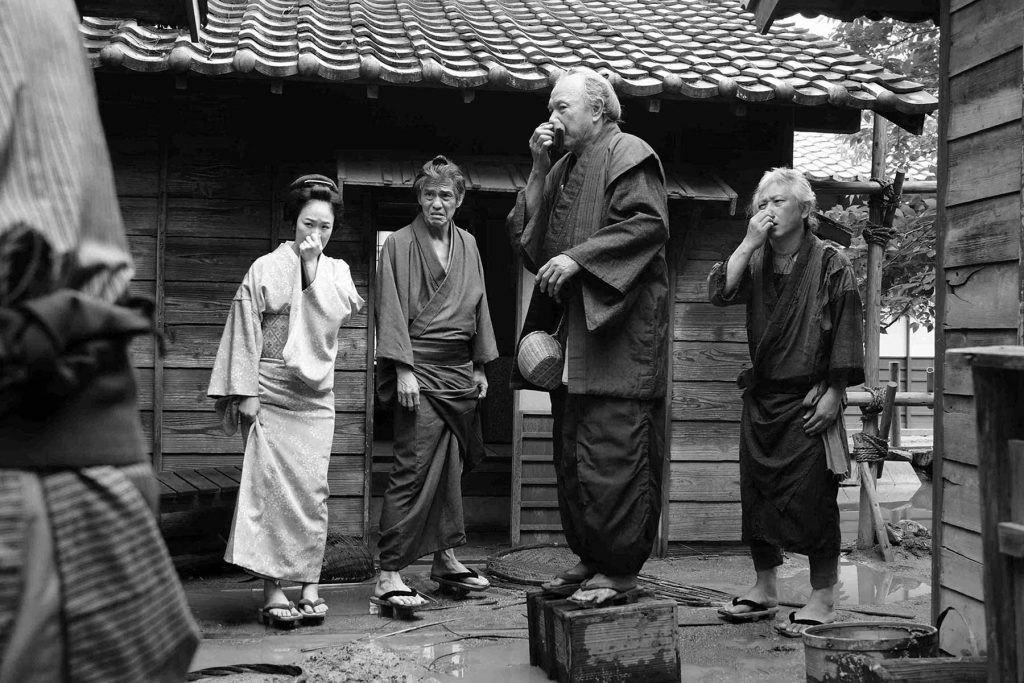
The differences between the common folk and Okiku and her father (Koichi Sato) are laid bare in the very first chapter. The down-to-earth logic of the common folk – they only want this smelly situation in the tenements solved as soon as possible, clashes with the more cultured stance of the Okiku and her father. Okiku’s father calls for patience and spins an answer around the signifier ‘injustice’, while Okiku tries to silence the proletariat by emphasizing her damaged family pride. This conflict furthermore shows that the investment in culture, which was only available for the samurai class, goes hand in hand with societal repressions regarding the various partial drives and underpins the presence of feelings of embarrassment within the subject concerning using signifiers associated with those drives (Narra-note 2).
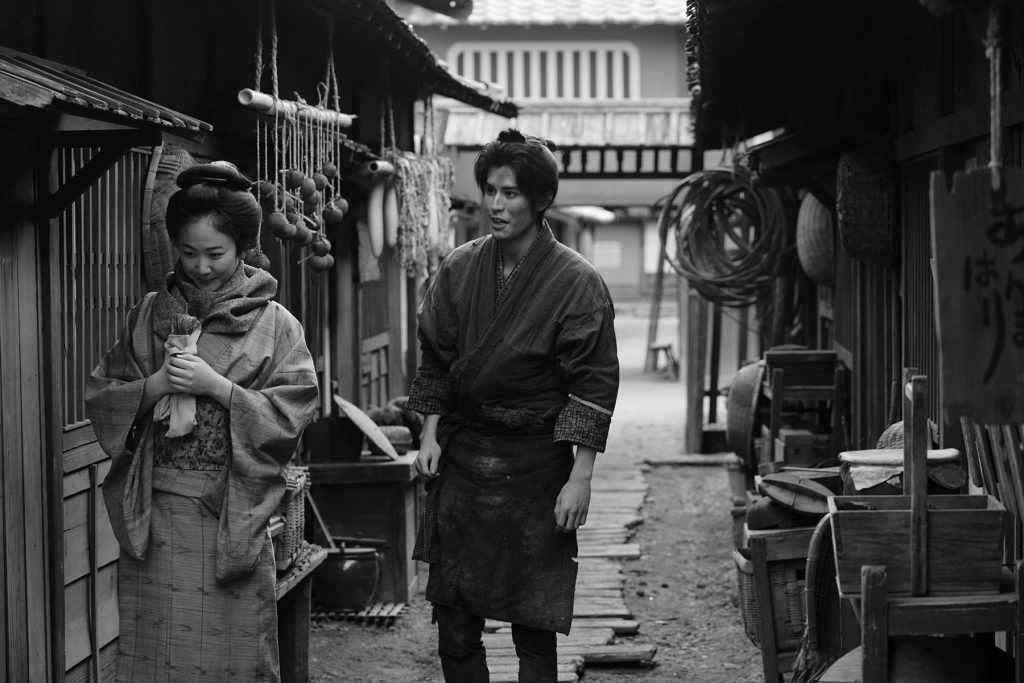
The story of Okiku and The World is mainly visualized with static shots – and fluid dynamic moments are merely thrown into the mix to offer some variety. The reliance on static shots, to compose conversations for instance, allows Sakamoto to utilize geometry and pleasing shot-compositions. Sakamoto, furthermore, utilizes these shots to create still life moments that echo, just like Ozu’s pillow shots, a certain fixity that persists at the level of the cultural field and the subject.
The black and white photography of Okiku And The World is disrupted by sudden shifts to polychrome colours. Yet, these shifts are not merely stylistic decorations, but thoughtful elements to fleetingly emphasize the beauty or the dirty nature of things. In fact, by creating such stylistic contrasts, Sakamoto texturizes his exploration of the anal dimension within the societal field and Okiku’s wandering within this world. The shifts make the narrative, by speaking to the dimension of the spectator’s imagination, a more tactile feel.
Okiku And The World proves that one can still deliver a refreshing narratives within the jidai-geki genre. While this kind of humanistic story about the lower classes has been created before, Junji Sakamoto proves that the frame of the period drama can still be elegantly exploited to explore the human condition. Highly recommended.

Notes
General-note 1: We do not really know the reason why the title Okiku no Sekai was translated as Okiku and the world. A more correct translation would be Okiku’s world, the world that is hers – and not hers at the same time, because she wanders in it.
Yet, the signifier world also has a somewhat different meaning within the narrative. Gonbei’s cultured conversation with Chuji turns the world as something that goes beyond one’s mere surroundings. It, in fact, becomes a signifier of an unimageable thing with no boundaries that can be contrasted with other signifiers to poetically evoke a certain subjective feeling.
General-note 2: The epilogue is called Okiku’s world.
Narra-note 1: Let us underline that Chuji’s refusal to eat might seem like playing out at the oral level, but is actually a response to the anal field he wanders in.
Narra-note 2: Okiku and The World also emphasizes that the impact of culture and its repressions is much harsher on the female subject than on the male subject. Yet, the attentive spectator will notice that even Okiku’s father avoids using signifiers that are, culturally, considered dirty.
 psychocinema
3 Comments Add yours