Introduction
More and more directors take the opportunity to explore the complex dimensions of sexuality within the Japanese societal field within their films. In recent years, more films that explore asexuality, homosexuality, …, etc. have been released and many of these films have been well received – nationally as well as internationally. With his first feature film, Yasujiro Tanaka aims to highlight a less explored sexual dimension, the dimension of cross-dressing, of drag.

Review
One night, Virgin Purity (Kenichi Takito)‘s practice of his drag-queen dance is rudely disturbed by a phone call. Much to his surprise and shock, Morylin Stone (Shu Watanabe) tells him that Natchan (Takeyama Kaningu), one of their friends, has passed away after collapsing at his bar.
After visiting his body at Ceremony Uranus, Virgin and Morylin are approached by Naitoh (Chikara Handa), someone who works there. He asks them if they know where he lived and came from. Yet, both are rendered speechless – they do not know. Not long thereafter, while glancing at Natchan’s pictures in the bar, Morylin realizes that him being a drag-queen needs to be kept a secret.
A few hours later, while visiting Virgin’s apartment to store the pictures and hide Natchan’s secret, Morilyn suddenly tells Virgin that he wants to visit her hometown. Yet, Lusty Zubuko (Tomoya Maeno), one of their drag friends who is a tv-personality, also do not know where she came from.

Natchan’s little Secret is, in short, a light-hearted road-trip movie that offers the spectator a glance at the Japanese drag-scene and gay-scene. While the narrative is not that deep thematically speaking, one can nevertheless read Tanaka’s film as an exploration of the tension between the drag-subject and the societal Other he is forced to wander in.
Before diving deeper in how this tension is visualized in Natchan’s little Secret, let us fleetingly analyse the act of cross-dressing. The act of cross-dressing is, in essence, a practice that stages the fantasy of the ideal woman. Despite the feminine quality that marks the presence of our cross-dressing gays, the algalmatic dimension of their glittery make-up and clothing underlines that our subjects follow the logic of the imaginary phallus. What they put on stage is not merely a body to support their fantasy but a decorative veil that playfully entices the presence of the phallus – yet, not as real.
Yet, this performance is in stark contrast with the last show of a subject, the event of the funeral. The funeral, as a symbolic institution, does not aim to deliver pleasure and spectacle to its audience, but enables a group of subjects to write the passing of a loved formally into the Other and in one’s own subject.
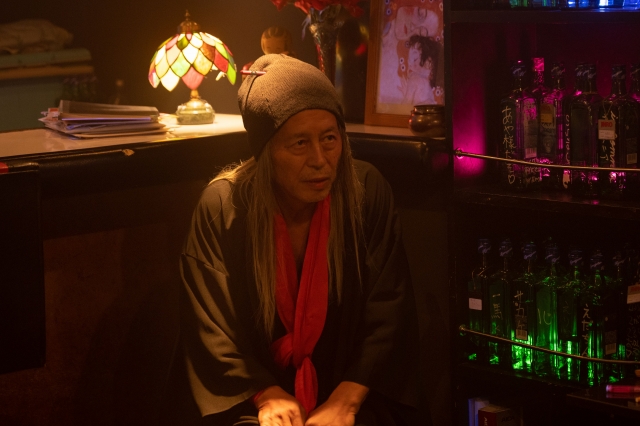
It is on the way to this formal social event of inscribing one’s loss, that Virgin and his friends echo the tension that exists between the drag-subject and the societal Other. Some of these subjects continue to fear the condemnation of the Japanese Other – an Other who seemingly becomes less open as the cityscapes make way for rice-fields. The narrative beautifully echoes that the act of cross-dressing is, first and foremost, accepted by the other when it functions as an act, when it is merely a comical farce constructed to entertain the viewer. Yet, many of these subjects feel that the dimension of cross-dressing as a practice is frowned upon and subjected to subtle societal disapproval.
The narrative of Natchan’s little Secret, however, does not truly reveal that such fear is unwarranted, but that such fear, which might or might not have found its support by past experiences, can be deeply inhibiting. What Tanaka ultimately stages with his comical road-trip is the necessity for the subject to pass through anxiety to attain, once more, a desiring position. This position causes the perceived Other to lose its inhibiting effect and allows the subject to put himself again on the stage as desiring.
While this tension is, most evidently, touched upon in Virgin’s lost desire to dance and perform as drag-queen, it is also subtly present in Morylin’s unexpected frightening encounter with his sexual desire. The only subject that avoids the impact of this tension is Zubuko, whose mediatized ego has earned him position of acceptance within the societal fabric. Yet, his trip is not without its highs and lows.

While some static moments are present in Tanaka’s composition, he mainly relies on dynamism to bring his story to life. His love for dynamism is most evident in those shots that, by being marked by very subtle camera movement, avoid being static. In long takes, Tanaka avoids visual monotony by thoughtfully shifting between static and dynamic moments.
The light-hearted feel of the narrative is mainly determined by the playful circus-like musical accompaniment. Due to the music, the overly dramatic acts and signifiers that blossom within moments of tension attain a farcical and entertaining quality. Luckily, Tanaka skilfully avoids framing the act of cross-dressing and being gay as such as a farce.
The music, however, is only able to amplify the entertaining quality of these moments because of the pleasant performances and the effective chemistry between the cast. The origin of the comical effect lies in the skilful way in which our actors bring the overly-dramatic rhythm of their conversations to life.

There is, however, one performance that stands out. Kenichi Takito as Virgin steals the show and glues everything and everybody together. With his presence and skill, he entertains the spectator and engages him into this road-trip and the world of fantasized femininity.
Natchan’s little Secret might not offer a too deep thematical exploration of the position of the drag queen within the Japanese other, it still succeeds in entertaining the spectator with its light-hearted framing of the tension between these subjects and the Other they are surrounded by. So be sure to give it a watch if you have the chance.

Notes
General-note 1: It is important to underline that even though the subtitles consistently uses ‘she’ to refer to Natchan, Zuboku, and others, this signifier is absent from Japanese speech – the context is enough to determine who is talked about.
Of course, this absence means that the question of gender-identification is not touched upon within this narrative. In fact, the verbalization of female signifiers (e.g. baba (hag), shukujo (lady), nee-san (older sister), … etc.) generally only happens while cross-dressing, while clothing themselves with the veiling fantasy of the ideal woman.
General-note 2: The usage of the signifier ‘onee/nee-san’ has become somewhat controversial in recent years within the Japanese societal field. For the purpose of our review, it suffices to highlight that the film does not utilize the signifier in its original meaning: to denote feminine gay who do not cross-dress. In Natchan’s little Secret, the signifier is utilized by Zuboku in a distorted way, used to identify himself as a gay who cross-dresses as a woman.
 psychocinema