Introduction
There are many hidden gems in the jidai-geki genre, movies that due a few colossal classics never receive the limelight they deserve. Yet, thanks to Eureka Entertainment, one such gem can finally be enjoyed by a wider public. Revenge (1964) is the result of a collaboration between Tadashi Imai, a director whose social realist and left-wing inspired work centres on human tragedies, and Shinobu Hashimoto, a screenwriter best known for his scripts for Akira Kurosawa’s Rashomon (1950) and Seven Samurai (1954) and Masaki Kobayashi’s masterpiece Harakiri (1962).
Review
1722, Late spring. Two farmers happen to see a group of samurai hard at work to build an official place for a duel to settle a vendetta at Kikyogahara. The claimant of the duel is Tatunosuke Okuno (Tetsuro Tanba) and the respondent Shinpachi Ezaki (Kinnosuke Nakamura).
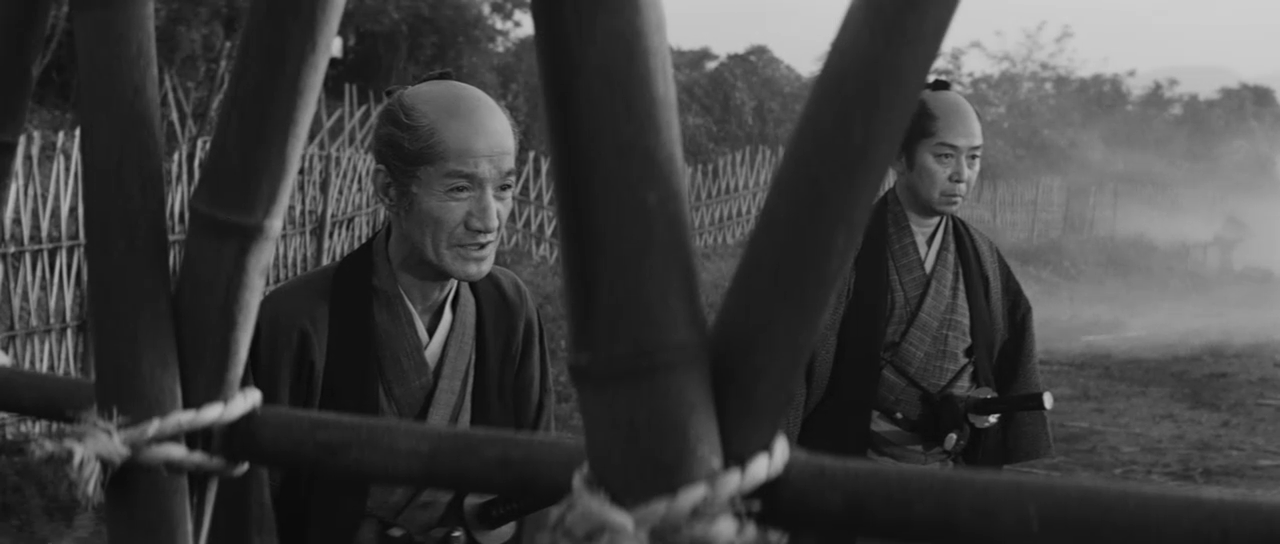
Sheriff Ogawa (-), who oversees the organisation of the duel, looks forward to the event as it can only improve the clan’s fortunes. After telling Jinza (-) that they should not cut any corners, he goes on discussing the trivial matter, a discussion between the lowly and rankless guard Ezaki and master of ceremonies Magodayu Okuno (Shigeru Koyama) about polishing and being treated with respect, that ultimately led to this duel.

Revenge, which follows the zankoku mould of samurai film, has generally been read as a mere critique of the hypocrisy within the samurai-class and the dehumanizing contradictions that arise from the reliance on hierarchy and the ‘venerated’ dynamic of honour. Yet, in our review, we want to offer a somewhat more radical reading. Rather than depicting a violent clash of honour, Imai’s Revenge depicts a tragic unfolding of one subject’s attempt to, against the established hierarchal structures, receive recognition for his subject. In our view, Ezaki’s acts and signifiers are not simply aimed at protecting his honour as samurai, as dictated by bushido, but to cut through its formalized dynamics to demand respect for him as subject.
Shinpachi’s demand to be treated as a subject and not as an inferior object-servant is, beyond all doubt, righteous, but his humane request disturbs the formal hierarchal structure and the well-formalized circulation of signifiers. His demand has, in fact, no right to be uttered, not only because of his low-ranking position but because his complaint, by merely being vocalized, disrupts the conventional flow of signifiers and, thus, the feudal symbolic societal organisation.
His enunciations illustrate the presence of an irreducible gap between the subject and the symbolic system he is subjected to (Narra-note 1). His defiance does not merely echo that one never fully fits this formalized societal Other but also that the symbolic system, while having real consequences for each subject, is but a mere construction of language and signifiers – it’s a semblant. His speech-acts highlight that, as he does not fit the demands that structure the feudal Other, he feels the need to radically question the hierarchical system of symbolically-inscribed loyalty and his position within it (Narra-note 2).
Shinpachi’s ‘madness’ is, in our view, not only caused by the weight of the imaginary dynamic called honour – i.e. the knowledge that Shume (Tetsuro Tanba) is coming to get his revenge, and his forced subjection to these samurai rules, but also of the continued silencing of his subjective voice by others. The head monk of the Sanno-ji monastery that houses Shinpachi erases his subject by rashly assuming he acted in accordance with the law of bushido and by, later, deeming him as going mad (Narra-note 3, Narra-note 4).

The main catalyst that inaugurates the conflict between Shinpachi and the Okuna-clan and which eventually culminates in the official duel at Kikyogahara is the death by Magodayu Okuno by the hands of Shinpachi during an illegal duel. After his death, his brothers’ seek official permission to enact vengeance. They do so not merely avoid the slandering of being cowards, but also to annul the disturbance of the hierarchal system by fulfilling their duty to protect the clan’s honour. It is due to their loyal submission to the symbolic code of the samurai that Shume and Tatsunosuke (-) cannot meekly accept the imaginary injury inflicted to their family’s honour. The subtly irony of the necessity they feel to seek revenge is that this law of vengeance, this duty to restore the image of honour of the clan, lies ultimately beyond all ethical discussion of right or wrong.
The framing of both subjects as being insane at the time of the illegal duel is an attempt to protect the harmony of the feudal Other. By doing so, the sheriff does not only declare that both subjects did not act in accordance with conventional societal patterns and norms, but also qualifies their quarrel as having no place within the sane and well-formalized circulation of signifiers. The critique that structures Imai’s narrative is that Ezaki’s demand to be recognized as a subject is drowned out by the societal dynamics sketched out by the bushido law. The whole semblant of the samurai code is aimed at formalizing and hierarchizing social relationship in such a way that subjective voice are erased.
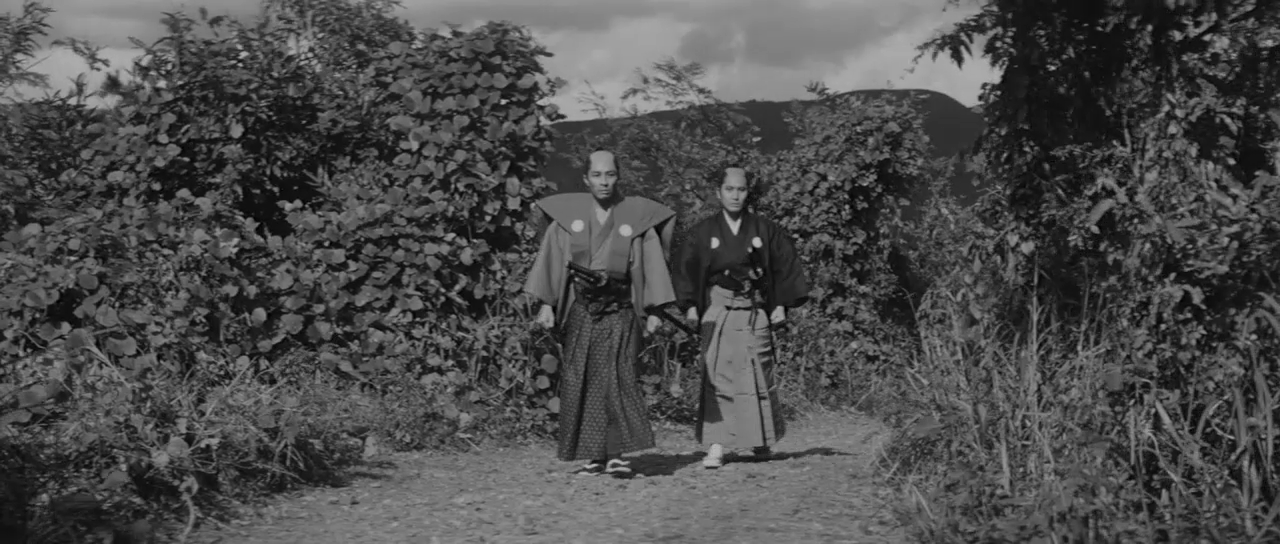
The elegantly interlaced pattern of flash-backs and fragments visualizing the present (i.e. the preparations for the duel and, ultimately the duel itself) does not merely develop and explore the dispute between Shinpachi and the Okuno clan, but allows Imai to question the problematic functioning of strict hierarchal structures, highlight the destructive consequences of the formalisation of the imaginary dynamic of honour and give his bloody finale its dramatic and unforgettable impact (Narra-note 5). The attentive spectator will, moreover, slowly realize that Imai’s narrative does not merely criticises Japan’s conflictual feudal past, but the fraudulent ‘feudal’ shadow that keeps haunting social structures in Japan – i.e. the continued reliance on hierarchal relationships that leave little to no space for a subjective voice, the malign effect of hierarchal structures and power-dynamics on the field of justice/injustice, and the need to safe one’s imaginary face.
The visual composition of Revenge, while highly dynamic, stands out due to its languid rhythm. Nevertheless, the way Imai frames the two meticulously choreographed fighting-sequences will put the spectator on the edge of his seat. His composition does not only frame the clashing of swords in a way that they can easily be visually appreciated but also emphasizes the dramatic flow-and-ebb of the choreography as such, hereby infusing the various show-downs with a palpable sense of tension.

The visual beauty of Revenge, however, lies in its effective monochrome photography. While Imai’s lightning-schemes are quite similar to other black-and-white narratives of the same period, elegantly emphasize lighting-contrasts and geometrical tensions, there are moments within the visual fabric that attain a more seductive flavour. One of the visual elements that adds atmosphere and elevates the visual impact of the black-and white imagery of Revenge is the lingering whitish mist that adorns some backgrounds and haunts other parts of the frame as well. Another element, one which sorts the same effect on the spectator, is the visual dynamism created by strong winds.
The atmosphere of Revenge is also modulated by Toshiro Mayuzumi’s beautiful musical pieces. Yet, the effectivity of his work lies in the fact that his compositions emphasizes both the beauty of traditional architecture and the natural landscapes that surround them as well as subtly echo the threat that resides within the societal space of the samurai.
Revenge is quite simply a classic – a jidai-geki that every cinephile should see. The effective temporal framework, which slowly develops the conflict between a subject that desires to be recognized as one and a formalized symbolic system that refuses his voice its righteous place, does not only sketch out the irony that marks a hierarchical societal system structured by an imaginary dynamic of honour but eventually culminates in a provocative and breathtaking finale that will haunt the spectator long after the credits have ended.

Notes
Narra-note 1: Enunciations of other characters emphasize that not all subjects fully adhere to the samurai code, bushido. In fact, Revenge can be said to be structured around the societal tension between the need to protect the clan’s fortune within the societal field and saving one’s face of clan-honour as dictated by the bushido-law. It is this irresolvable tension that dooms the Okuno clan and leads them to their demise. This tension is also echoed in the way that the sheriff demands that Jubei (Takahiro Tamura), Shinpachi’s brother, to fulfill his duty in light of the coming duel.
Narra-note 2: While it is implied that the rabid nature of Shinpachi is caused by his adherence to the law of bushido and the dynamic of saving one’s face of honour, such view forgets to take the true aim of his rebellious speech-act into account.
Narra-note 3: Shinpachi’s later enunciations of having always acted with honour should be read in the following way. Of course, this honour refers to the one dictated by the laws of bushido – he remains, by being subjected to this symbolic system, radically marked by it. Holding on to this imaginary element is, in fact, the only way can stabilize his ego and keep himself standing in a strict hierarchal symbolic system that cannot abide by his radical demand to be treated as a subject.
Narra-note 4: It should be quite obvious the signifier of his brother Jubei has such an impact on him. Jubei is the only person that, via his signifiers, opens up a space for Shinpachi’s subject and grants him the right to chase his own subjective desire. The immediate result of Jubei’s recognition of Shinpachi’s subjectivity is that his samurai-ego loses its frailty and his emotional turmoil recedes.
Narra-note 5: The finale painfully illustrates that those who, within a hierarchal structure, hold a position of power can rely on the system of laws and signifiers that aims to maintain the symbolic equilibrium as well as its phantasmatic consistency.
Within such kind of formalized symbolic structure, any kind of protest that lays bare the fact that it is merely a self-serving semblant, a mere construction of signifiers to be exploited and manipulated by those with power, needs to be violently annihilated.
 psychocinema