Introduction
While Eiji Uchida gained international attention by delivering quirky indie narratives like Greatful Dead (2013), Lowlife Love (2016) and Love And Other Cults (2017), he has in the last couple of years chosen to craft somewhat more straightforward movies, like Midnight Swan (2020), Offbeat Cops (2022) and Shrieking In The Rain (2021). Some might lament Uchida’s shift, some might welcome it. For us, all that matters is that he keeps delivering great cinematic experiences the audience. Is Shrieking In The Rain (2021) such experience?

Review
1988, early summer. At the Toei Tokyo Studio, Shiro Watanabe (Toshihiro Yashiba), the chief assistant director, tries to convince rookie director Hanako Hayashi (Marika Matsumoto) to come out of a locked car and shoot the next scene. Yet, as she keeps ignoring his pleas, he loses his patience. After Watanabe’s failure, Kiyoshi Ota (-), the cinematographer, Gonzo Mitamura (-) from the lightning crew, and Kota Yagiri (-), the sound recorder, try to break her stubborn refusal to come out. Yet, to no avail.
Not long after Kaoru Yajima (-) from the make-up department says something about guts with a flavour of disdain, a discussion breaks out between her and some of the men from the other departments. Hanako, still locked in the car, closes her ears. Yet, when Falcon Video’s Kenji Onoei (Kiyohiko Shibukawa), who witnesses the ordeal, expresses his concern, Yoshimasa Tachibana (Kazuya Takahashi) reassures him and tell him that she is just struggling with nerves over her first feature film, a soft-core piece.

Shrieking In The Rain is a light-hearted film that, by following the coming-into-being of a female director, explores certain tensions and conflicts that trouble or have troubled the art of filmmaking (Narra-note 1). Uchida, first and foremost, stages the enduring conflict between the demand of being profitable and the desire to have the artistic freedom to express oneself creatively, the everlasting tension between manufacturing filmic products to consume quickly and crafting filmic pieces of art to slowly savour for years to come.
It is evident that the interactions between the producer, who wants the film to be a financial success, and the spokesman (Shinya Owada) of the FCC who follows the strict ethics guidelines ultimately hampers the realisation of the director’s creative vision. Shrieking in the Rain shows that the ultimate power within the filmmaking process is not held by the director, but by the producer and the production committees. Even though Uchida’s narrative is set in the eighties, this uncomfortable truth has not lost one bit of its relevance.
Yet, this element should not detract the spectator from the staging of another truth within the narrative, i.e. the fact that being a director is, first and foremost, a job of making compromises, of thoughtfully playing with time and budget constraints in a way that one’s creative vision can still finds its expression. Hanako’s struggle is, in part, caused by her failure to realize the role of mediator, hereby damaging and sabotaging her own cinematic narrative.
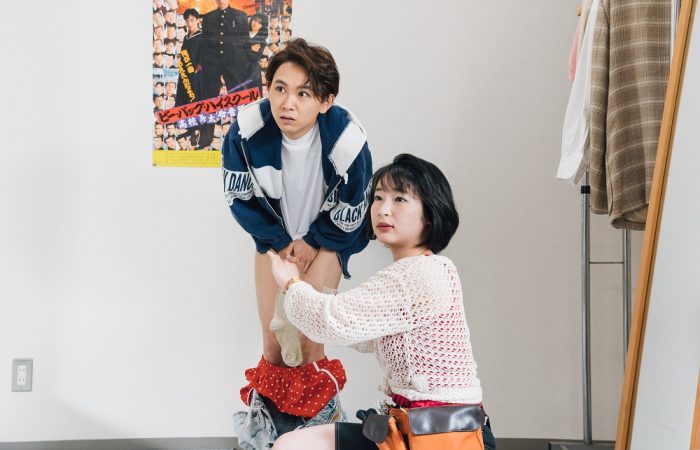
The second dynamic that Shrieking In The Rain explores is the sexist logic that lingered within the late eighties – a sexist logic that, nevertheless, already received some beatings and injuries. It is, as a matter of fact, because these patriarchal sexist ideas have come under pressure from societal changes and the blossoming of ‘rebellious’ discourses that Yajima’s comment about guts sparks protest. The same is true for sexists comments – Try to dress a little less slutty – that Hanako’s clothing style generates and for the sexist flak Yoshie Sato (Serena Motola), the camera assistant, gets for making mistakes.
The damaged state of the sexist and patriarchal logic is further emphasized by Inoue’s signifiers, by which he brings Hanako back to her senses. By telling her that women are breaking barriers in the US and inviting her to smash the old ways he does not merely emphasize that society is transforming, but emphasizes that she, by being given the change to direct a soft-core film, can play a role in breaking barriers herself (Narra-note 2). Yet, are his signifiers truly well-meant? Does he really want to support her and her creative vision or are his words of support mendacious, sweet bits of speech hiding the bitter fact that all he cares about, in the end, is manufacturing profit?
Yet, that this sexism can be so openly be expressed is also due to the ‘contradictory’ relational structures. While Hanako, as woman, is supposed to direct the different crews, her position is complicated by being conscious of the fact that she, at the level of experience, is merely a junior (kohai). Yet, the traditional patriarchal dynamics (kohai-sempai) that structure the relational field of the filmmaking business do not only allow sexist remarks to be vocalized, but also inhibit her as subject and as director (i.e. her silent voice, her dozing off, her absent-minded presence, and her inability to vocalize her vision clearly). Can she, ultimately, overcome the weight of these sexist power structures and realize the role of director with her subject?

Yet, the sexist signifiers and acts are not the only problem Hanako needs to deal with. In an attempt to make her feature debut more attractive for audiences, the production gave popular idol Shinji Segawa (Kenta Suga) a role in the film. Yet, Segawa, whose arrogance is supported by his entourage – they continually please his fantasy of being an shining object-of-desire for the female other, constantly fails to remember his lines on the set, thereby angering actor Kazuto Higuchi (Yuma Yamoto). Not much later, Kaedo Sudo (Maeko Oyama), a washed-out actress who hopes to breathe new life into her career with Hanako’s film, asks the director to make her sex-scene with idol Shinji un-simulated.
Even though Shrieking In The Rain provides a lot of fun moments and a pleasant insight in the way the process of making a film unfolds, Uchida fails to give Hanako’s coming-into-being as a director its genuine emotional power. While the spectator learns that her thirst for eroticism and her love for the cinematic art is determined by creating her own kind of erotic cinema as a child – by pushing a hole in the shoji paper to watch her mother having passionate sex, Uchida could have interweaved this narrative element more firmly in the unfolding of the narrative to breathe more emotion into Hanako’s subjective struggle. If he could have visualized Hanako’s inner conflict better, the revelation that the ultimate thrust of her desire to become a director is, in short, nothing other than the desire to recreate and recapture the voyeuristic pleasure of seeing her mother-in-enjoyment would have been so much more satisfying.

The composition of Shrieking In The Rain is a pretty straight-forward affair. Dynamism is utilized to give the narrative a pleasant visual flow and static-shots are utilized to emphasize important interactions and to give certain visual moments their dramatic flavour. The visual pleasure of the composition is ensured by the softness that marks the colour-schemes and the lightning.
Uchida does rely on musical accompaniment to breathe some emotion into the unfolding of his narrative. As a matter of fact, the bursting forth of heroic music in the finale partially compensates for the narrative’s struggle to give Hanako’s growth as director its genuine emotional rhythm. And by decorating the rebellious twist in the finale with a heroic flavour, Uchida also succeeds in celebrating the very passion of the director, the crew and the cast for their craft and the love they have for making a work of art.
Shrieking In The Rain is a narrative that does everything well, but lacks the emotional punch to make the experience unforgettable. Uchida explores the tension between financial and artistic motives, relational dynamics infested by sexist thoughts and the director’s duty to compromise in such a way that their artistic vision can still be realized with a dynamic elegance, but fails to give his finale the burst of genuine emotion and triumph by underutilizing Hanako’s phantasmatic motive to become a director.

Notes
Narra-note 1: The change in how the assistant director sees Hanako is elegantly underlined by shift in the manner that he vocalized the signifier director to address her.
Narra-note 2: We should also not forget that the very fact that she is given such a chance is, in itself, a sign of societal change. In a certain sense, the chance that she is given proves that the sexist patriarchal discourse has lost some of its strength and is not strong enough anymore to cover up the holes from where societal change, subcultures, and different discourses (e.g. the kawaii discourse of the late 60’s) can blossom.
 psychocinema
Great movie watched it twice last year on my dvd.