Introduction
Anshul Chauhan is back with his third – and maybe final – Japanese feature-length film (General-note 1). While Chauhan wrote his own scripts for his previous films, Bad Poetry Tokyo (2018) and Kontora (2019), he based himself for his courtroom-drama on a story written by Rand Colter. Can he still deliver an effective and satisfying narrative without having written the story himself?

Review
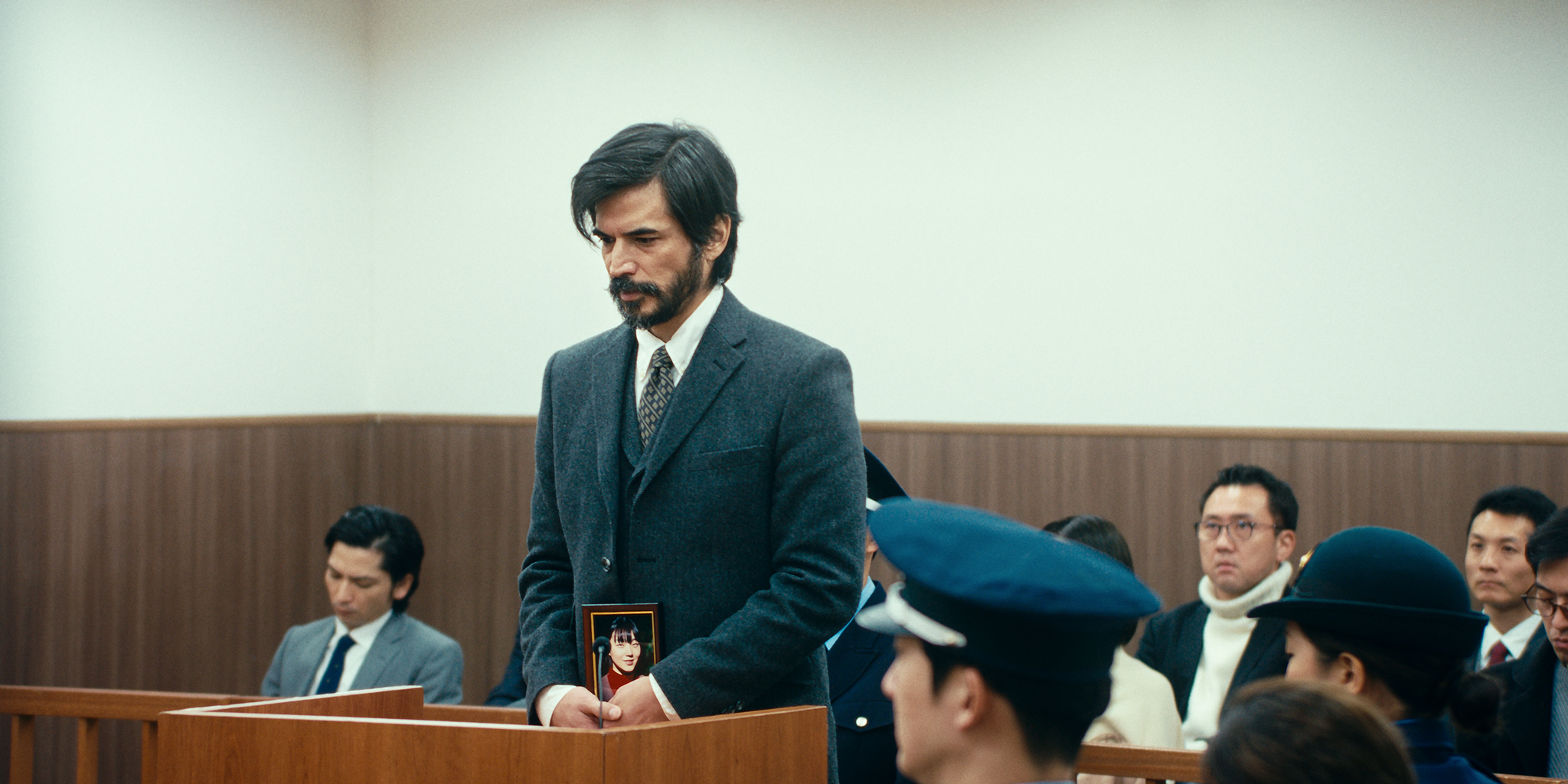
One day, both novelist Katsu Higuchi (Shogen) and his ex-wife Sumiko Okazaki (Megumi) receive a letter from the Japanese ministry of justice. The letter invites them to attend the trail where the legality of the sentence Kana Fukuda (Ryo Matsuura) received for the murder of their daughter Emi Higuchi (Kanon Narumi) seven years ago will be re-examined.

December is a touching and emotionally powerful narrative that – to put it somewhat vaguely – explores the subjective struggle to leave the past behind. The emotional power of Anshul Shauhan’s narrative is mainly function of the way the narrative is structured – i.e. the conflicts arise and the confrontations that follow.
At first, the context that led to the murder of Emi Higuchi is kept a secret for the spectator – one is merely given the information that Kana stabbed Emi multiple times on the riverbank near Miwake school on December 20st. This absence, by implying the cold-blooded nature of the murder, elegantly forces the spectator to identity with Katsu Higuchi’s vengeful position.
Yet, by integrating evocative flashbacks from Kana’s perspective in the unfolding of the narrative, the subjective context surrounding the murderous act is not only slowly sketched out but the very subjective dimension of the act is revealed. What drove her to stab Emi? Was it merely, like the defence attorney says, a selfish act? Or was it a radical acting-out to protect herself from being consumed by anxiety and avert the effacement of her subject?

Where does Katsu Higuchi’s vengeful drive comes from? What compels him to radically frame her as a monster, something so Other that it needs to be locked away for good? While these questions are important, the central question December asks the spectator to consider is the following: what good has it done for Higuchi’s subject to demonize the murderer of his daughter? Has this imaginary dynamic, which has helped him maintain a certain version of his ego and avert the disintegration of his subject by the impact of the Real, not radically hindered him in ‘rewrite’ his subjective trajectory? Can he, so insistent on punishing her, accept the subjective nature of Kana’s act?
Kana’s attorney is correct when he states that the letter of the law is cold and emotionless – dried letters on a paper to calculate sentences for factual offences. It does not exist to satisfy anyone but the symbolic Other/order as such, i.e. the societal fabric structured by rules, demands, values, norms and ideals.
Due to the cold nature of the letter of the law, the clash between lawyers and witnesses during the court proceedings transforms into a manipulative, deceptive but emotional game of signifiers to create a fictionalized truth that, when passed through the calculus of the law, benefits either the defence or the prosecution. It is this truth that underpins many of the turns and twists the narrative takes.

Chauhan’s composition is thoughtful and elegantly structured to evoke the dimension of subjective struggle (Cine-note 1). While the use of shaky framing, like in many other narratives, has two interlinked functions – i.e. the infusion of a sense of realism into the narrative and the strengthening of the emotional flow and the genuineness of the emotions expressed through non-verbal as well as verbal means, Chauhan’s evocative use of shakiness stands out.
By reserving visual shakiness for scenes depicting Katsu and contrasting them with the fluid and more static framing that marks Sumiko’s sequences, Chauhan elegantly reverberates that Katsu’s life still lies in shambles – that he, as subject, is still profoundly marked by the traumatic event in his past (Cine-note 2). The frequent disappearance of this contrast when Katsu and Sumiko are together subtle invites the spectator to wonder whether Sumiko, after all that happened – i.e. the murder of their daughter and their divorce, still an anchor for Katsu. And, in relation to Kana, one is led to ask oneself whether she bears any guilt concerning her murderous act (Narra-note 1).
Another stylistic element that stands out is Chauhan’s use of jump-cuts. While the use of this stylistic element introduces a lot of visual information in a quick but fragmentary way, the visual flow that results from using this kind of shot clashes a few times with the rhythm of the character in focus. Yet, in the finale of December, the cutting is perfect, beautifully heightening the drama of what unfolds and playing with the spectator’s anticipation of what might happen.
The musical accompaniment ensures that the visual fabric attains a certain elegance while also subtly heightening the dramatic atmosphere of Chauhan’s narrative – the dimension of subjective drama. Luckily, the moments of emotional drama are not merely function of these musical pieces, but fully carried and realized by the cast. Shogen proves, once more, with his natural performance his skill as an actor. And Ryo Matsuura’s performance also leaves a lasting impression on the spectator.
December is a highly moving and emotionally powerful narrative that explores the struggle of a subject to shake of the winter of his subjectivity. That Chauhan’s narrative ends up being so powerful is not merely due to the effective narrative structure and its great visual composition, by due to the cast that breathes a genuineness in the maelstrom of emotions that the re-examination of the case brings about.

Notes
General-note 1: While the film started screening at film-festivals in 2022, we have taken the liberty to use the year that it’ll release in cinemas in Japan. That way, Chauhan latest’s film makes a chance to make the top Japanese films of this year.
Cine-note 1: The visual pleasure of December’s composition is enhanced by the beautiful colour-schemes and the effective lighting design.
Cine-note 2: When shaky framing comes to mark some of Sumiko’s scenes, the spectator readily feels that the court-proceedings that cause the ‘excavation’ of her past traumatic experience affect her as a subject. Later, the shaky framing also comes to mark the scenes of Naoki (-), her husband, emphasizing that they way the trail impacts his wife is not without consequences for his own subjective position.
Narra-note 1: In Kana’s case, there interaction between how she presents herself in court and the shaky framed flashbacks that attack her at night enable the spectator to gain insight in her subjective position – an insight neither the parents of victim nor the lawyer that defends her case has.
It is this narrative interaction that allows the spectator decide about whether she feels any guilt or not.
 psychocinema
2 Comments Add yours