In the late sixties, the ninkyo genre began losing its appeal for audiences as the political turmoil that swept the world problematized the nostalgic idealization of patriarchal values. Audiences began to see the patriarchal ideals – e.g. ‘giri’ and ‘inase’ – staged within these films for what they truly were: nostalgic fantasies that never existed. Nevertheless, in the weaning days of the ninkyo genre, Toei succeeded in delivering the genre’s carmen cygni with the Red Peony Gambler series.

Be sure to also read our review of Red Peony Gambler (1968) and Red Peony Gambler: Gambler’s obligation (1969).
Each film in this series stages in their own way the triumph of a fictional constellation of patriarchal values over the capitalistic reflex that was secretly perverting and transforming the old ways. Yamashita, with the inaugural entry of the series, introduced the spectator to the mesmerising beauty of the logic of the ‘male’ chivalrous code embodied and animated by a female subject, while comically criticizing the restrictive and suffocating hold of the patriarchal Other on women and their subjective logic. Norifumi Suzuki utilized the framework of ninkyo, the traditional Other’s triumph over individualistic and capitalistic tendences, to confront the spectator with the failure of any a-subjective moralistic system, of any Other, to restrain a subject’s desire, irrespective of its aim. Desire will, in other words, always upset the subject’s relation to the Other.
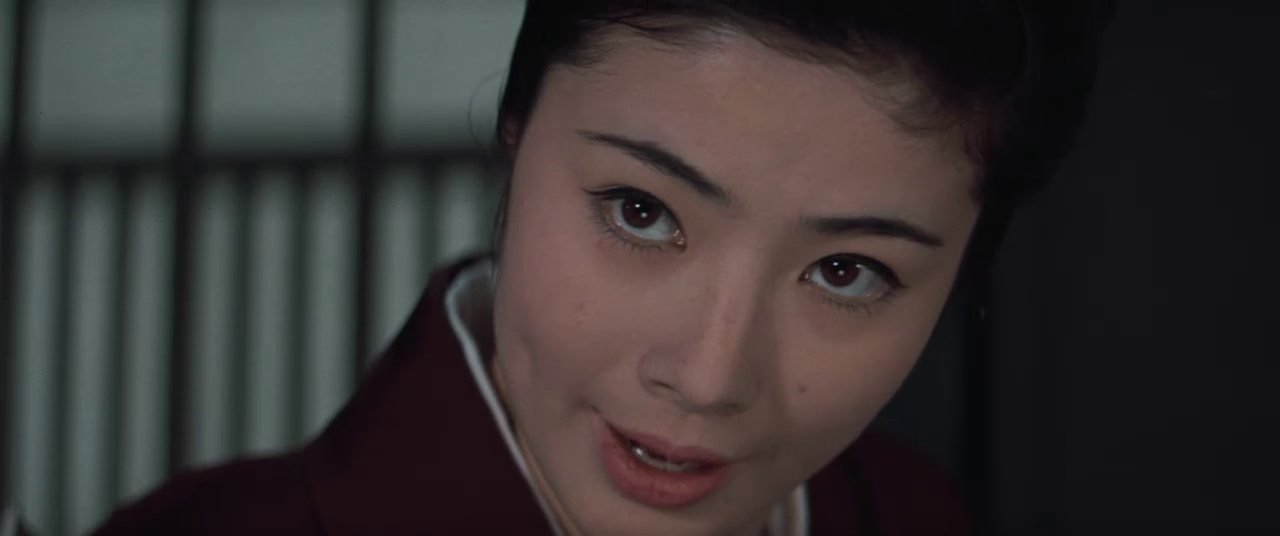
As screenwriter Norifumi Suzuki revealed desire’s truth in Red Peony Gambler: Gambler’s Obligation, we must investigate how he will continue his investigation of the conflictual relationship between subject, Other, and desire. Can he give director Tai Kato a fresh perspective to explore the triumph of the patriarchal Other over the socially erosive outbursts of individualistic capitalistic desire? Can he offer him different pathways to highlight the necessary faltering of the formalized moral calculator called ninji?
Whether Tai Kato’s narrative can offer a fresh perspective mainly depends on how Suzuki reshuffles the three interrelated thematical oppositions: between giri and ninjo, the patriarchal Other and the capitalistic threat, and between desire and the a-subjective enactment of the moral calculations. To start unfolding the thematical layers of Red Peony Gambler 3: Flower Cards Game, we first need to unveil the way the capitalistic threat rears its head within the societal field structured by the patriarchal Other.
Within Kato’s narrative, the capitalistic logic is represented by the figure of the imposter and the ‘westernized’ yakuza boss. The narrative thread of the imposter, the cheating gambler abusing Oryu’s name, is first utilized to re-affirm Oryu’s loyal subjection to the moral demand of the Other (giri), her radical inscription into the male moral code (jingi) that seemingly calculates all lack and desire away.
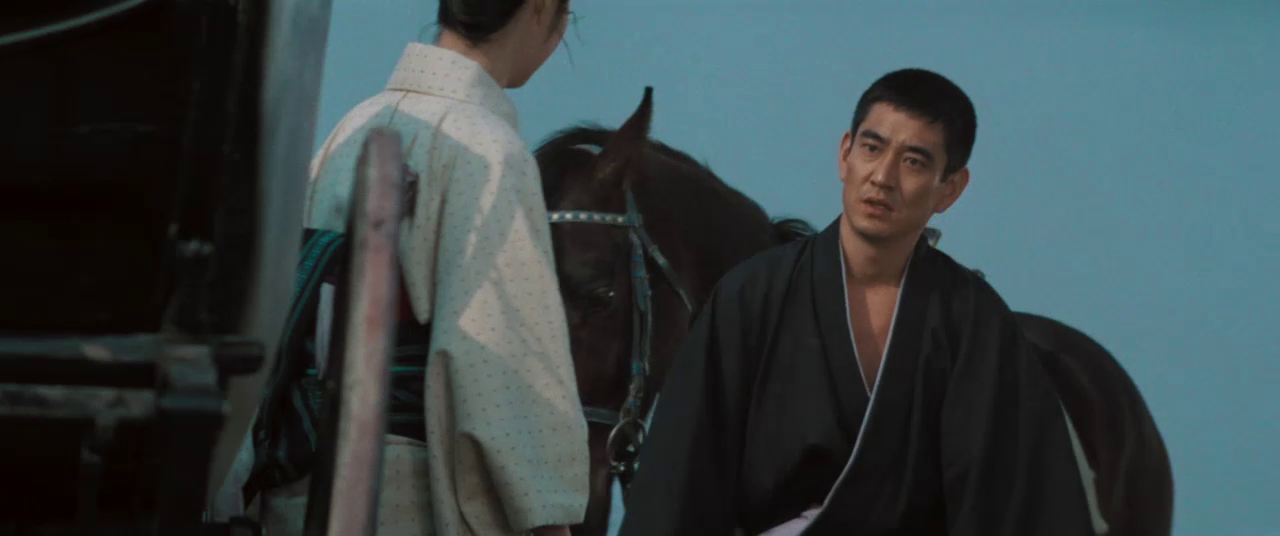
Kato and Suzuki powerfully establish her adherence to the traditional Other by contrasting the heroic act that opens the narrative with the outrageous accusation of one kobun of the Nishimura family that she is a cheat. Oryu’s heroic act – i.e. saving the blind child from the oncoming train, is a logical consequence of her symbolic inscription into the patriarchal moral calculator. In the same way Oryu had to take revenge in Red Peony Gambler, she must, in accordance to the moral code, help the weak. There is, in other words, little to no emotional feeling (ninjo) towards the child in play when she hastens herself to rescue her. This act, a mere consequence of the moral dynamics of the patriarchal Other, gives the subsequent accusation a ridiculous flavour.
The narrative contrast, moreover, confronts the spectator with the following two questions: Who steals and cheats under Oryu’s gambling name? And what the imposter’s penultimate aim? Given the importance of the destabilizing dynamic of western capitalism within the Red Peony Gambler series, we can easily reformulate the second question as follows: Is the imposter’s turn to cheating solely determined by a capitalistic desire or is there another motive in play? The answers to those questions, which are given quite early in Red Peony Gambler 3: Flower Cards Game, allows the spectator to grasp that capitalistic desire as such does not exist. Capitalism creates a phantasmatic framework that leeches on the subject’s lack, perverts the false aim of his desire – from the Other’s love to the excremental object – and seduces him to generate enjoyment by obtaining the desired object-of-trash. In the scene where Oryu confronts Otoki (Junko Toda), the imposter, the spectator easily understands that the capitalistic fantasy, by perverting her motherly lack, seduced her into installing a criminal logic and produce enjoyment beyond her otherwise noble motherly aim (Narra-note 1, Narra-note 2).
The second representation of ‘capitalistic’ desire within the narrative is the yakuza boss Tetsunosuke Kimbara (Asao Koike). His corruption by the capitalistic fantasy manifests itself when he offers his daughter Yaeko (-) to congressman Furuta (Asao Uchida) to secure the contract to construct the extension of Nagoya port and enrich himself (Narra-note 3). The reduction of his daughter to an exchange object, the radical erasure of her subjectivity, has no other aim than to obtain more wealth and amass more power – the two symbolic elements by which he can support his ‘right’ to enjoy. Later in the narrative, our thirsty capitalist tries to exploit a setback to his plan to increase his power within the societal fabric and acquire the ‘freedom’ to transgressively enjoy within the boundaries of the patriarchal Other by fabricating an imaginary injury that grants him the moral duty (giri) to annihilate his enemy: the Nishinomaru family.
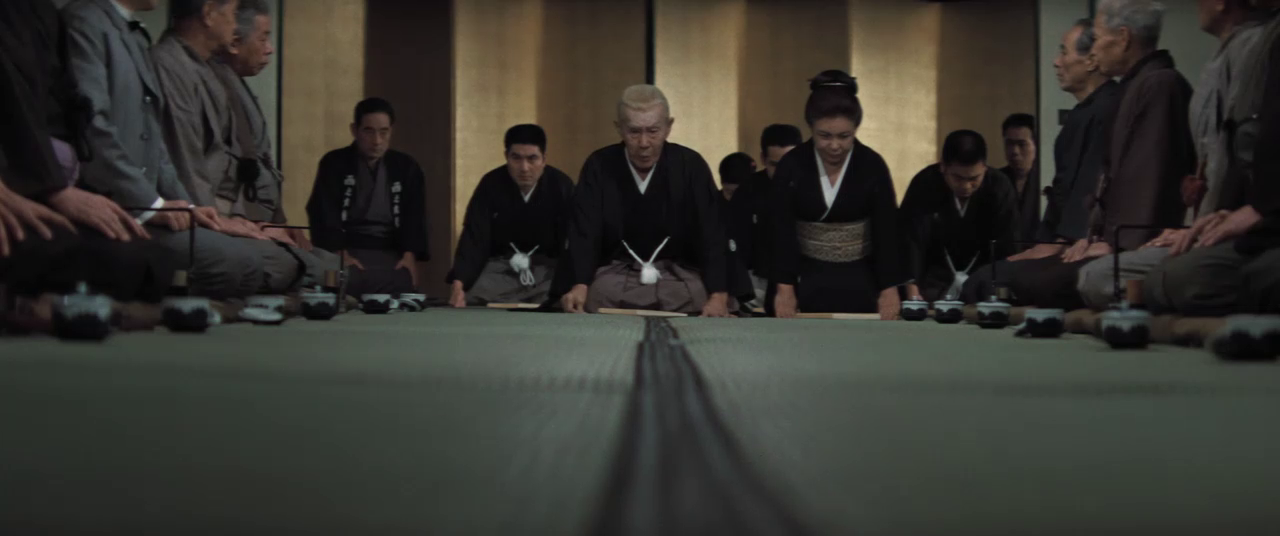
This more subtle depiction of the capitalistic thirst allows Suzuki and Kato to re-affirm that the subject, drunk on the capitalistic fantasy, tries to bend the chivalrous image and logic of the traditional Other and its moral coordinates to gain access to transgressive enjoyment. Such subject cunningly manipulates the moral framework of giri or formalized and ritualized exchanges to create an opening for what the Other and its moral structure aims to forbid: enjoyment.
It is important to highlight that Oryu, in contrast to the spectator, remains blind to the perverting effects of the capitalistic fantasy; she cannot see behind the veil of traditional formality. Oryu’s blindness is not, as some might think, caused by her focus on the imposter but because she, who has radically inscribed herself into the moral Other, must trust the deceptive image of formalized and symbolically determined harmony.
Having singled out the way capitalism is featured in Red Peony Gambler 3: Flower Cards Game, we can now trace out the evolution of Suzuki’s thematical exploration of the capitalistic discourse. In Red Peony Gambler, capitalism is merely staged as a threat to the traditional Other In the sequel, Suzuki underlines that all desire is transgressive and that no societal system can silence desire. In Red Peony Gambler 3: Flower Cards Game, capitalism is revealed as being a phantasmatic frame that perverts desire and seduces the subject to partake in a deceptive cycle of enjoyment fuelled by an infinite number of excremental objects (i.e. money).
To further develop our thematical analysis of Red Peony Gambler 3: Flower Cards Game, we must approach Oryu’s story from the signifier couple giri and ninjo. The conflict between duty and feeling is represented in two different ways within the narrative: an inter-subjective and an intra-subjective manner.
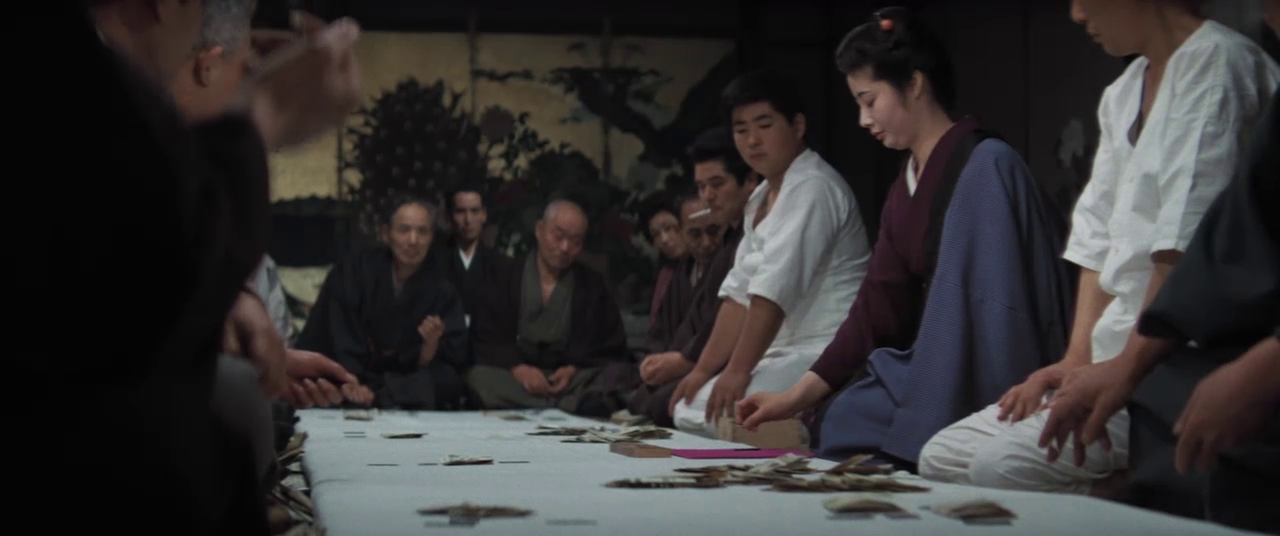
The inter-subjective representation of this conflict is nothing other than the narrative’s catalyst. Everything starts spinning out of control when Sugiyama’s son, Jiro (Teruo Ishiyama), refuses to accept that his love Yaeko is given, as a marital exchange object, to Furuta. While his father demands that he honours his willingness to forfeit the way of the yakuza and study in Tokyo (giri), Jiro wants his father to intervene and satisfy his ninjo, his love for Yaeko. Yet, his father refuses
The intra-subjective version of the conflict is represented within the narrative by Oryu. Yet, rather than exposing her subjective split like in Red Peony Gambler: Gambler’s Obligation, Tai Kato shows how a subject can avoid the confrontation with his own psychic tear. Oryu decides to help Jiro not only because her radical inscription in the moral calculus of the Other demands it, but also on account of seeing her own thwarted female past, i.e. the logic of lack and desire, reflected in Jiro’s radical longing for Yaeko, inhis self-sacrificing love and his desperate beautiful sincerity. However, Oryu does not act because she has projected her own lack onto Jiro (ninjo), but because she seeks, through her radical adherence to the a-subjective moral prescriptions of the Other (giri), to keep her subjective split in a repressed state. She chivalrously flees into the demands of the moral code so that the unwanted reflection of her own repressed lack and desire for love cannot destabilize her.
By approaching Oryu’s split in this way, Kato and Suzuki succeed in highlighting that, in some cases, the subject flees in the meaning generated by the symbolic coordinates to avoid the confrontation with their own gnawing lack. This revelation allows the spectator to retrospectively grasp that, in Valiant Red Peony Gambler, Oryu’s instantaneous identification with the father’s moral mathematics – morally, she becomes her father – had no other aim than to avoid the subjective impact of the trauma of her father’s loss.
Yet, this revelation also enables us to sketch out the fundamental truth staged within the three first Red Peony Gambler narratives. Each narrative shows, in its own way, that the subject, by virtue of the fantasy he subscribes to, makes use of the societal field. Each subject subjectifies, via alienation and separation, the Other to find a particular way to deal with loss, either accidently inflicted by trauma or structurally by symbolic castration – i.e. by prohibition. Oryu radically inscribes herself in the father’s moral discourse to short-circuit the process of mourning and the loss of her father and accompanying fantasy of becoming wife and mother. Kimbara, on the other hand, manipulates the moral coordinates of the traditional Other to seek satisfaction for the lack/loss that the capitalistic fantasy, by inhabiting it, perverts – from loss to greed.
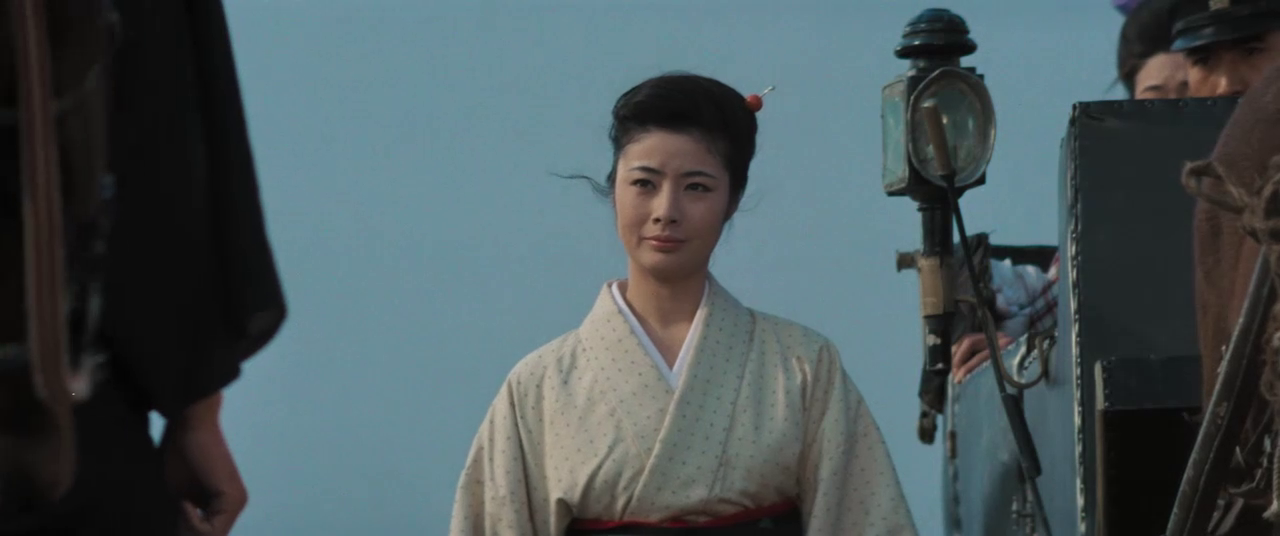
Yet, what sets Red Peony Gambler 3: Flower Cards Game apart from the two previous narratives is that Suzuki and Kato imply that the only act that can change a subject’s stance within the societal field is an act of radical kindness – a sign of the Other’s love (ninjo). Only an act of love can truly invite a subject to purify himself of the poison of the capitalistic fantasy and break out of the seductive prison of cyclic enjoyment (Narra-note 3).
The way Tai Kaito open his continuation of Oryu does not merely offer a narrative variation for the spectator, but also allows him to distance himself stylistically from Kosaku Yamashita and Norifumi Suzuki (Cine-note 1). Rather than seeking to please the spectator by simplifying the spatial dimension and flattening the physical space in which the characters reside, Tai Kato elegantly plays with perspective and framing to create a more complex but equally pleasing visual fabric. He litters his composition with dramatic shot-perspectives, creates pleasing frictions and visual sequences by utilizing the cut more regularly, and exploits traditional Japanese architecture to deliver effective frames within frames and heighten the impact of the compositional lines that structure the shot. Kato, furthermore, creates many pleasing visual moments by effectively positioning characters within the frame.
Tai Kaito does, however, retain the compositional aim that organized both Yamashita and Suzuki’s compositions: the adoration of Junko Fuji. Yet, Kaito is more subtle in his visual adoration by integrating close-ups of Junko Fuji’s face more elegantly in the visual fabric and by reducing the time spent to frame her facial lines.
If we compare the compositions of the three films and their respective narrative structures, we can easily discern that each films’ visual fabric supports the aim determined by the narrative’s structure. While Kosaku Yamashita’s compositional choices allow him to adore ninkyo through the figure of Oryu and persuade the spectator to identify with this patriarchal moral position of giri, Suzuki installs a narrative gap between the spectator and Oryu to visually demonize the capitalistic fantasy. Tai Kato’s narrative plays with a similar narrative gap, yet neither to adore Ninkyo nor to criminalize the capitalistic thirst. Instead, he shies away from generating tension and refuses to visualize the shocking excess of violence to stress, with visual elegance, the importance of ninjo within the societal field.
With Red Peony Gambler 3: Flower Cards Game, Tai Kato delivers an impressive visual experience that develops the themes of the series in a meaningful way. Yet, Kato’s a-dramatic framing of the third chapter of Oryu’s tale might not be to everyone’s liking. Rather than delivering another heroic celebration of Ninkyo or dramatic demonization of the capitalistic fantasy, Tai Kato delivers a more emotionally subdued exploration of the importance of ninjo within the societal field.

Narra-note 1: We must remark that Otoki’s choice to cheat as a gambler and enter the societal field of yakuza is not a coincidence. Why does she target men? The answer lies in Otoki’s relationship with the father of her child.
Narra-note 2: The influence of capitalism on Kinbara’s logic is visually echoed by the western interiors that he inhabits and the western clothes he adorns himself with.
This visual contrast creates a false image that the capitalistic corruption was imported from the West. It would be more correct to state that, as very societal system seats the seed of capitalism in its symbolic and subjective soil, the push to westernize in the Meiji period allowed it to fully blossom.
Narra-note 2: Otoki and Okimi’s signifiers confront Oryu with the female ideal of marriage and motherhood she consciously renounced by inscribing herself in the system of moral fatherhood.
Narra-note 3: Some spectators might argue that the dynamic between Oren and Kasamatsu in Red Peony Gambler: Gambler’s Obligation resembles the one between Otoki and Kimbara. Yet, there are two radical differences to note. The first difference is that Kasamatsu did not know about the capitalistic thirst that seduced Oren to the way of cheating, while Kimbara wants to enlist Otoki precisely because she is good at cheating. The second difference is that Kasamatsu approached Oren via the perverted assumption that, as man, one can use the female object as one sees fit, while such assumption is absent from Kimbara’s logic.
Cine-note 1: One of the first visual highlights in the composition is when Oryu formally introduces herself to the Nishinomaru family. By elegantly alternating between the two different narrative spaces, Tai Kaito does not merely reveals the disparate impact of the signifier, but emphasizes the split between the formal space structured by the code of the traditional Other (giri) and the subjective field that lies repressed behind this empty symbolic mathematics (ninjo).
 psychocinema
2 Comments Add yours