While the outlaw and the societal misfit haunted the visual field of Japanese cinema well before the second world war (e.g. the image of the image of the drifter within the Matatabi-mono), it was only in the early sixties that these various images crystallized and melted together into image of the honourable yakuza. The Ninkyo genre, fuelled by a nostalgic craving, utilizes the setting of prewar modern Japan to stage the triumph of patriarchal values (e.g. ‘giri’ and ‘inase’) over the capitalistic reflex that was perverting the old ways.

In the political turmoil of the late sixties, however, the patriarchal quality of the societal field came under fire and the nostalgic idealization of these values within yakuza films lost their appeal. Instead of seducing the Japanese other with a reflection of an impossible idealized past, yakuza films started to explore the brute societal reality of the post-war societal field. Within this shift from heroism to anti-heroism, Kinji Fukasaku’s Sympathy For The Underdog stands out as one of the transitional masterpieces, confronting the spectator, in a shocking way, with the inherent destructive finality of subscribing to the Ninkyo ideal. To put it differently, in the Japanese post-war societal field – as the dust of the second world war slowly settles, only those yakuza who anchor themselves in the mundane Other by radically subscribing to the capitalistic logic can survive.
Fukasaku investigates this nihilistic finality of this ideal in Sympathy For The Underdog by contrasting the differences between Masao Gunji (Koji Tsuruta) and his loyal drifters (Ozaki (Asao Koike), Shark (Hideo Murata), Shotgun (Harumi Sone), Old man (Toru Yuri), and Noboru Kudo (Noburo Ando)) and the enormous Daitokai corporation, the anonymous army of suits led by Eisaku Oba (Asao Uchida) and his right-hand Shigeru Kaizu (Tadao Nakamura).
The opening of Sympathy For The Underdog, which sketches out of Japan’s post-war criminal reality – the fiction’s non-fictional frame – foreshadows Masao Gunji’s alienated position within a vastly changed field of organized crime. Within these expository moments, the spectator can infer that while the early post-war societal field, which swirled around a dark economical void, caused an explosion of conflicts between syndicates, these gang-wars culminated, as the years went by, into a firm symbolic power structure (General-note 1). Yet, this structure did not arise from the violent clashes as such, but from the shrewd way by which certain syndicates, draping themselves with the cloth of corporate legality, firmly etched their capitalistic claws within the ravished economical field.
It is the confrontation with this consolidation of power and the massive capitalistic threat that in no way can be counter-acted that causes ex-convict Gunji to propose his loyal drifters to ‘escape’ to Okinawa, the only place in the Japanese archipelago where a hierarchical structure between syndicates has not yet been truly solidified, and forcefully grab some turf (General-note 2). The absence of such structure is simply because Yakuza cannot legally operate within the boundaries sketched out by the mundane Other of the law in Okinawa, this cultural field shaped by American consumerism and capitalism.
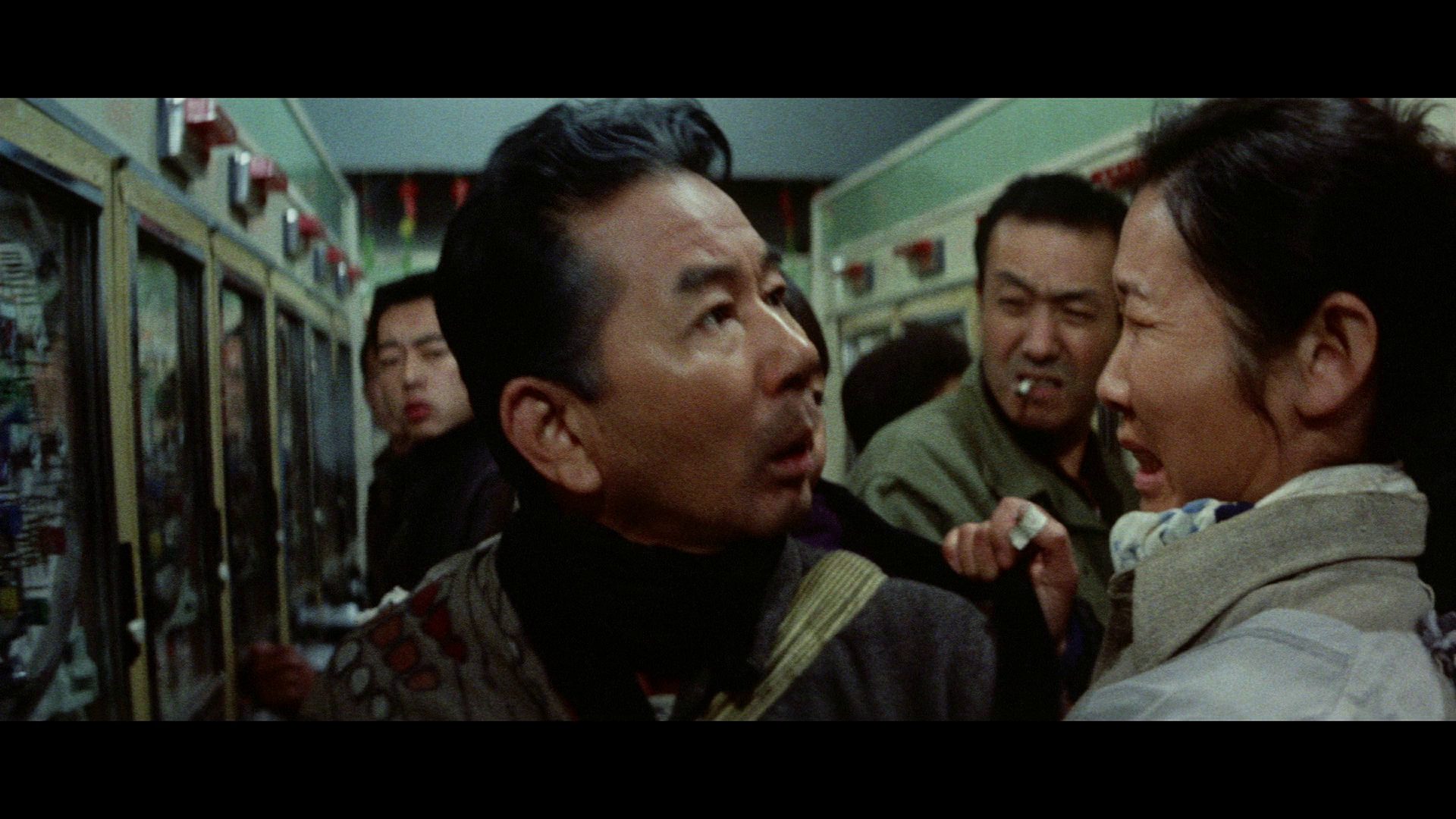
In Okinawa, Yakuza can only exert some control over the societal field from the shadows cast by the mundane curtain of the law. Haderuma (Rinishi Yamamoto) exploits Naha’s waterfront and Gushiken (Kenjiro Morokado) controls the bars, cabarets and whorehouses in the nightlife district. Yet, the fact that yakuza must operate within the blind spots of the law is best illustrated by Gushiken’s whiskey smuggling operation. Thanks to broker Kusakabe (Kaku Takashima), Gushiken can obtain whiskey from various American bases to sell them for huge profits to all the dens on their turf.
Okinawa, this place not yet subjected to the capitalizing reflex of the mainland Japanese yakuza, forms the ideal place to stage the nihilistic finality of the Ninkyo ideal. In this respect, the structure of Sympathy For The Underdog turns around two simple questions: How can Gunji and his loyal drifters upset the rather weakly sewn hierarchal network of yakuza that structures Naha from the shadows and acquire turf for their own gang? And can they, upon acquiring their place within this criminal fabric, deal with the forces that seek to re-organize the criminal Other?
The two questions are deeply interconnected because Gunji and his gang, by perforating the shadowy criminal Other and exposing its frailty by seizing turf, sets the whole aggressive imaginary dynamic in motion. The other criminal forces do not merely respond to squash the threat Gunji and his drifters pose – he can castrate them and take away their position of criminal power, but to grab the opportunity to confiscate or augment their position of power within the fabric of the Okinawan criminal Other.
It is important to underline that for Gunji the importance of acquiring ‘turf’ is not merely spatial, but symbolic. It is not simply about putting a block or two under one’s control, but to seize a material space that one can give a signifier, a name, a designation. Gunji and his crew can, in other words, only inscribe themselves in the symbolic fabric of criminal Naha and assume their right to symbolically exist via the violent inscription of a name.
While Gunji and the others have a real presence – a bodily presence, a sack of flesh and meat – and an anonymous imaginary presence – a face fleetingly perceived while wandering the streets of Naha or while hitting the nighttime bars, they do not symbolically exist within the local Other. Without being able to symbolically designate a space within the physical real of Naha, this melting pot of Americans, Ryukyuan and Japanese, Gunji and his gang are radically ‘aliens’, a-symbolic foreign elements that only have the potential to rewrite the societal equilibrium by forcefully inscribing themselves in the criminal Other’s flesh.
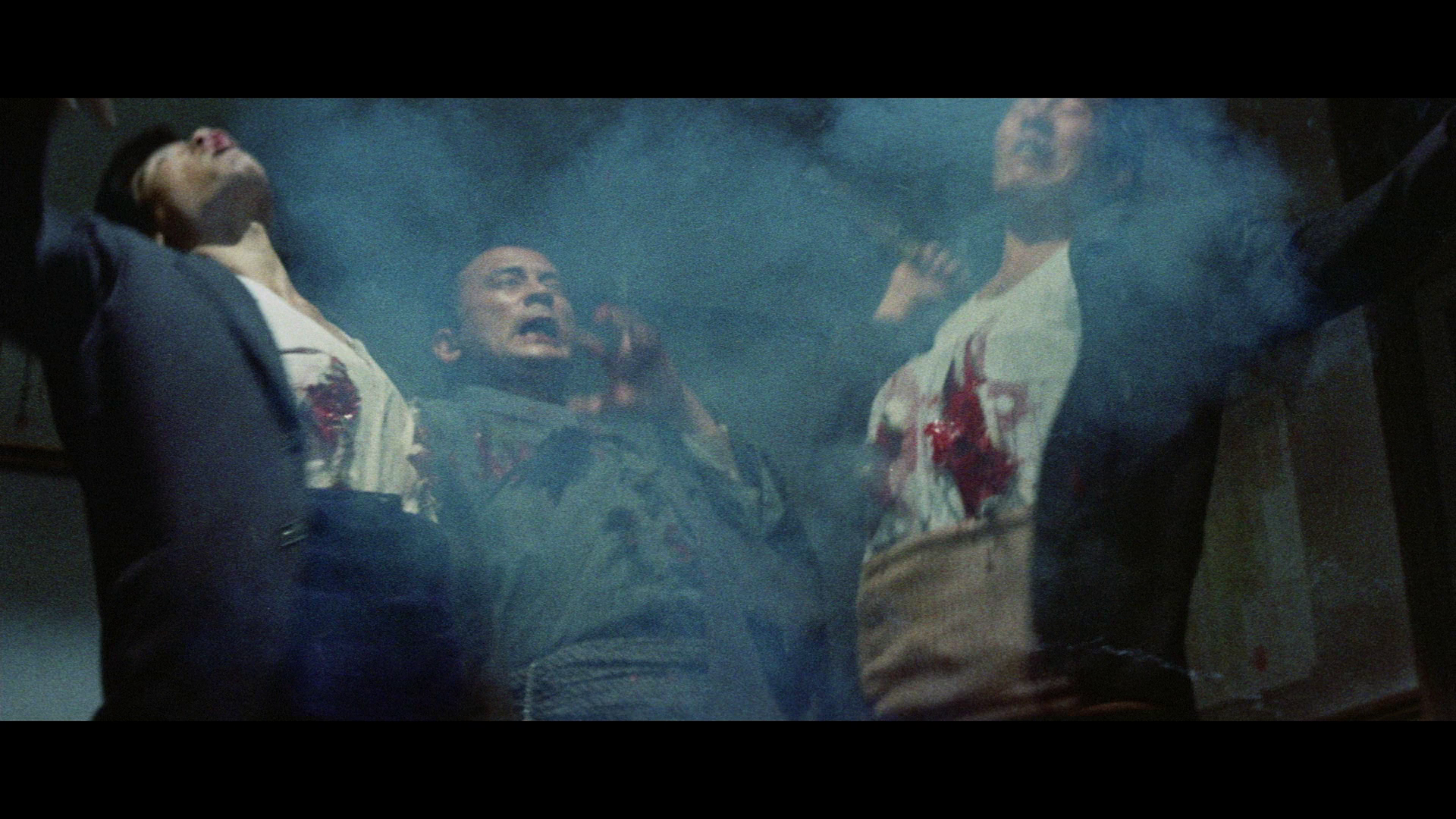
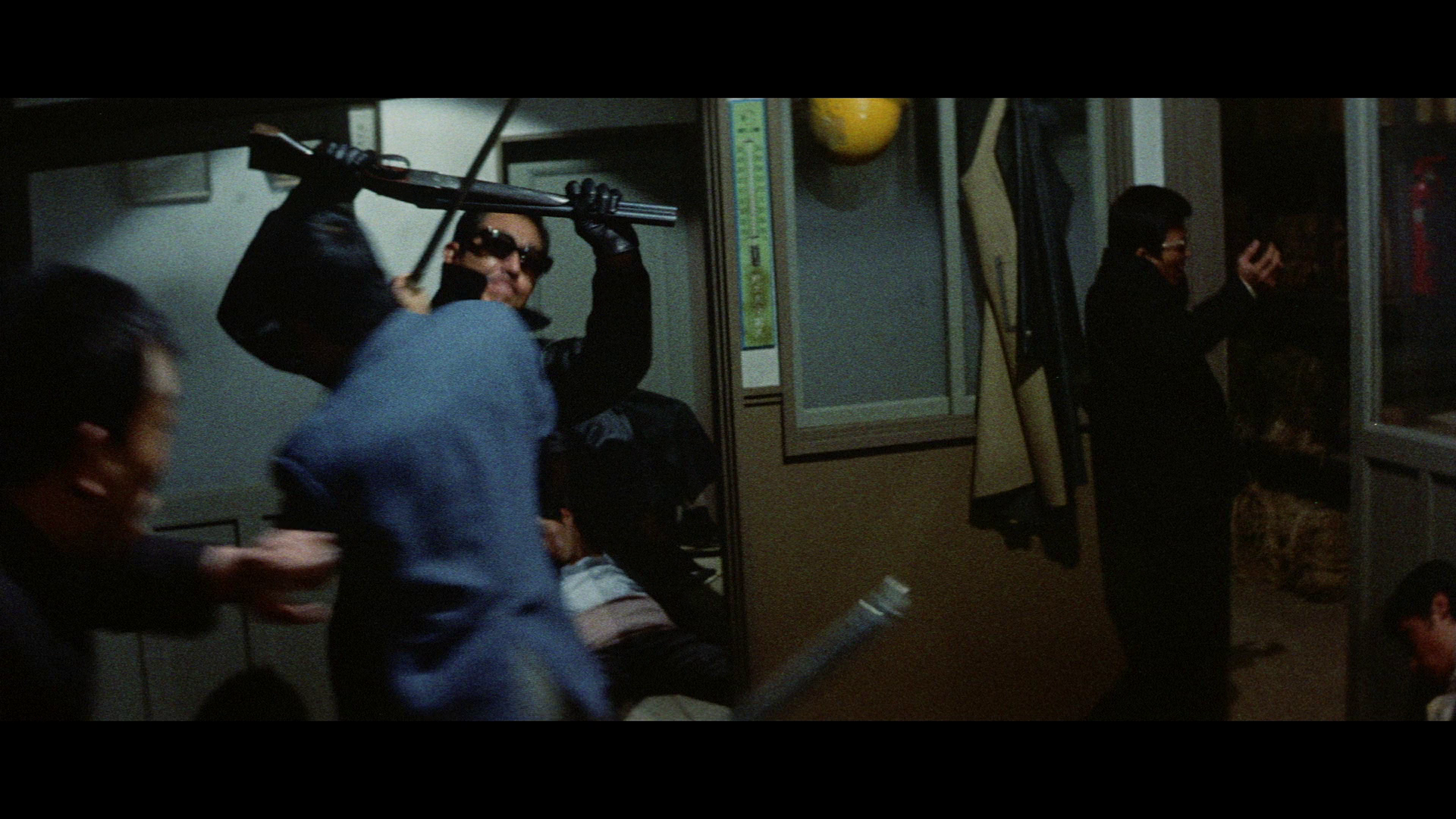
As the narrative turns around acquiring a spatial area to name within the criminal Other, the spectator can expect shoot-outs, brawls in small alleyways, verbal swordplay with threatening signifiers, and imaginary phallic parades. Yet, Fukasaku structures his narrative in such a way that the spectator is left guessing about which turns Gunji’s narrative will take. As a result, the spectator is not only kept on the edge of his seat throughout the entire narrative and subjected to a few surprising narrative twists, but can only be shocked by the deeply nihilistic violent finale.
The sudden shift to nihilism, which turns the finale into the highlight of the film, only impacts the spectator so deeply because Fukasaku enamours the spectator with a phallic parade, a concatenation of cool bursts of violence that titillates the spectator’s phallic fantasy – the power-fantasy.
The phallic dimension of Sympathy For The Underdog is function of the cold calculated presence of Gunji, seductively brought to life by Noboru Ando. Gunji is introduced to the spectator as a phallic character, a character who does not merely ‘know’ he possesses the phallic object, but also knows how to wield it in the societal field to manipulate the criminal other and acquire the power and influence that is ‘rightfully’ his. What allows Gunji to violently reshuffle the criminal Other is the poker-faced manner by which he emanates the imaginary possession of the phallus to the threatening criminal Other – he forcefully demands, without desire. Even when death creeps up on him, his sunglasses gaze with cool detachment, his stoic facial expression reverberating his unfearful determination (Narra-note 1). The enunciation “You’ve got guts” which the Okinawan criminal Other utters to Gunji, is nothing other than an affirmation of Gunji’s possession of this non-existing phallus. Gunji’s character, furthermore, echoes the fact that the ideal of Ninkyo is phallic in nature, a set of coordinates that makes a subject desirable for the Other.
In this sense, the finale of Sympathy For The Underdog does not only stage the bankruptcy of the ninkyo ideal in the post-war societal field, but also functions as a brutal ripping of the imaginary veil that hides the absence of the phallus. The final dance of penetrating knives and bullets, this orgy of vengeful jouissance that ravishes the symbolic, ultimately offers the spectator a disheartening glance at his very own lack (Narra-note 2). The spectator, who fantasized himself in relation to film’s object of desire, i.e. the cold-blooded Gunji, must endure this violent disrobing and will feel the aftershocks of this revelation long the credits have finished.
The narrative of Sympathy For The Underdog is brought to life with moody atmospherics. The moodiness that pervades the unfolding of Gunji’s story is not only function of the decorative jazzy musical accompaniment, the emphasis of certain diegetic sounds (e.g. the wind, the dull clash of the cue stick with the balls, … etc.), and the harmonization of the visual rhythm with the musical flow, but is also supported by integrating moody visual elements (e.g. the wind playing with the leaves, the black sunglasses reverberating Gunji’s emotional stillness, a pattern of gunshots flashes behind the window’s curtain, … etc.), creating atmospheric contrasts with colour and light/shadow, and by fluidly interweaving more artistic shot-compositions into the visual fabric.
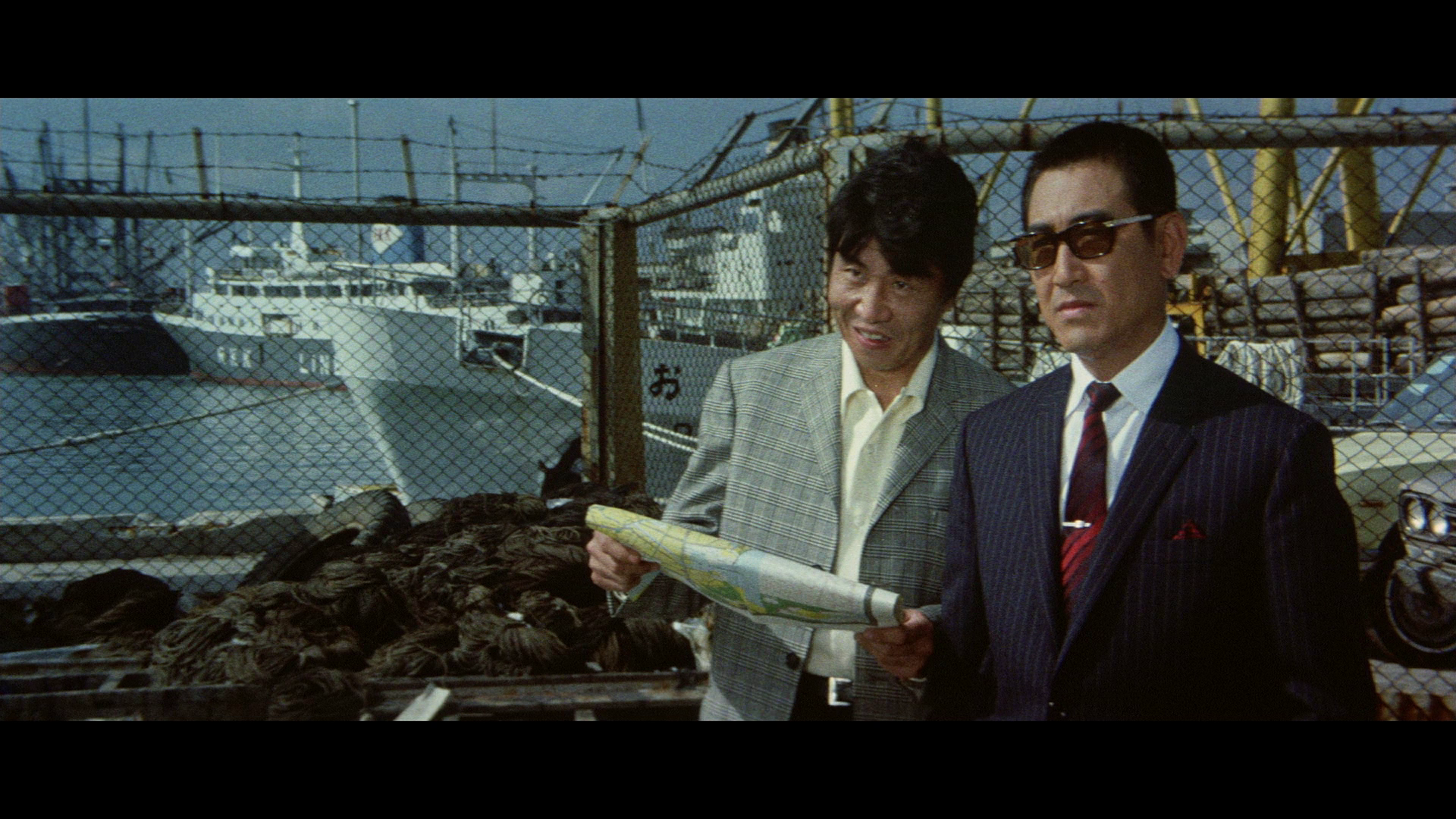
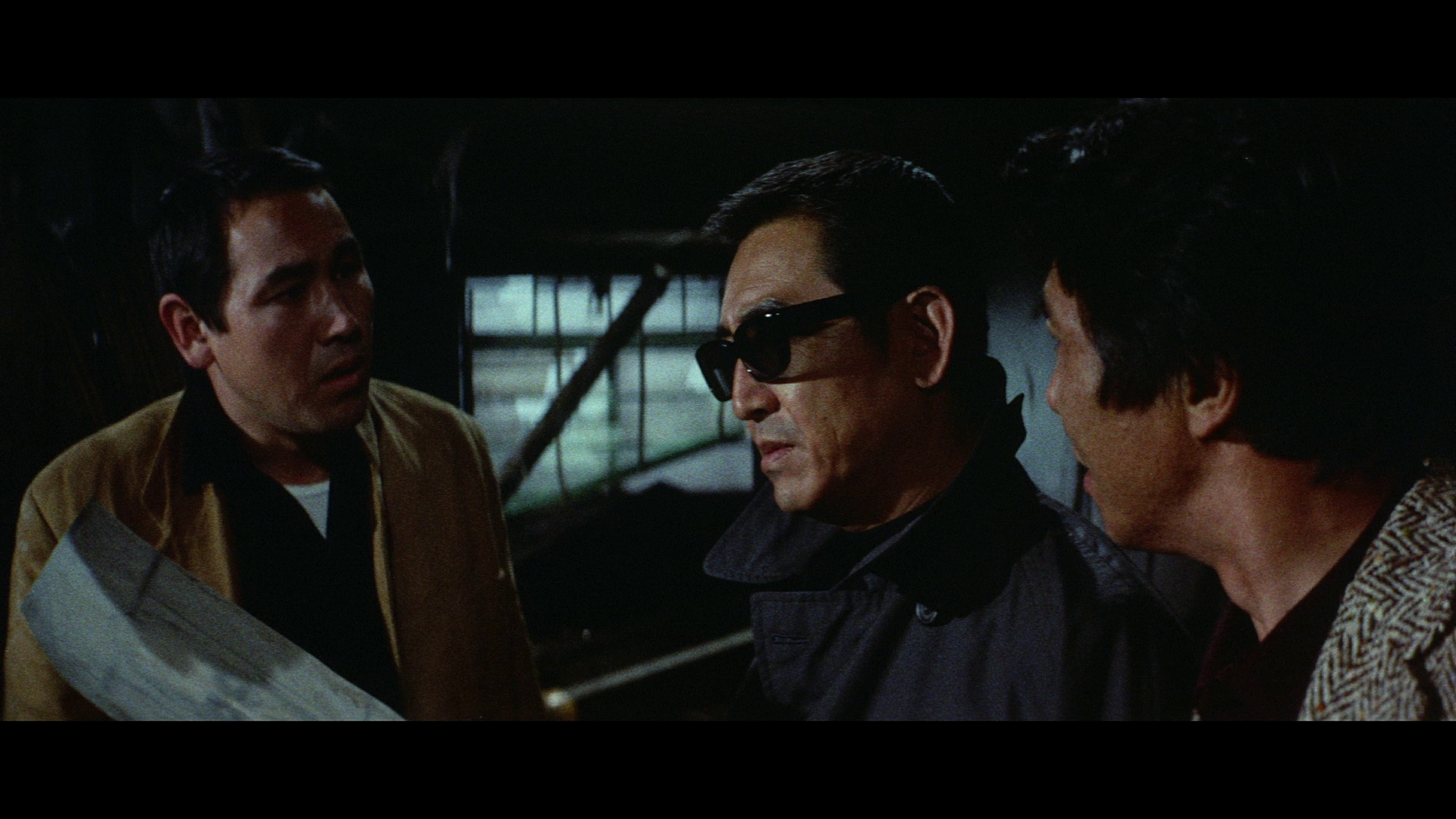
The visual pleasure delivered by shot-compositions is either function of Fukasaku’s thoughtful patterning of characters within the visual frame. (e.g. the black suits surrounding Oba, the Hamamura gang members surrounding the wounded Kudo, three faces lining up … etc.) or by dynamically using expressive camera-perspectives and vivid colour-contrasts.
Thus, rather than meeting the Fukasaku that strictly emulates a documentary-style to give the unfolding of this narrative an engaging realism, we encounter in Sympathy For The Underdog a Fukasaku who seeks to deliver some visual poetry, who interweaves poetic elements into his fabric to guide the mood and deliver fleeting moments of scopic pleasure (lighting-note 1).
However, Fukasaku’s visual fabric is not without its documentary-like elements – this transitional narrative introduces a director in transition. The use of still-shots, the concatenations of documenting photographs, is not only a precursor of the rough documentary style that bursts forth in all its glory in his celebrated series Yakuza Papers, but also gives the moody visual flow an echo of realism. The surges of shaky framing and snappy dynamism, which bring the more action-driven moments alive, have a similar effect, emphasizing the rough and bleak apoetical reality of gang violence.
Musical pieces give these moments of crude realism quite often a dark poetical touch, reverberating the forlorn and nihilistic quality of violence as such. Or, to put it differently, the musical decorations come to poetically echo the a-poetical truth of the excess of violent enjoyment. The violent clash between two different societal dynamics – i.e. the field of imaginary rivalry organized by the prescriptions of Nikyodo and the field of opportunistic greed fuelled by capitalistic perversion of desire – can only produce death, beautiful death.
Sympathy For The Underdog is not merely a yakuza classic, but a masterpiece of Japanese cinema. What makes this transitional narrative in the yakuza genre – from the fatherly ideal to the excess of jouissance – so effective in satisfying the spectator is its fertile metaphorical dimension. This is not merely a film that speaks to those who felt lost due to the rapid shifts that upheaved the Japanese societal field after the second world war, but continues to speak to those who feel out-of-place, who feel, like Gunji, unsuited for this world of ‘criminal’ suits.

Notes
General-note 1: The spectator should know that, at the time of the film’s release, Okinawa was still under American control. This reality is visually echoed by Fukasaku by interweaving shots of alphabetic writing adorning buildings and foreigners populating the streets of Naha in his composition.
Narra-note 1: Gunji’s cool-blooded presence is ultimately nothing more than a phallic facade. In other words, he does not have the phallus, but merely believes that he possesses it. It is, in fact, by letting this mistaken belief guide his actions that he often puts himself in mortal danger and needs to saved.
What his crew-members aim to save is – and this is important – not merely Gunji’s body, but his phallic function. He is, in a certain sense, the erected object that provides organisation and sense by ejaculating signification.
Narra-note 2: Some spectators might be confused by the final twist. From a psychoanalytical perspective, Gunji and his drifters’ suicidal act of vengeance function as a passage a l’acte. The appearance of the Daitokai in Okinawa confronts Gunji with the following unescapable truth: there is no material place within the post-war Japanese societal field left to freely inscribe one’s name (Symbolic) and find support for one’s criminal ego (imaginary).
It is in the void of this suffocating truth that Gunji and his drifters plunge themselves in the finale to brutally realize it – a radical identification with the lack of a symbolic place. One could even argue that this nihilistic finality animated Gunji from the very beginning. Gunji’s phallic facade, in truth, veiled his desire for his own annihilation and realize the unvocalized truth of a past forever lost.
General-note 2: As we have argued elsewhere, the law that symbolically structures the yakuza syndicates does not attempt to subdue the imaginary dynamic of rivalry, but merely tries to guide it. This law does not supress the imaginary sense of rivalry and honour, but etches out a ‘legal’ area where both are allowed to blossom in, often with disastrous effects.
While the yakuza law deserves a deeper analysis, we can nevertheless state that it instrumentalizes the dual opposition between respect and disrespect.
Lightning-note 1: Fukasaku’s play with light and shadow, of course, helps the patterning of faces or characters attain more impactful visual tensions.
 psychocinema