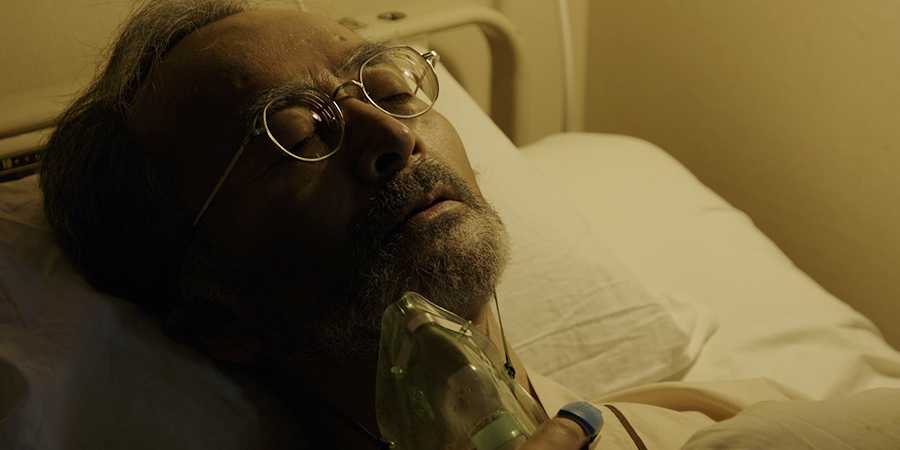
It seems that the societal field keeps on giving Masao Adachi, Japan’s most well-known activist director, material to transform into a filmic expression. In 2022, he utilized the shocking assassination of Shinzo Abe by Tetsuya Yamagami to create a film that confronts the spectator with the hypocrisy of the political Other, and, in 2024, Satoshi Kirishima’s death-bed confession gave him material to question the Japanese Other.
Yet, this time, Masao Adachi is not the only director that took the chance to bring Kirishima’s story to life on the silver screen. Banmei Takahashi, who worked together with Koji Wakamatsu in the seventies, also crafted a creative interpretation of Kirishima’s escape in his film called I Am Kirishima (2025). Given that both films deal with the same topic and seek to emphasize the humane logic of Kirishima as subject and his revolutionary stance, we cannot avoid drawing some comparisons between both films.
[For readers who desire some more context about the East Asia Anti-Japan Armed Front (EAAJAF), we gladly refer to our review of Takahashi’s I Am Kirishima (2025).]
The first thing that the spectator will notice is that both films have a different narrative structure. While Banmei Takahashi’s film opts for a strict chronological recounting of Kirishima’s escape within the societal Other, Adachi plays more freely with time, utilizing the evocative quality of the signifier to sketch out the political beliefs of Kirishima and the East Asia Anti-Japan Armed Front (EAAJAF). Adachi’s introductory sequence is a concatenation of evocative fragments that explore the formation of the Scorpion cell and highlights certain salient elements of the EAAJAF and a few time-jumps to introduces the spectator to the unwavering political conviction of Kirishima in his final moments – ‘We will with that resolve keep fighting. We even after that continue attacking. We without killing people continue our fight. Yes, we were desperately striving to fight’.
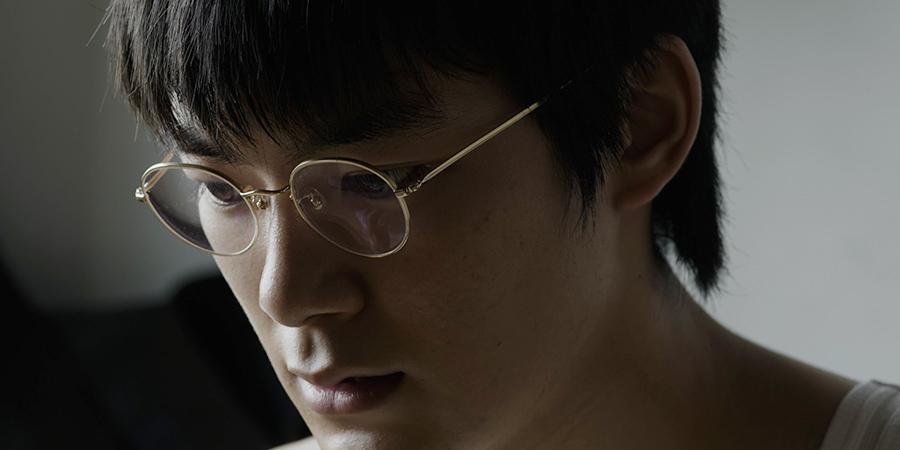
While Adachi’s film continues to alternate between Kirishima as a wanted man and Kirishima on his deathbed, the overall structure becomes less evocative after the introductory sequence, becoming a more chronological exploration of Kirishima’s escape from the Other of the law within the Other blind to its own transgressions. Adachi’s concern to sketch out a more psychological portrait of Kirishima makes him integrate a few phantasmatic sequences (e.g. the older Kirishima meet his younger self at a riverbank, Kirishima meeting his arrested comrade Hisaichi Ugajin at his apartment, … etc.) to deepen the emotional dimension of Kirishima’s unstable subjective position, an ego-instability born from the clash between the radical erasure of his name, the assumed guilt of having blood on his hands, and the lingering presence of his revolutionary conviction/desire.
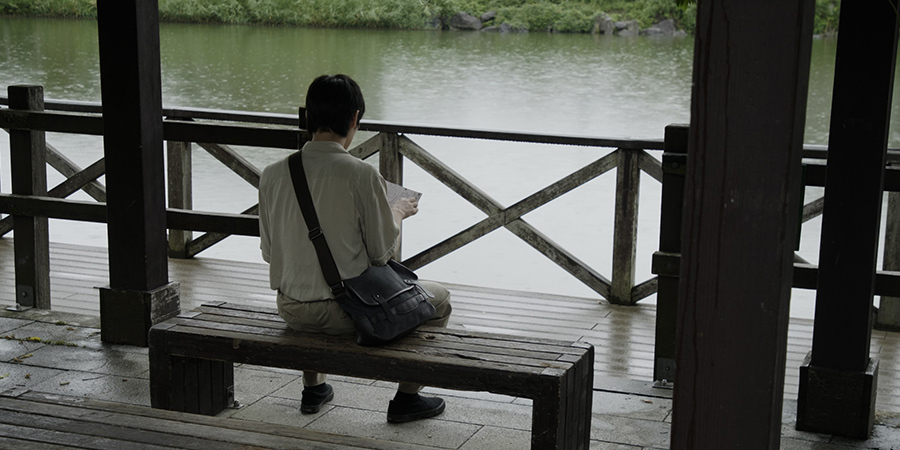
One element that Adachi, in contrast to Takahashi, introduces to the spectator is the manual Hara Hara Tokei (Narra-note 1).This manual, written and published by the wolf cell of the EAAJAF in 1974, gave an overview of their ideology, explained guerilla tactics and explained how to manufacture and set-up bombs. What was also included in this manual were guidelines on how to blend in with ordinary citizens and avoid being spotted as an extremist (General-note 1). Adachi introduces this manual in Escape, so that he can emphasize that Kirishima, to escape the conservative forces of the Other and blend into the mundanity of the societal field, followed the principles stipulated in the Hara Hara Tokei – i.e. “to life by blending into the masses”.
Kirishima’s escape is, as Adachi introduces it, synonymous with keeping the revolutionary fight alive, in keeping the slash from which the capitalistic truth of exploitation can ooze out open. Kirishima’s escape does not merely prove his determination to the cause, but also underlines his refusal to yield to the repressive thirst of the Societal Other. Moreover, his flight from the capitalistic-nationalistic Other ends up supporting his belief in the need to confront the Other with his exploitative transgressions, committed as imperialistic power and as post-war conservative capitalistic nation, and force the political and corporate Other to make amends for their sins.
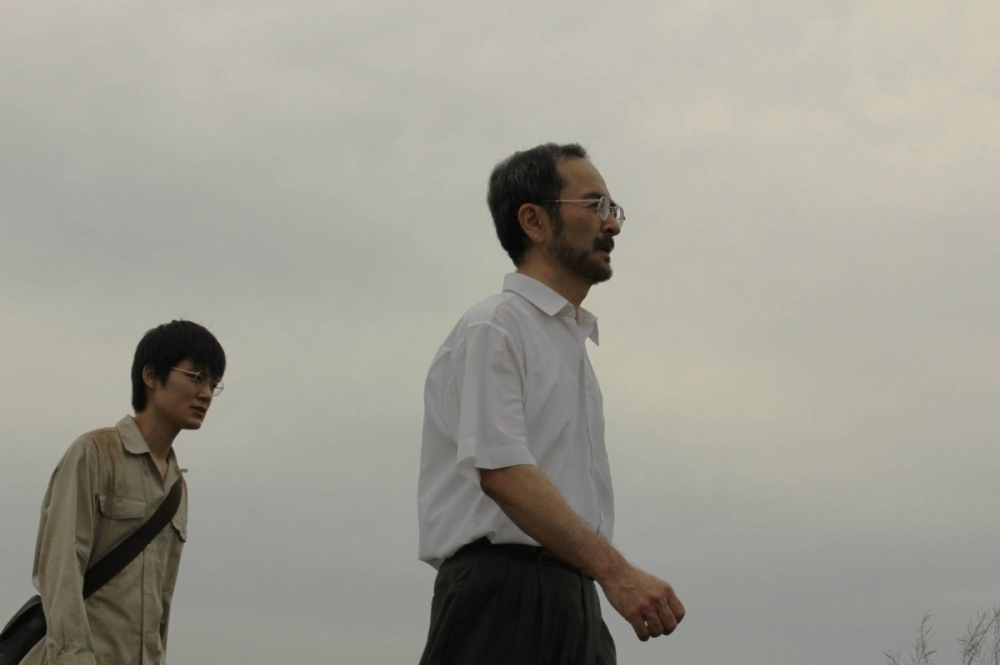
The formation of the EAAJAF was a response to the continued discrimination by the political Other against the Ainu and Ryukyu, their oppression of the indigenous Taiwanese, and the capitalistic abuse of workers in China, Korea, and other Southeast Asian countries. They targeted Japanese corporations that colluded with the military and exploited the blood and sweat of Asian people for profit. For the members of the EAAJAF, the crimes committed by war criminals were continuous with the way companies supported the capitalistic invasion and help organize the oppression of Asian workers within the Japanese imperialistic system, as organized around the image of the emperor.
In 1974, however, the bombing of Mitsubishi Heavy Industries’ HQ (August 30, 1974) by the wolf cell went fatally wrong, causing damage beyond their expectations and leading to many casualties. This miscalculation was, as Adachi underlines, a terrible mistake that put the aim of the EAAJAF into jeopardy: their desire to emphasize the repressed signifier concerning the crimes of exploitation in an explosive manner to arouse a sense of guilt within the societal Other and force the political and corporate Other to take responsibility for their imperialistic transgressions. Adachi shows, in a rather oblique way, that the bombs by EAAJAF were not aimed at the building or the people who worked there, but at what these corporations represented: the capitalistic logic that structures the societal field and the dynamic of exploitation that is the result of the pursuit of capital.
The labelling of the members of EAAJAF as mere ‘criminals’ by the Other brutally undercut the veracity of their signifiers and pushed them into the reach of the oppressive hands that shape the societal field. Yet, despite this devastating and destructive setback, the Scorpion cell decided to continue the fight, bombing corporations (e.g. Kajima, Hazama, …) in accordance to the principle of ‘never killing anyone’ in the hope of breaking the Other’s closed eyes open to the misery that it, as capitalistic-nationalistic machine, produces.
While both films emphasize that the attacks by the EAAJAF were acting-outs to force the Other to assume guilt concerning the exploitation of South-east Asians during its imperialistic past and its nationalistic present, Adachi’s film also evokes that the explosions also aimed to be brutal acknowledgements of the suffering caused by the capitalistic machine. What escapes from the fire of rage with the ongoing political attempts to repress their crimes and transgressions are embers of recognition, fiery indications at what the societal field must do – repent and change.
In his escape, Satoshi Kirishima, of course, gets confronted with struggles close to his revolutionary heart. During his time at Obayashi corporation, under the name Tamotsu Yoneda, he is, one night, brutally confronted with the continued subjective effects of imperialistic ideology and seemingly watered-down post-war nationalism on Japanese subjectivity, i.e. the dismissive attitude towards Zainichi and other nationalities.
Later, when he has settled down at Iizuka construction, under the name of Hiroshi Uchida, he has a fall out with some businessmen after hearing the news of the Japanese Red Army’s hijacking at Dhaka airport in Bangladesh. This sequence reveals how revolutionary acts are undone of their political aim/message by being structurally subjected to interpretation – a businessman turns the revolutionaries into secret capitalists by lamenting the ease by which they can make a fortune – ‘shouting revolution for quick cash’, a woman reduces them to mere criminals and hopes, full of pleasure, for the Other to radically erase their message. In fact, Adachi shows that those who fully accept the capitalistic Other, allowing it to completely shape their subjectivity, do not merely struggle and often radically refuse to see what remains repressed within the political and societal Other (Narra-note 1).
While Adachi’s film is more cerebral in nature than Takahashi’s – putting more emphasis on the signifier, he does succeed in sketching out the destabilizing effect of being forcefully alienated from one’s own name and identity within the societal field in a touching manner. It is, in fact, due to Adachi’s emphasis of the signifier that he can show that the only reason why Kirishima succeeded in counteracting the weight of his own repression and, thus, protect his own escape is by holding on to what forced him into hiding: his belief that the Other must make amends for its exploitative crimes and the assumed need to atone for the EAAJAF’s tragic failure.
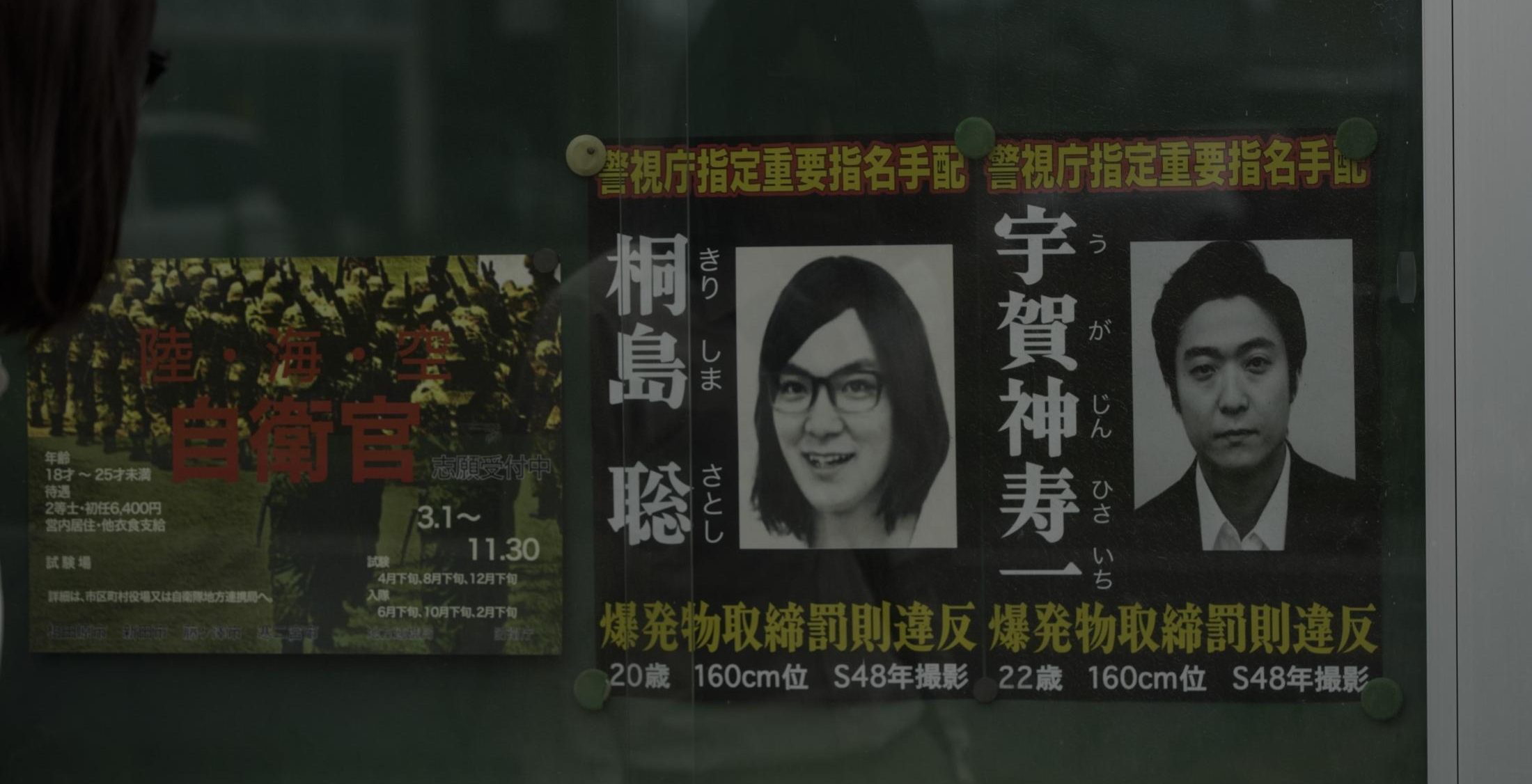
Yet, Escape also underlines that, despite erasing one’s name and taming one’s revolutionary speech, one cannot completely elide one’s ego – one’s body-image – from the societal field. Kirishima always ran the risk of being recognised, his mugshot continually reminding the other of his ephemeral youthful smile. So, what protects him from tipped off to the police? In Adachi’s view, nothing other than his humanity, that what animated his revolutionary desire and organized his interactions with the other around him (Narra-note 2).
The composition of Escape offers a nice balance between rough dynamism and a cleaner manner of framing. By leaning in both styles of composition, Adachi succeeds in evoking the style of documentaries while also sneaking in some striking shot-compositions. The documentary-like roughness emphasizes the fact that this fictionalized account has a factual basis. The use of a cruder style of filming and the more energetic way of composing, moreover, gives the phantasmatic recounting of Kirishima’s escape more emotional depth.
Visual dynamism and cutting are combined to great effect to turn the evocative imagery into a frame that amplifies the signifier – the political signifier of EAAJAF. In fact, Adachi’s desire to tell Kirishima’s story aims at nothing other than reviving this repressed signifier within the societal field – make revolution through cinema, eiga kakumei. The Japanese political Other has succeeded in erasing this uncomfortable imperialistic truth of exploitation – young adults know little about the bombings and the motives behind it and curriculums at school protect the ideological frame by remaining ‘objective’.
The energetic anarchistic piano-pieces do not merely translate the act of rebellion against the Other in a musical form but also instils a sense of urgency into the secretive atmosphere that marks the interactions between the members of the EAAJAF. Adachi relies on jazzier musical pieces to evoke the conflicted mood of his protagonist and his comrades after the catastrophic bombing of Mitsubushi Heavy Industries’ HQ and to decorate the subjective impact of the implosion of the EAAJAF by the police arrests (Sound-note 1).
Our emphasis on the role Adachi’s composition plays in heightening the emotional impact of Escape runs the risk to overshadow the element that Adachi merely seeks to amplify: the performance of Kanji Furutachi. Without his pitch-perfect performance, Adachi’s exploration of Kirishima’s troubled subjectivity would never been so engaging and emotionally impactful.
Masao Adachi’s Escape forms the perfect companion piece to Takahashi’s I Am Kirishima (2025). He delivers a beautiful and affectionate piece on the troubled subjectivity of a subject who choose to escape, erasing his name from the societal field, to avoid being apprehended by the police. The film is not only a must-watch because it sketches out Japan’s lesser-known revolutionary past, but also because it emphasises the radical need for voices who demand societal change.

Notes:
General-note 1: Adachi also introduces the omamori, the cyanide capsules to be used to commit suicide when caught or tortured by the police. The use of these omamori in time of need also served as a symbolic act to emphasize their rage and unwavering determination.
General-note 1: What led to the mass arrest was the authorities’ discovery of rough drafts to claim responsibility for bombing of Oriental Metal and the Korean Industry Economic Research Institute (19 April 1975) in the trash outside their hideout.
Narra-note 1: What ousts these people at the bar as subjects-of capitalism is the unvocalized, yet sensible importance of money. The only thing they desire is that the radical and revolutionaries keep their violent hands of the capitalistic machine – the machine that, once it regains its speed, will undo their financial worries of the parasitical scavengers.
Narra-note 2: Adachi touches upon the fact that while the EAAJAF and the Aum Shinrikyo are both labelled as terrorists, the logic of their violence is completely different. While the former aimed to change societal field and the political Other for the better, the latter, relying on a mish-mash of religious concepts sprinkled with a large dash of paranoia, merely aimed to destroy and exploit their fellow man. The logic of the EAAJAF was, in contrast to the logic of the Aum Shinrikyo not poisoned and fuelled by transgressive enjoyment.
Sound-note 1: The voice-over is used by Adachi to offer the spectator some contextualisation concerning the societal field and the EAAJAF.
 psychocinema
One Comment Add yours