With V. Maria, Daisuke Miyazaki (Tourism (2018), Videophobia (2019), Plastic (2023)) returns to the exploration of the crossroads between music and the ongoing process of the subject’s coming-into-being. Yet, while he delivers an enjoyable narrative with some touching moments, he is unable to rely on those narrative elements that transformed Yamato (California) (2016) into such an impressive and convincing debut.

Miyazaki latest film centres on Maria (Hina Kikuchi), whose daily rhythm is deeply shaken by the sudden passing of her mother. One month later after her passing, she finds a path to work-through her loss and guide her coming-into-being as subject by discovering, among her late mother’s stuff, a box full of merchandise of Japanese visual-Kei rock-metal bands (X Japan, … etc.), an unplayable demo tape, and a diary. Maria decides to pursue the hitherto hidden signifier-couple – Guilty and Maria – and approaches Hana (Mayuki), whose bobbing Hide doll signals her love for Visual-Kei. With the help of Hana, Maria enters the V-Kei scene full of bangya (band gyaru) to try and elucidate the relationship between the legendary band Guilty, who created and performed the song Maria, her mother’s act of naming her Maria, and the absence of her father.
In V. Maria, Miyazaki follows a subject as she tries to elucidate her mother’s opaque desire and discover, if possible, the narrative of her birth. For Maria, the riddle of who her mother as subject was is synonymous with the question of her desire, the desire that led to her birth. Yet, this kind of search – a search to make the truth of a beloved one transparent – is structurally bound to fail. It is therefore not surprising that Miyazaki’s film illustrates how the faithful following of the signifier’s trace within the Other, in many cases, does not deliver what one seeks, but produces what one needs.
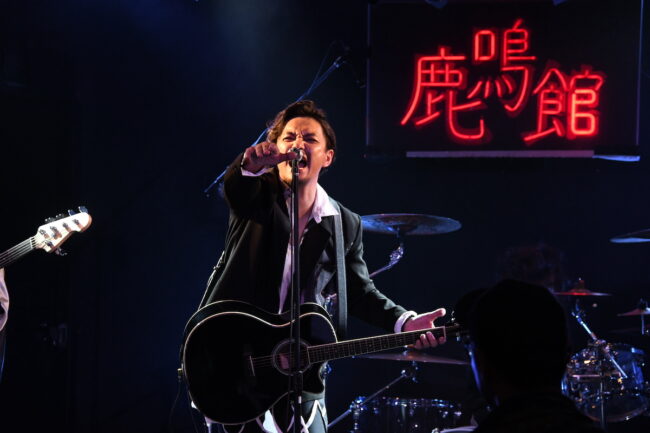
Walking the path of the signifier within the societal field produces subjective and inter-subjective effects. The chasing of a signifier within the Other invariably results in a concatenation of signifiers, the coalescing of words into a sentence that etches out a certain image of the truth. Yet, the ultimate ‘truth’ that must be assumed by the subject is that the truth of the Other radically resists elucidation and that one must content oneself haphazardly constructing a phantasmatic image of the Other to serve one’s subjective needs – Maria ends up creating an incomplete phantasmatic support out of the signifiers associated with her mother.
Maria’s identification with her mother’s position as bangya – the assumption of the position of bangya within the V-Kei scene – is, thus, an attempt to craft a certain image of the mother. The mother is reduced to the image of the bangya to foster a fictitious, yet soothing closeness to the motherly subject, whose desire nevertheless remains opaque. The finale of V. Maria re-emphasizes that Maria, by constructing such image of the mother, creates the necessary support for her to pro-actively embark on the path to come-into-being beyond the unvocalized societal demand to adhere to the image of kawaii.
The dimension of loss is not only evoked within the (imagined) subjective constitution of the main character, Maria. It is also repeatedly echoed within the multitude of confrontations between the past and the present that subtly structure the narrative. Within the visual field, the posters of performances, the Visual Kei music magazines, …etc. echo with their material presence the faded state of Visual Kei, a rock-sub genre that burst forth in the eighties but whose flame slowly doused in the closing years of the nineties – the death of X Japan’s Hide in 1998 signalled the end of the era.

The faded state of the V-Kei genre – the consciousness of the present – is also verbally emphasized by Toshiki, Guilty’s drummer, and by Kyoko (Sahel Rosa), the legendary Bangya. Toshiki tells Maria that time is cruel while pointing out his youthful face, adorned with make-up, on a poster of Guilty. Kyoko, on the other hand, bemoans the loss of friends as time passes and, implicitly, her own inability to break free from her own past. She lives out her past in the present.
The various flashback sequences, in this respect, do not merely offer the spectator a fragmentary glance at the mother’s unvocalized truth, but emphasizes that the signifiers Maria concatenates within the societal field can never reveal who her mother as subject was – her mother’s subjective truth is an unresolvable absence within the Other.
The elegant interweaving of the dimension of loss within V. Maria results in a narrative fabric that will resonate with many\ spectators. If the spectator can perceive the echo of his own experience of loss in one of the forms of loss featured within the film, the narrative will be able to emotionally touch the spectator. Yet, for spectators who do not discern such kind of echo, Miyazaki’s V. Maria might end up ending up falling somewhat emotionally flat.

Miyazaki’s composition is, for the greater part, quite straightforward. Luckily, he finds the time and space to elevate his visual fabric with some nicely integrated visual decorative elements (i.e. jump-cuts and split-screen effects) and some pleasing nice tracking shots.
The spectator will easily notice that Miyazaki relies heavily on shaky framing. Like many other directors, he utilizes the quivering of the frame to emphasize the naturalness of the performances and amplify the impact of the emotions on display. This stylistic shakiness, coupled with thoughtful cutting, is also exploited to convincingly sketch out the atmosphere of live-performances and visualize the interactional flow between the band – the lead singer’s signifiers and the shift in musical rhythms – and the audience.
Of course, the stylistic quivering can only have its effect if the performances caught within the frame are harmonious to it. Luckily, Miyazaki can count on a cast that is fully up to the task. Hina Kikuchi does a great job at evoking, through her bodily presence, the subtle effect of her loss on her subjectivity – the absence that marks the self-deceptive image of well-being she reflects to the other signals that, together with her mother, a part of her died as well.

Yet, despite Kikuchi proving her acting ability, screenwriter Santa Ikegame chose to underutilize the dimension of loss that marks his main character. In our view, Ikegame counted too much on the fact that the spectator would encounter an echo of his own experience of loss within the narrative fabric. A deeper exploration of how the motherly loss impacts Maria as subject would have enabled more spectators to blaze life into the film’s emotional flow and transform the endearing narrative into a truly touching one.
V. Maria is a great experience that offers the spectator a glance at the past and the present of the V. Kei scene. The neatly interwoven narrative fabric, which evokes the dimension of loss in various forms, beautifully sketches out the importance for the subject to construct a narrative to support and jump-start one’s coming-into-being. Yet, the emotional impact of the narrative will depend greatly on whether the spectator can relate his experience of loss with one of the echoes that structures the unfolding of the narrative.

 psychocinema