In 2018, director Kazuya Shiraishi, former assistant-director to Wakamatsu, and screenwriter Junichi Inoue, Wakamatsu’s apprentice during his university years, joined hands to deliver an energetic biopic called Dare To Stop Us (2018) about Koji Wakamatsu, the unsung master of politically fuelled pink cinema, the establishment of Wakamatsu productions, and the tragedy of Megumi Yoshizumi.

For the sequel, Junichi Inoue penned down a more personal story. The sequel, which explores the birth of Cinema Shkole, essentially allows Inoue to turn his youthful failure under Wakamatsu into a cinematographic ‘success’. Hijacked Youth – Dare To Stop Us 2, while delivering a heartfelt ode to the cultural phenomenon of the mini-theatre, is thus, first and foremost, an appreciative piece of Koji Wakamatsu aimed at inspiring new youths who are hijacked by the capitalistic demand to consume.
It is, therefore, no surprise that Inoue took the director’s seat to bring his own experiences to life on the silver screen. Inoue, by exposing his own failure under Wakamatsu, hopes to persuade young people to combat the inhibiting impact of a fear of failure. What’s worse than failing – the educational stumble in life – is letting the fear of failing radically inhibit one’s subject(ivity).

In the first half of the Hijacked Youth – Dare To Stop Us 2, Inoue traces out the birth of Wakamatsu’s cinema Skhole in Nagoya, the cultural vacuum of Japan, and the struggle to make it profitable. While set in a different era – the early eighties, the discussions between Junji Kimata (Masahiro Higashide), the manager, and Koji Wakamatsu (Arata Iura), the owner, offer an insightful echo of the challenges Japanese mini-theatres face nowadays. This exploration underlines, at the same time, the importance of protecting these temples of culture, these protectors of indie-cinema and the classics of the past.
In the second half of the narrative, Inoue focuses on his relationship with Koji Wakamatsu, on the myriads of clashes between the unsung master of Japanese pink cinema and the unexperienced and inhibited Inoue, as brought to life on the silver screen by Rairu Sugita. These conflicts, which generally end with Wakamatsu brutally ordering him to leave the set, are born from the clash between Inoue’s lack of know-how and Wakamatsu’s directorial passion, which can swiftly turn him ‘dictatorial’ towards those who he deems incompetent. However, this passionate but brutal ‘performance’ – the master briskly seizing the reins – is Wakamatsu’s way of teaching.
Yet, while Wakamatsu’s way of interacting with Inoue is driven by his passionate idealism concerning the art of film, Wakamatsu’s interactions with Kimata about making Cinema skhole profitable brutely reveal him as a subject whose idealism has been eroded by societal reality. This contrast allows the spectator to grasp that Wakamatsu can only pursue his ideals by taking the position of director and that he can only be rebellious within the field of cinematic production – a creative rebel, a politically subdued realist.

Hijacked Youth – Dare To Stop Us 2 is riddled with visual and verbal refences to foreign and domestic films and to well-known and lesser-known directors and screenwriters. For the Japanese cinema fan, these references will not merely function as fan-service, but also an oblique reminder of the miserable situation of Japanese cinema in the eighties. The eighties turned into the lost decade of Japanese cinema because the big production houses (i.e. Toho, Toei, Shochiku and Nikkatsu) unintentionally created a cinematic void. Not only did the popularity of the soft-erotic films – Toei’s pinky violence, Nikkatsu’s Roman Porno, started to dwindle due to the rise of the AV (adult video) and the small screen and the VHS slowly gained popularity, but the older generation of directors, their numbers dwindling, started to produce less and not enough talent was fostered in the previous decade to counteract this unwelcome but self-created lack (General-note 1).
Of course, the vague way by which the reality of Japanese cinema in the eighties is echoed in the narrative does, however, impact the ability of the spectator to enjoy Hijacked Youth – Dare To Stop Us 2. As much of the spectator’s pleasure derives from perceiving the past and the future of Japanese cinema through the eyes of Kimata, Wakamatsu and Noriko Kanemoto (Haruka Imou), a spectator who is less knowledgeable about Japanese cinema will feel somewhat disoriented by all these references. While some of those spectators might be able instrumentalize their feelings of disorientation to embark on an exploratory adventure through Japanese cinema, it is obvious that Junichi Inoue’s film is, first and foremost, dedicated to those people who have already invested time into exploring the rich history of Japanese cinema and its past and present masters.
The composition of Hijacked Youth – Dare To Stop Us 2 is full of dynamism. Yet, this dynamism is not only function of Inoue’s use of fluid dynamic tracking moments, but also of the way he lets subtle camera-tinges disturb the otherwise fixed nature of certain shots. In other words, within Inoue’s composition, the cinematic frame is never at rest and the camera is ever ready to echo its ‘documenting’ presence. The fluid dynamism might give the unfolding of the narrative a certain elegant flow, but the rougher dynamism – those moments revealing the presence of the camera – deceivingly signal that an ‘objective’ reality is staged (Cine-note 1, Music-note 1).
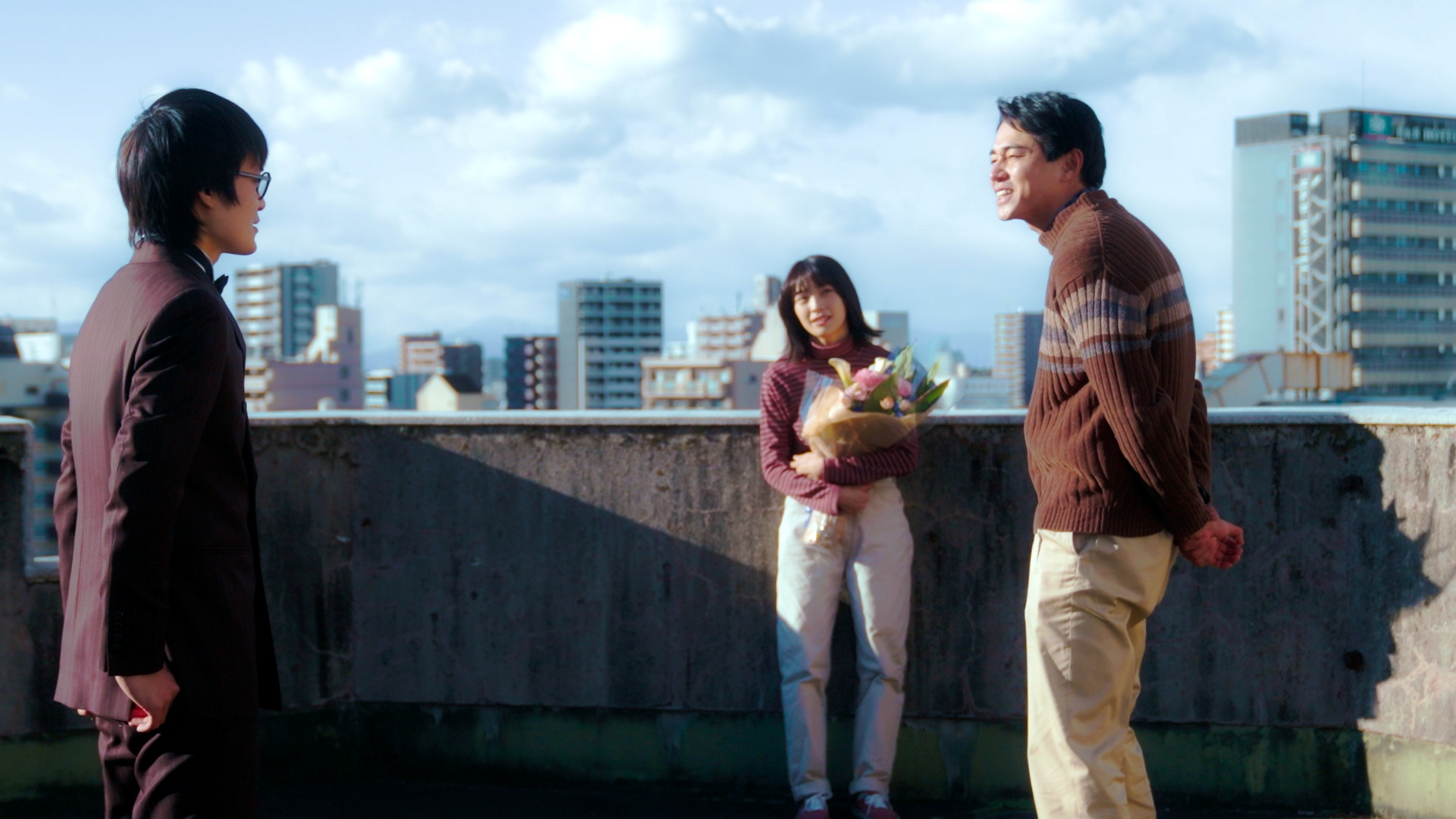
The spectator will surely realize that, while Inoue’s narrative is largely an auto-biographical product, it cannot stake any claim to objectivity. Inoue’s auto-biographical experiences are, first and foremost, deeply coloured by the way he manifested himself, as subject, within the Japanese Other. And, secondly, to turn this collection of fragmented memories into a cinematographic product, he had to perform a secondary revision – rewrite the truth of his experience and fictionalize it in function of creating a visual story. The truth, as Lacan would say, always has the structure of fiction.
This digression allows us to grasp that what the shaky framing signals is not any kind of objectivity, but the reality of Inoue’s fictionalized subjective experience. These fleeting moments of roughness offer the spectator an affirmation that Inoue, as subject, has truly experienced fragments of this fictionalized account and that his experience is embedded in the reality of the cultural Other (General-note 1).
Yet, Hijacked Youth – Dare To Stop Us 2 is not a pure autobiographical film as Inoue, to smoothen the unfolding of his story, interweave sequences where he, as subject, is absent. Not only is Inoue, as fictional character, absent from the opening of the narrative, which solely focuses on Kimata’s interactions with Wakamatsu, but certain excursions are made to tell the stories of other ‘characters’ like Kimata, the manager of Wakamatsu’s cinema, and Noriko Kanemoto, the university student who ends up working at the cinema’s booth (Narra-note 1, Character-note 1).
Hijacked Youth – Dare To Stop Us 2 is a completely different narrative than Shiraishi’s Dare To stop Us (2018). While Shiraishi could rely on the politically charged era of the sixties and the urgency felt by Wakamatsu and his troupe to create political cinematic pieces to deliver a story that celebrates passionate (activist) filmmaking as well as lament cinema’s failure to save certain subjects from being consumed by their own inner struggle, Inoue must do without such background to tell his story. Yet, despite being unable to rely on such societal unrest to energize his narrative, Inoue does sketch out the societal frame of the eighties in an effective way to deliver a heartfelt ode to the mini-cinema and subjective failure.

Notes
Cine-note 1: The moments of shaky framing can also be taken as a homage to the way Koji Wakamatsu and his troupe had to work to shoot their narratives.
Music-note 1: The sporadic use of musical accompaniment within the composition highlights that Inoue was not merely concerned with staging the truth of his experience, but also with staging it in an appealing and more impactful manner.
General-note 1: Let’s takeAkira Kurosawa as an example. While he created nine movies in the fifties and five in the sixties, he only created two in the seventies and two in the eighties. The oeuvres of directors like Seijun Suzuki and Yoshishige Yoshida follow a similar pattern.
The renown of the dwindling troupe of talented directors, who gave cinephiles many classics to savour, was simply not enough to counteract the many cultural and technological shifts that put Japan’s major cinema players in financial trouble.
General-note 2: There are, of course, many factual elements in the narrative. Yet, these elements are presented to the spectator through the lens of Inoue’s secondary revision of his fragmented memories.
Narra-note 2: Noriko Kanemoto is a fictional character.In our view, the main reason why Inoue interweaved a fictional character into his narrative is to vaguely echo the tragedy of Megumi Yoshizumi and emphasize the immobility of the Japanese Other. The societal fabric of the sixties as well as the eighties are marked by subtle institutionalized xenophobia and sexism.
Character-note 1: Inoue characterizes his side-characters in a clear and easy to grasp manner. Kanemoto is a female subject who sabotages herself by letting the weight of the societal Other inhibit her. And manager Kimata is a cinephile who is blinded by his love for films who are, nowadays, considered classics.
 psychocinema
One Comment Add yours