Everyone who has any kind of interest in Japanese society will have heard of the term Hikikomori and subjects who, due to a certain mental dynamic, end up withdrawing themselves from society, avoiding the presence of others. 42-years old Yoko (Rinko Kikuchi), the titular character of Kazuyoshi Kumakiri’s Yoko, has established such a symptomatic lifestyle. Yet, one day, her peaceful existence is crudely disturbed when Shigeru (Pistol Takehara), her cousin, drops by to inform her of her father’s sudden passing and his decision to take her along to his funeral in Aomori. Yet, at the first service area, things go wrong. With no time to find Yoko who was wandering about, Shigeru and his wife depart to take their youngest son Kaito, who accidently injured himself, to the hospital. All alone and nearly broke, Yoko has no other choice than to hitchhike all the way to Aomori.

It is evident from the opening of the narrative that the 42-years-old Yoko has embraced a solitary existence where the Other in its physical and mental presence is refused. What she keeps at bay, however, is not simply society as such, but the signifiers and acts of subjects that wander around the societal field. The only link she has with the outside world are mere formalized exchanges (i.e. doing costumer support chat and receiving packages from the delivery guy).
Whenever Yoko can, she relies on the written signifier and the screen. One could even argue that, for our main character, the installation of the screen between subject and Other deflates the signifier of its subjective weight; she can deal with a hollow signifier. If such screen cannot be installed, she short-circuits the interactional dynamic, the space where her subjectivity can be called upon, by remaining silent.
So, what forces her out of the safe confines of her small darkish apartment? It is not, as some will surely argue, the death of her father, but Shigeru’s demand to attend the funeral. It is the very logic of avoiding subjectivity – her own as well as the other’s – that leaves Yoko no other choice than to meekly obey. Any kind of a refusal would have brought her own subject into the gaze of the Other, i.e. Shigeru.
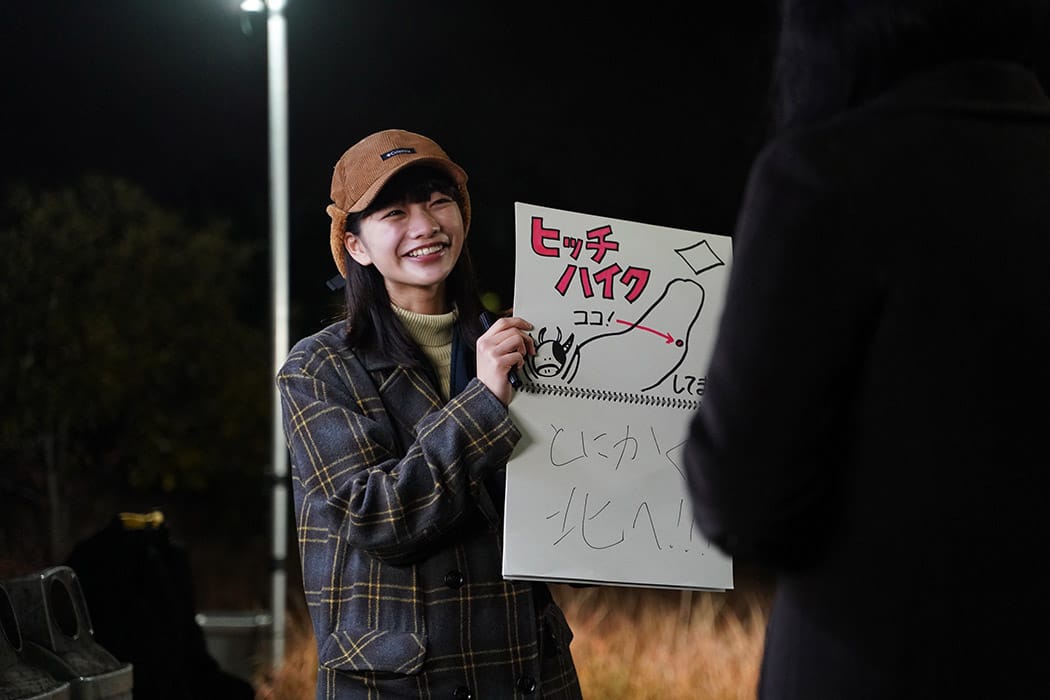
Of course, the sudden death of her father is not without effect on Yoko as subject. It cracks her a-subjective prison-like existence to give birth to a question in her consciousness: Why did you go and die? It is this unanswerable question that gives the sights and events on the way to Aomori their power to call forth memory-fragments and make her explore/confront her conflicted relation with her father. Yet, while Yoko’s monologues arise from her ego – her sudden reminiscences, the signifiers are, when all said and done, addressed to her own subject (Psycho-note 1, Psycho-note 2). Can these reminiscences and monologues help Yoko, as she hitchhikes her way to the funeral, to accept the passing of her flawed father?
Being abandoned by Shigeru and his family at a service area leaves Yoko disoriented within the societal space and forces her to rely on others. She has but one tool to reach her destination: her own voice, the sound coming out of her throat signalling her presence and her subjective existence to the other. Yoko finds herself, in other words, in a situation where she has no other option than to bring something of her subject into play and break out of her self-imposed subjective prison. How will this insisting demand to produce subjective signifiers and make herself, as subject, present in the societal field affect Yoko as her trip goes on? Will her unintended hitchhiking road trip cause a durable shift in her subjective position (Psycho-note 3)?
It is evident by the way Kumakiri visually composes his narrative that he knows that images speak and that the spectator, to attain a fragment of meaning, searches the visual frame for signifiers. For example, by guiding the spectator’s attention to various visual elements (or signifiers) in the frame, Kumakiri succeeds in less than four minutes in making the spectator realize Yoko’s situation of self-isolation, her existence as hikikomori. Kumakiri also utilizes the slowness of his dynamism to echo something of the near petrified daily rhythm that imprisons Yoko and surges of shaky framing to emphasize the traumatic trembling of her subjectivity.
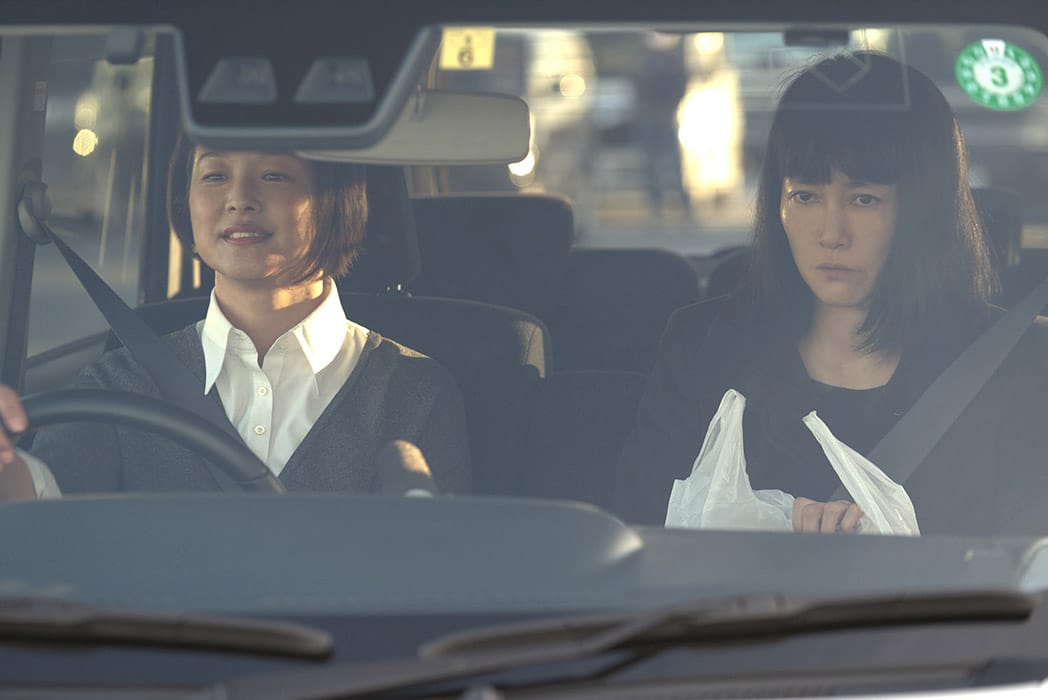
Kumakiri’s reliance on long takes to bring Yoko’s road-trip to life means he expects a lot from the performances of his cast. While in many cases the director would merely seek to emphasize the facial expressions of his cast, Kumakiri aims to show with his long takes how the physical presence of his main character emotionally wavers in response to the signifiers she receives from and expresses to the other. By being able to rely on such a talented actress as Rinko Kikuchi, Kumakiri is able to fully realize his artistic vision and affect the spectator as intended. Rinko Kikuchi fully embodies her character and enables the spectator to feel Yoko’s fragile emotional rhythm.
With Yoko, Kazuyoshi Kumakiri succeeds in delivering a tactile emotional experience. The spectator is not merely led to grasp something of Yoko’s subjective struggle, but to feel it as the narrative unfolds. By giving the talented Rinko Kikuchi space and time with his thoughtful composition, Yoko offers a complex full-bodied filmic wine that cannot but stir the spectator’s emotions.

Notes
Psycho-note 1: The visual presence of her father around her while she explores her conflicted bond with him illustrates the psychoanalytic therapeutic idea that one can only truly deal with a person, i.e. Yoko’s father, by making him present through one’s speech – Yoko’s signifiers give him a presence that can slowly be worked through.
Psycho-note 2: The visual presence of her father in the narrative has also another implication. As the narrative unfolds, it becomes clear that the conflictual bond between Yoko and her father is the cause of her self-imprisonment. What she, unconsciously, aims to avoid by locking herself up is nothing other than the very echo of her violent father within the patriarchal dynamics that keep structuring the societal field and the interactions that support it.
Psycho-note 3: In the last 15 minutes of the narrative, Yoko emphasizes the signifier ‘running away’. One could, indeed, state that her whole logic is centred on running away, in the first place from the father and, secondly, from its echo in the societal field.
 psychocinema
2 Comments Add yours