Introduction
Rikiya Imaizumi has, in recent years, established himself as a director that concentrates on exploring the dimension of love from different viewpoints. It is therefore not surprising that Undercurrent, a film based on Tetsuya Toyoda’s manga, deals with love as well. Yet, while many of his previous narratives dealt with finding love, Imaizumi’s latest explores the effect romantic loss has on a subject.
Review
One day, after having closed the bathhouse Tsukinoyu for several months due to personal reasons, Kanae (Yoko Maki) decides to reopen her business together with Ms Kijima (Kumi Nakamura) (General-note 1). Yet, Kana’s inner turmoil has not been abated yet – Kana’s husband Satoru (Eita Nagayama) has not returned after vanishing during a bathhouse association trip.
Then, one morning, a strange guy wanders around the garden. The man, Mr. Hori (Arata Iura), was send by the bathhouse association to inquire about a recent job opening. Kanae, surprised by his qualifications, is somewhat confused that he wants to work at Tsukinoyu. While Kanae tries to politely refuse him, he subtle pushes her to give him the job and, as the association informed him, a room to stay.

Undercurrent is narrative that sketches out the impact of loss-experiences on the subject, how one reacts to such infraction and the way it impacts the subject’s trajectory. Given the emphasis on loss and its subjective effect, it is not surprising that the dimension of time is explicitly stated in the narrative – Kanae’s story commences in June and reaches its conclusion in November). By naming each chapter to a month, Imaizumi does not merely emphasize the passing of time, placing a certain concatenation of events within the space of a month, but elegantly invites the spectator to pay more attention to the subjective changes Kanae and Hori undergo.
While there are six chapters in Undercurrent, Imaizumi’s narrative can be divided in two thematical halves. The first half of the story presents the spectator the following questions to ponder over: What does it mean to truly understand someone? Is there not, within the subject that is dearest to us, not a subjective kernel that always remains beyond our reach? Is the sense of understanding someone not an imaginary dynamic to keep the lid on one’s own Otherness as well as keep the Otherness of the other subject at bay? And last but not least, what to do with the lies that gave rise to an imaginary sense of sameness that made two subjects enter a marital bond?
The second half offers a variation of the theme of secret – that what swirls underneath our social face, our ego as presented to the Other. Yet, rather than further exploring the secrets that remain hidden behind an imaginary sense of relational peace, the second half of Undercurrent turns around the dynamic of repression – i.e. subjects hiding fragments of memories in the deep recesses of their unconscious – and the effect the return of such fragmentary narrative puzzle pieces has on the subject.
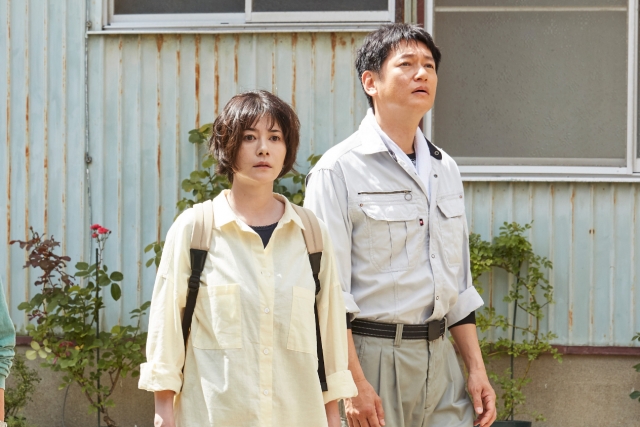
To allow the spectator to get the most out of Imaizumi’s narrative, we’re now going to analyse Kanae’s subjective position and logic deeper. First of all, it should be evident that Kanae, by giving Hori the job, recreates the situation before her husband went missing (Narra-note 1). Or, to put it differently, she re-establishes a relational structure – i.e. a man and a woman working together in a bathhouse – that opens the floodgates of raw memories and muddled and conflicted emotions. The opening of these gates is what causes the initial undercurrent that shudders her subject. Of course, Kanae tries to keep this unsettling feeling, as generated by this unintended recreation, beneath the surface of her own ego and the minimal symbolic structure installed by the signifier-couple ‘employer’ and ‘employee’.
The conflictual feelings lingering within Kanae reverberate clearly in the way she interacts with him, i.e. the signifiers she directs at him. While Kanae invites him into the empty space of her household (“I know but it is the same effort to cook for two as for one.”), she also subtly tries to push him away and evacuate him from the position he shouldn’t occupy (e.g. “It’s only till you get an apartment anyway”).
The fuel for Kanae’s conflictual feelings is nothing other than a form of guilt that cannot be resolved. As Kanae tells Kanno, a friend from her university times, is that she fears their relationship never ventured into the inter-subjective field – two subjects ever lingering in the peaceful ebb and flow of the deceptive imaginary – and that she failed him as she wasn’t someone, he could truly share his feelings with (Narra-note 2).

The visual motive in Undercurrent is Kanae’s returning dream of being strangled under water. While she knows that this dream visualises a desire (as fulfilled), she is not ready to fully assume it as her own – this drifting desire cannot be connected to anything within her conscious experience. This dream childishly stages the desire to be murdered, to be released of a certain burden, a certain undercurrent, but neither Kanae nor the spectator can place where this desire comes from (Narra-note 3).
What stands out in the composition of Undercurrent is the peaceful rhythm Imaizumi gives to the concatenation of images. He further heightens the visual pleasure of his composition by discretely inserting shots with effective visual tensions. What makes these visual moments satisfying is that Imaizumi does not seek – i.e. forcing the composition too much to deliver visual pleasure, but finds – i.e. utilizing the features of the visual space in an elegant way.
Imaizumi adds a bit of visual flair to his composition by sporadically inserting a slow-motion shot. Yet, his use of slow-motion is not merely decorative, but aims to reverberate that the spectator has entered Kanae’s subjective experience, the recurring dream of desire that haunts her.
The emotional flow of the narrative is mainly carried by Yoko Maki’s impressive acting-performance. It is with a lot of elegance and control that Maki stages how the mental undercurrent that coils within her subject speaks through her signifiers, bodily movements, and facial expressions. It takes a lot of skill to give Kanae’s frailty a naturalism/authenticity that reverberates with the spectator.
Imaizumi continues to impress the spectator with his latest work, Undercurrent. Due to the cross-fertilisation between his compositional skills and the acting prowess of Yoko Maki, Imaizumi is able to deliver an engaging but understated emotional experience that does not merely uncovers the deceptive nature of imaginary veil that binds two subjects together, but also how, via the dynamic of repression, the subject alienates himself from what structures his relational logic.

Notes
General-note 1: The narrative touches upon all the different facets of running a sento (bathhouse) (e.g. heating the furnace, cleaning the baths, doing the register, preparing the woodblocks, … etc.
Narra-note 1: Just like her disappeared husband, Hori remains distant and ensures that his speech does not reveal anything about his own subject – a verbal emptiness in service of the imaginary sense of harmony. Yet, with the truths the detective uncovers about Kanae’s husband, it is only logical that Kanae and the spectator come to suspect that Hori is hiding something too.
Narra-note 2: The narrative also touches upon the link between lying and the desire to be desired by the Other. Undercurrent shows a radical version of the dynamic of using lies to clean up one’s ego to ensure oneself of the Other’s desire and love. Yet, the more lies one uses, the more danger one runs that the refined but frail construction shatters.
Narra-note 3: These visuals that visit her continuously are, as the narrative elegantly reveals, is the leftover of the repression process. It’s the door by which the repression can be lifted. Yet, what can be the key?
Despite the nearly neat erasure of the traumatic event from her consciousness, this event nevertheless reverberates within her logic, her presence within the societal space. The guilt concerning her husband is grafted on the guilt associated with this repressed event.
 psychocinema