Introduction
Japanese people have, due to the influence of Shinto – the indigenous religion – revered nature for many centuries. It is thus not surprising that the godliness of nature impacted the cultural development profoundly and allowed many traditions, like the tea ceremony, ikebana, and incense appreciation, to blossom.
Despite having little ceremonial rituals, bathing remains an important act within the Japanese cultural fabric. It is thus not surprising that it has become the object of a cinematic product, of a filmic appreciation.
Review
One day, Shiro Miura (Toma Ikuta), a talented but struggling architect, learns that he has inherited the parental sento (a public bathhouse), Marukin. Of course, he hopes to demolish it and utilize the space to build an apartment complex that will boost his career as architect.
Upon meeting Goro Miura (Gaku Hamada), his estranged younger brother and shared owner of the bathhouse, Shiro immediately tries to persuade his brother to close the parental business. Yet, his brother refuses to budge.

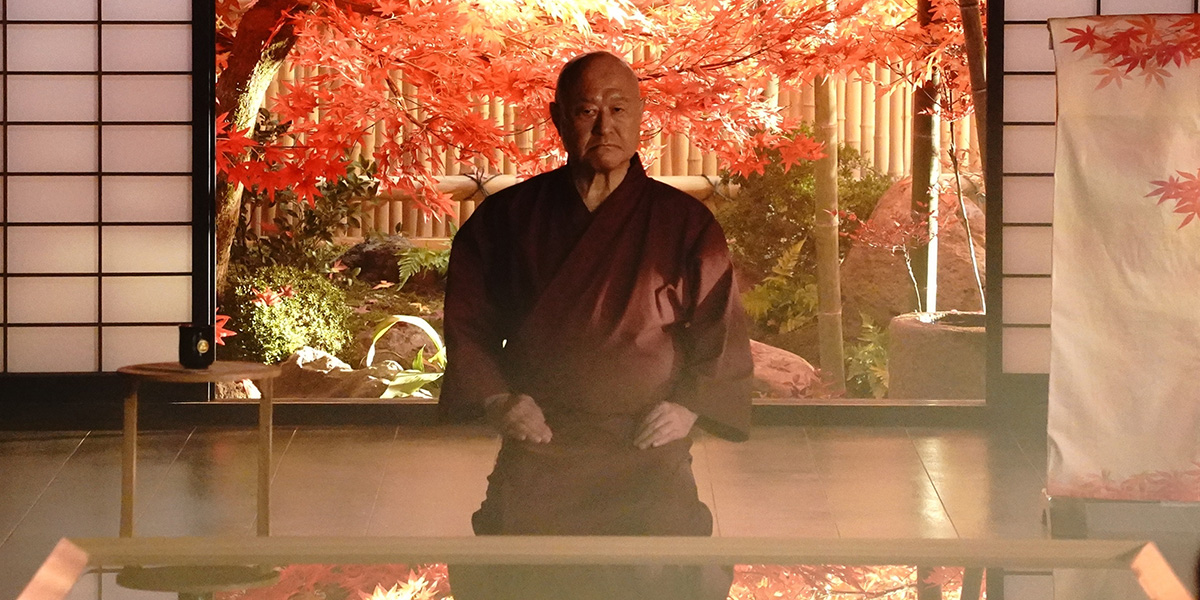
Yudo offers a comical celebration of the joy of bathing and the refreshing of one’s soul by soaking in a hot tub. The comical dimension is, for example, evident in the dramatization of the bathing etiquette. The ritual seriousness by which Shigeaki Ninoyu (Takuzo Kadono) performs the way of bathing does not miss its light-hearted effect. The same formal serenity also forces some chuckles when he introduces the power of sedative hot liquid to wash away differences and to deepen bonds between two subjects. Yet, Ninoyu’s light-hearted philosophical statement underpins the many turns and developments in the relations that fill the narrative.
The narrative of Yudo is structured around two contrasts. The first narrative tension is between the Japanese onsen experience, which remains a subject of fascination for many, Japanese as well as non-Japanese, and the often-ignored sento, a communal place where local people bath together. The sento, in contrast to the onsen, underwent a sharp decline in the 1970s when more and more private baths were integrated in private homes and apartments. While many sento closed their doors – finding someone to take over this kind of business is near impossible, others radically reduced their opening-times. This contrast is, in this narrative, embodied by Yoichi Ota (Kotaro Yoshida), the onsen critic. While he celebrates the sublime and elitist quality of the natural hot spring – one of the symbols of traditional Japan, he despises the mundaneness and pedestrian nature of the bathhouse and, as a result, he does not see any value in preserving traditional bathhouses.
The second contrast is between modern opportunism and conserving tradition and unique architectural structures – e.g. the sento featured in this narrative was built in the Showa Era. This contrast ravages the whole of Japan, especially in local and rural areas. While certain traditions – e.g. the shopping street – disappear due to the impact of aging society, shifting dynamics of consumption and globalization, others are endangered by people who do not realize the societal worth of certain buildings and practices, by those fixated on the worth of land and its financial potential. The subject that embodies this contrast in the narrative is, of course, Shiro Miura.
Even though the composition of Yudo: Way of the Bath features some nicely geometrically composed shots and some pleasant visual decorations like slow-motion, the mixture of fixed shots and slow dynamic movement is a fairly straightforward affair. Yet, Masayuki Suzuki’s often overutilizes dynamism to bring this narrative to life. For every moment in the composition where dynamism is utilized in a pleasant and effective way, there is a moment of movement that lacks purpose and endangers to derail the peaceful flow of the narrative.

While Yudo plays it safe by offering the spectator a very predictable story, this tale of wet communal relaxation still delivers a pleasant celebration of the Japanese bathing culture. If one, as spectator, merely seeks a heartwarming story, Yudo is an easy recommendation. Yet, those looking for more satisfying experience should shy away from Suzuki’s exploration of the ailing sento.

 psychocinema