Introduction
Tetsu Maeda is a kind of director that has worked for many different companies to bring a multitude of novels to life on the silver screen. While, in most cases, the script is written by a screenwriter, there are some films for which he took the pen in his own hand. His latest work, Do Unto Others, is a film written by his hand and broaught to life through his directorial eye.
Review
One day, caregiver Munenori Shiba (Kenichi Matsuyama) and intern Yuki (Natsu Kato) attend Hanemura’s funeral, an elderly woman who recently died. After the service, at the bar, Inoguchi (Rie Minemura) that the daughter, a single mother who has a day job at the supermarket and a night job at a bar, must be relieved that her mother, who suffered from Alzheimer has passed away.
Not long thereafter, Kantaro Umeda (-), a patient of Yaga Care Center, and Dan Motoharu (Hajime Inoue), the director of the Care Center, are found dead in Umeda’s house. While Otomo (Masami Nagasawa), a persecutor, wants to investigate this strange case deeply, she is pressured by the higher-ups to swiftly close the case. Yet, rather than meekly obeying the order from above, she decides to uncover the truth.

Do Unto Others has a great premise – Maeda aims to underline the need for the Japanese societal system to grant, within the symbolic, the elderly subject the choice to die, yet fails to develop this premise into a biting experience that shocks the spectator awake. Maeda allows his narrative to become too melodramatic for its own good, washing away the impact of its societal critique. The latter half of the narrative, by being too concerning with forcing tears from its audience, blunts the fleeting but biting societal commentary that blossoms in the middle of the movie and structures its turning point.
The societal critique of Do Unto Others is function of the reasoning of the string of murders on elderly subjects. Despite the humanistic reasoning that underpins these murders, these violent acts are deeply criminal. Yet – and this might surprise some readers – the criminal dimension does not lie in the benevolent nature of murdering as such. What makes the murders criminal is the lack of consent. The murderer, despite his benevolent intentions, assumes the law subjectively; he becomes the living letter of the law, creating justice and passing judgement by projecting his own subjective suffering imaginarily onto the others (Narra-note 1).

The dimension of consent is also utilized to put the righteousness of capital judgement, of the death penalty, into question. Yet, while the string of murders and the death penalty share the evaporation of consent, the death penalty is a-subjective; it is a result of the way the judges apply the cold dead letter of the law.
The string of elderly murders function as a societal critique because every murder, and especially the one that started it all, reverberates the lack of an ethical system for the subject to organize his own dignified death within the Japanese societal field – what remains for the subject is either the path of suicide or, when self-consciousness has dwindled and self-determination has become impossible, the path of suffering. In Japan, there is no possibility for the subject to determine, in accordance with the symbolic law, in what circumstance (e.g. a fully realized dementia) one wants to be euthanized. Rather, the Japanese system, which is heavily groaning under the weight of the ageing society, structurally fails the suffering elderly subject, shifting most responsibility for their ongoing care on the remaining family members (Narra-note 2). The elderly subject is forced to live through the physical and mental suffering and their familial caretakers are expected to carry the physical and mental burden.
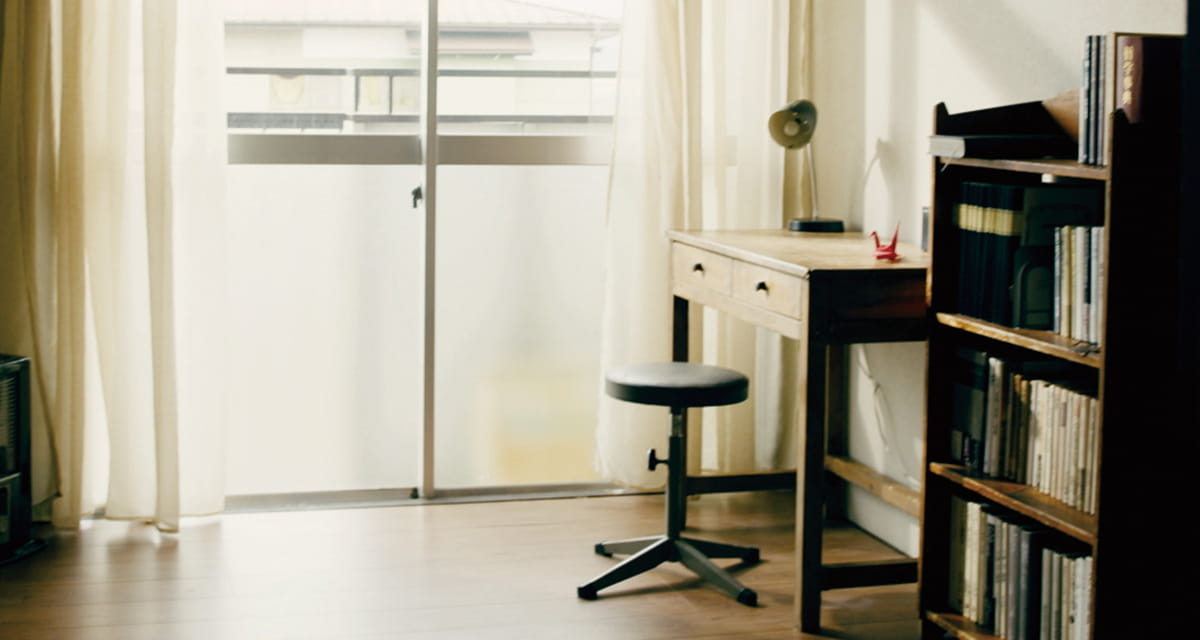
While static moments are present within the composition, Maeda tells his story mainly by utilizing slow and restraint dynamism. Static moments fluidly turn into dynamic movements. In some cases, the meandering camera fleetingly takes a pause, fixates for a moment, before returning to its dynamic origin. Longer static shots are, generally, utilized to give space to the cast to infuse some emotionality into the narrative fabric – i.e. to show that the signifier is not without emotional effect – or to emphasize the conflictual flow of conversations, either due to subjective differences in perspective or due to the impact of dementia (Cine-note 1). As a result, the second half of the narrative, a concatenation of conversational confrontations, is more static than first half.
Do Unto Others might pose the right question concerning euthanasia, but decorates it with such thick emotional heavy-handedness it blunts the critical analysis it presents concerning the Japanese societal field. While many spectators will shed tears at the emotional unfolding, our tears lament Maeda’s choice to go full melodrama.

Notes
Narra-note 1: The Christian Golden Rule, which echoes in the English title of the film, is deeply imaginary in nature. The ethical demand to treat other people as one’s self would prefer to be treated is an invitation to project one’s own ego onto the Other, to erase the other’s Otherness by turning him into a mere semblable.
Narra-note 2: The sense of societal abandonment is also touched upon in the case of Kawauchi-san (Chie Ayado), an elderly woman who feels isolated and tries to convince the prosecutor to sent her to prison. For her, giving up her freedom is but a small price to pay for feeling secure and being well-cared for.
Cine-note 1: A sequence of static shots are also used to stage fragment of the police interview of Shiba, Yuki and Inoguchi.
 psychocinema
One Comment Add yours