Introduction
Hideo Gosha is a director that, in his career, had three quite distinct periods. In the sixties, Gosha created chambara productions and delivered two of the best post-war chambara movies, Goyokin (1969) and Hitokiri (1969). In the seventies, he shifted his attention to the contemporary crime genre and started to direct yakuza films besides the occasional sword-fighting film (The Wolves (1971), Bandits vs. Samurai Squadron (1978), and Hunter in the Dark (1979)). In the eighties, Gosha returned to period films but focused on prostitutes as protagonists. This time, we cast our psychoanalytic eye on one of his most beloved yakuza films: Violent Streets (1974)
Review
Lately, bar Madrid in Ginza, which is now exploited by former yakuza Koichi Egawa (Noboru Ando), has been forced to regularly deal with troublemakers He suspects that Gohara (-), the chairman of Togiku Corporation ltd. is behind it. Not much later, Egawa is approached by Gohara who offers him a large sum of money for the bar. He tells him that acquiring his bar is part of the plans to put a halt to the attempt of the Western Japan Alliance of Kansai to steal territory in Ginza. When he confronts Gohara with the attacks that have been plaguing his bar, he denies that the Togiku corporation is behind it.
At around the same time, Minami (Minami Nakatsugawa), a popular star, is kidnapped from the tv-studio. The same night, her agency, led by Yazaki (Akira Kobayashi) from the Toguki corporation, receives the news that Minami wants to change her agency to Star production, a company seemingly part of the Western Japan Alliance. A few days later, some of his former family members show up at the bar to convince Egawa to revive his dissolved family and right the wrong inflicted by their boss by taking on the war the Western Japan Alliance.

Violent City is a narrative that plays with the conflict between the traditional yakuza code and the attempt of yakuza organisations to erase their criminal origin and clothes themselves with a legit business image. It is because the push to attain a legitimate image within the societal fabric – an image that allows them to conduct business and earn money – tries to repress but fails to erase the identification of some with the old ways of manly honour – the symbolic inscription of the violent dynamic of inflicting imaginary injuries, that the conflict between quickly spirals out of control. Yet, Violent City does ultimately underline with that the old ideal of the Yakuza, the one soaked in blood and violence, has no place anymore within the societal field.
The character of Egawa is profoundly marked by the old yakuza ideals of manliness. This is not only evident in the way he violently deals with the troublemakers at his bar, but also the way to treat, through signifiers and acts, the mama (-) of his bar. Yet, when Mochizuki (Hideo Murota) and Hama (Isao Natsuyagi), two of his former family members, show up to ask him to revive the family and go to war, he refuses.
While his refusal might surprise some spectators, one should understand his decision as being function of his retired status as well as the need to safeguarding his identification with the yakuza ideal of manliness – refusing is simply the most honourable thing to do. While his ego is still profoundly marked by the ideal image of manliness espoused by the yakuza code, the absence of a family structure around him due to his retirement allows him to avoid being seduced by the imaginary dynamic of honour and injury. He does not need to protect the honour of his family anymore, only his own.

The demand of the former yakuza to revive his family, however, is born from the simple fact that they have not found a way to deal with the imaginary injury inflicted to them in the past – i.e. the dishonourable dissolution of the family after serving time for the war with the Chuo group. While Egawa could ease his injury by receiving Bar Madrid and realizing he has no place in a corporate world in the Yakuza, Muchizuki, Haruo (Asao Koike) and Hama, radically robbed from their yakuza-ego and used as mere pawns to be thrown away in the process of becoming a legitimate business, are unable to cope with this dishonourable injustice.
What will, ultimately, force Egawa back into the criminal world of violence? What will force him to leave his passive position and enter the field structured around honour and injury? Without saying too much, it is nothing other than the infraction of the violent real, a real that shakes up the remains of his disbanded family, that forces him to realize, once more, the true ideal image of the male yakuza.
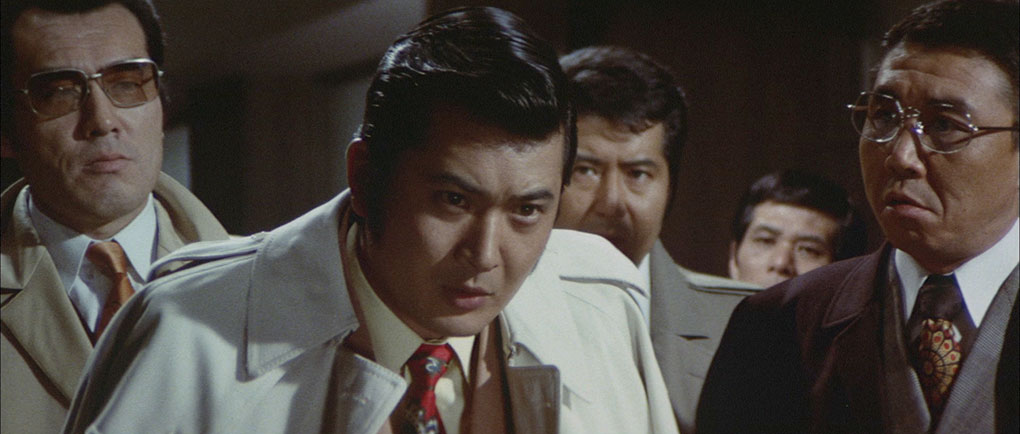
Gosha’s composition stands out due to its stylish nature. The stylishness is evident in the composition’s engaging visual rhythm that, at times, comes to celebrate the beauty of corporal movement and also in the many visually pleasing shot-compositions – compositions created by elegantly exploiting geometry, but also by smartly utilizing colour-contrasts to emphasize the already present compositional tension (Cine-note 1, cine-note 2, Cine-note 3).
The framing of crude violent acts does not clash with the stylish nature of Gosha’s composition. The reason why such clash does not happen is due to the fact that the violence, while bloody, is swift. Within Gosha’s composition the moments of brutality are but fleeting disturbances within the elegant visual fabric. By staging violence as mere disturbances, Gosha avoids that the stylish nature of his composition ends up glorifying the crude and vicious cruelty – the disturbing quality of the violence always shines through. It is, furthermore, this refined balance between stylishness and crudeness that allows the nihilistic dimension of the spiral of violence to fully blossom and profoundly impact the spectator.
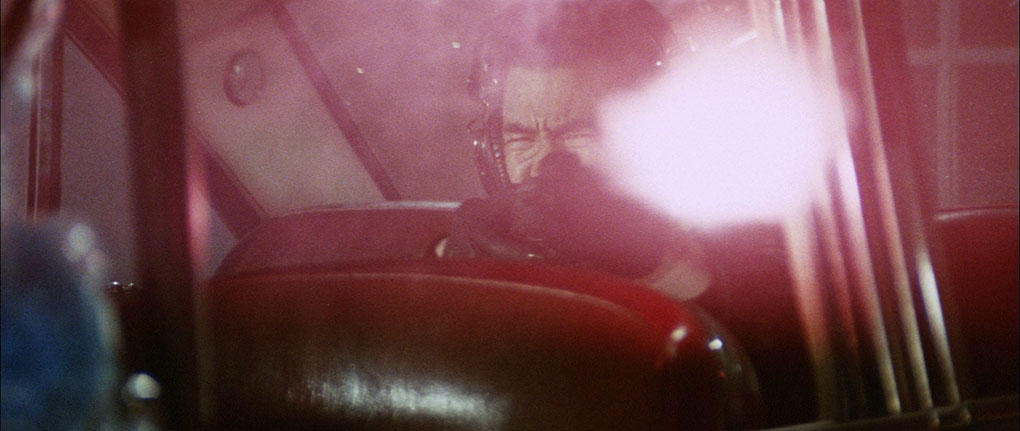
The stylish nature of the composition is further supported by the musical accompaniment – a combination of moody jazzy, passionate flamenco, and more melancholic Spanish-inspired pieces. These quite often very rhythmical musical pieces do not only enhance the visual flow of the composition, but also emphasize, in certain instances, the movement of bodies as such or infuses a quantum of tension into certain sequences.
Violent City is a nihilistic and violent yakuza classic. What makes Gosha’s stylish narrative so effective is that it depicts the conflict caused by the changing shape of the yakuza in a brazen and quite depressive way and also confronts the spectator with the fact that beneath the changing shape the same reverence of male virility and territorial power remains in play. Highly recommended.

Notes
Narra-note 1: The lingering effects of the male ideal propagated by the Yakuza structure on the male subject is evident in the many nude posters that adorn their offices and so on. The posters underline the importance of phallic virility for the yakuza-subject.
The interlinking phallic sexuality and the ideal image of yakuza, be it the old one of honour or the new one of corporate transformed one, is also evident in other visual elements. In fact, it is this interlinking that makes one of the final murders so impactful – i.e. the yakuza victim is killed in the act of satisfying his own phallic desire to be desired as male subject.
Cine-note 1: The visual rhythm is created by combining a variety of dynamic shots, like zoom-in, tracking-shots, spatial shots, zoom-outs, … etc. The composition is further decorated with slow-motion and shifting depth-of-field.
Cine-note 2: The visual pleasure is mainly function ofplacement of characters within a given narrative space.
Cine-note 3: Shaky framing is utilized to add some tension to the sequence and zoom-ins to add some dramatic flair.
 psychocinema