Introduction
It is not uncommon in Japan for talents like comedians or actresses to try their hand at directing full feature films. Comedian Hitoshi Matsumoto, for instance, has made some strange but beloved films, like Big Man Japan (2007) and R100 (2013). This year, Jimon Terakado, who is part of the comedy trio, Dachou Club, tries his hand at creating a feature-length film. Can he be as successful as Macchan?
Review
Ever since her husband passed away, Yasue (Ryo) has been running her former husband’s Yakiniku restaurant Negishi-En, while trying to make sure her son Yoshito Sato (Naoto) is raised well. One day, due to false comments from popular food critic Tatsuya Furuyama (Satoru Matsuo), the business starts struggling, but Yasue keeps working hard. After a case of food-poisoning, Yasue is forced to shut down her once thriving restaurant.
Eighteen years later, Yoshito tries to make a living as a freelance writer. One day, he is introduced by Eiji Shinsei (Ken Ishiguro) to Shizuka Takenaka (Tao Tsuchiya), a young editor for Next Age, to help her create content for a new food guide website. Despite the tensions between both personalities – Yoshito’s rude free-spirited presence clashing with her formalized friendliness and blind trust in Tabelog reviews and ratings, Shinsei orders them to write an article that uncovers the hidden yakiniku gems in the city. Not much later, Yoshito learn that his estranged mother has collapsed and has been hospitalized.

Food Luck tell the story of Yoshito, a subject whose love for delicious food is deeply intertwined with his love for the elegant figure of the cooking mother. It is, in our view, only because meat and mother are synonyms within his unconscious that his approach to eating and food has attained a quasi-religious devotion. His obsessional ritualism is, in other words, an expression of his loving devotion to his mother. Yoshito’s direct and unabashed way of delivering his criticism is, in this sense, not only function of the direct disrespect that is shown to the joy of eating and culinary art of yakiniku, but also because this disrespect deeply dishonors his beloved mother.
Yet, Yoshito is not simply marked by a fixation on the motherly figure preparing food, but by the image of the loving mother making food for him. The image of his mother is, to put it different, an image that proves her love for him. The signifiers meat, mother, and love are, in this sense, an unconscious complex that determines his past and current logic (Narra-note 1 (minor spoiler)).
Via the character of Tatsuya Furuyama, a popular food critic and business owner, Food Luck underlines that the buzz that fashionable foodies create online and the swarming of wannabe food-critics that it causes (i.e. the imaginary) is more important than the quality of food that a restaurant delivers. Restaurants do not need to sell quality or culinary oral enjoyment but sell the idea of quality and such enjoyment by fabricating their image by carefully manipulating foodie influencers.
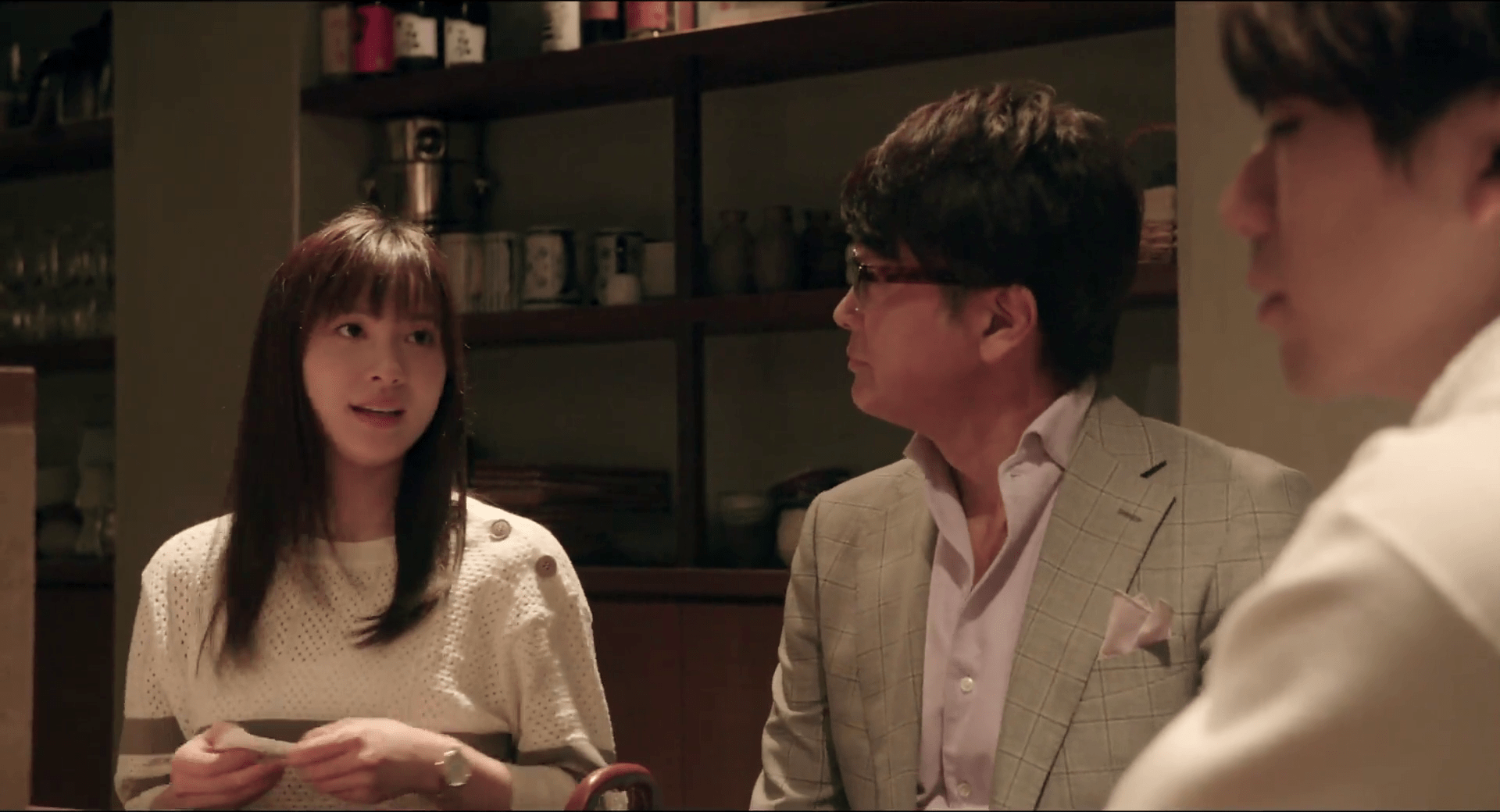
One of the dupes of this manipulation is none other than Shizuka. It is, moreover, because she is duped by this intricate social media manipulation that she does not taste the food simply with her own oral drive but with a tongue that is contaminated by the signifiers she has heard on television or those she has read on websites like Tabelog.
Yet, it is not this contamination that causes Yoshito to vocalize his wish to quit the writing job. It is also not the confrontation with the fact that Shizuka has, at first, no desire to uncover the true hidden pearls of the Yakiniku restaurant world, to find where oral pleasure of savoring quality meat truly can be found, but that she simply wants to dupe others with the website in a similar way that Tabelog dupes her. The true source of his wish to quit is a fear that his signifiers and acts will have irreparable consequences.
His subjective inhibition is obviously linked with his not-yet-mended relationship with his mother. And, as can easily be guessed, the exploration of yakiniku restaurants in Food Luck allows our inhibited hero to discover how his mother, driven by her knowledge of and love for the art of yakiniku, influenced other practitioners of this culinary art (Narra-note 2 (spoiler)).

Terakado’s narrative is sadly far from perfect. He wants to hit too many different narrative notes, e.g. the importance of mending relations, overcoming one’s subjective inhibition, the conflict between taste imposter Furuyama and near-religious Yakiniku devotee Yoshito, the celebration of eating and preparing of yakiniku, that he sadly never finds the right harmony. Due to the lack of such harmony, Terakado’s narrative struggles keep the spectator engaged.
The composition of Food Luck offers a straightforward mix of static shots and dynamic shots. Static shots are, as can be expected from a narrative about food, richly exploited to emphasize the beauty of the ingredients, the art of the Mise-en-Place (e.g. cutting vegetables), the visual poetry of sizzling meat, the water-mouthing elegance of an arranged dish, and the enjoyment of eating as such. Spatially moving shots are, on the other hand, utilized to give the spectator a flavour of the atmosphere of the various restaurants.

Terakado’s use of traditional Japanese sounds is not only pleasant – indicating a certain rhythm in the imagery – and is also instrumental in emphasizing how Yoshito has ritualized the act of eating and how, for him, the art of Yakiniku demands a ‘quasi-religious’ devotion. The traditional inspired musical accompaniment and the more dramatic musical pieces are utilized to ensure the lighthearted flavour of certain interactions and confrontations.
Yet, the musical accompaniment to strengthen the emotional moments uncovers the unsolvable problem that marks Food Luck as narrative. Due to Exile Naoto’s inability to truly breathe life into his character, the emotional power of the narrative solely depends on the music. As the acting and the music fail to complement each other, the narrative becomes, at times, overly dramatic without being able to grab the spectator. In a certain sense, the music tries to dupe the spectator without delivering genuine emotional quality.
Food Luck is a jack of all trades, but a master of none. Terakado’s narrative tries to deliver a visually delicious piece about the art of yakiniku, the joy of eating meat, and the beauty of motherly love, but ends up offering us an unbalanced mix that cannot truly touch or engage the spectator. The narrative might offer beautiful shots of meat, but one is better off going to a yakiniku restaurant to indulge oneself in the rich and deep flavours of Kurowagyu.

Notes
Narra-note 1: It is this unconscious complex that led Yoshito to put detergent in the pickles and the case of food poisoning that forces Yasue to close her shop. What prompted him to poison the pickles is not simply his desire to have her attention, but a desire for the poetic repetition of her preparing rib meat on shredded cabbage with nukasuke on rice for him, a repetition of the very image that signals her love for him.
Narra-note 2: It is not difficult to see that Yoshito’s position at the end of the narrative is a transformation of his relationship he, as a child, had with his mother. In a certain sense, he became his ‘mother’ by writing, by helping others find a culinary experience like the one he repeatedly had in his childhood.
 psychocinema