Introduction
While Hideyuki Hirayama is not that well-known by international audiences, he is nevertheless a director that has made rather some well-received movies in various genres, like his romance narrative Talk, Talk, Talk (2007) and his period drama Sword Of Desperation (2010). Can his romance Tsuyukusa (2022) follow in their footsteps and charm local and international audiences alike?
Review
One night, on her way back from the first meeting at the alcoholic abstinence society, the car of Fumi Igarashi (Satomi Kobayashi) is hit by a meteorite. Stranded near the beach, she calls Naoko Kushimoto (Kami Hiraiwa) one of her colleagues at Tatsune inc., a company manufacturing washcloths, to come pick her up.
Kohei (Taiyo Saito), Naoko’s son who is obsessed with all things space-related, saw the meteorite fall. Of course, he is eager to find a piece of it, but as his friend Namie (-) underlines the assumed site of impact is too far – it might even be on the other side of the mountain. Not long thereafter, after learning about Fumi’s car accident, he asks Fumi to visit the beach and search for a piece. That night, visiting her local bar, Fumi starts talking to Goro Shinoda (Yutaka Matsushige), a man fond of blowing music with Tsuyukusa leaves.

Tsuyukusa is a heart-warming narrative that touches upon the importance for the subject to assume the right to start over and grant him/herself the permission to invest in a new social bond, a new romantic relationship. Yet, to ensure that the narrative stays light in tone, Hirayama avoids emphasising the emotional struggle that marked subjects too much – most subjective conflicts in the narrative are almost entirely resolved. Instead, Tsuyukusa emphasizes the necessity for the subject to have a chance encounter to be able to overcome his subjective standstill, to receive a signal that a new beginning with another subject can be written.
Fumi Igarashi’s subjective standstill concerns her alcoholism. While Fumie already decided to stop drinking form the beginning of the narrative, the spectator is left somewhat unsure about her ability to remain sober. One of the reason for said doubt is the fact that she hides the true reason for her problematic use of alcohol at the alcoholic abstinence society meeting. The only thing she confides with the others is that her drinking started in her second year at high school, the day her love confession was rejected. While this story, of course, explains what made her reach for alcohol, the traumatic event that made her use of alcohol problematic remains, as of yet, unsaid. Yet, it is clear for the spectator that what caused her alcoholism has something to do with the two pictures that adorn her small apartment.
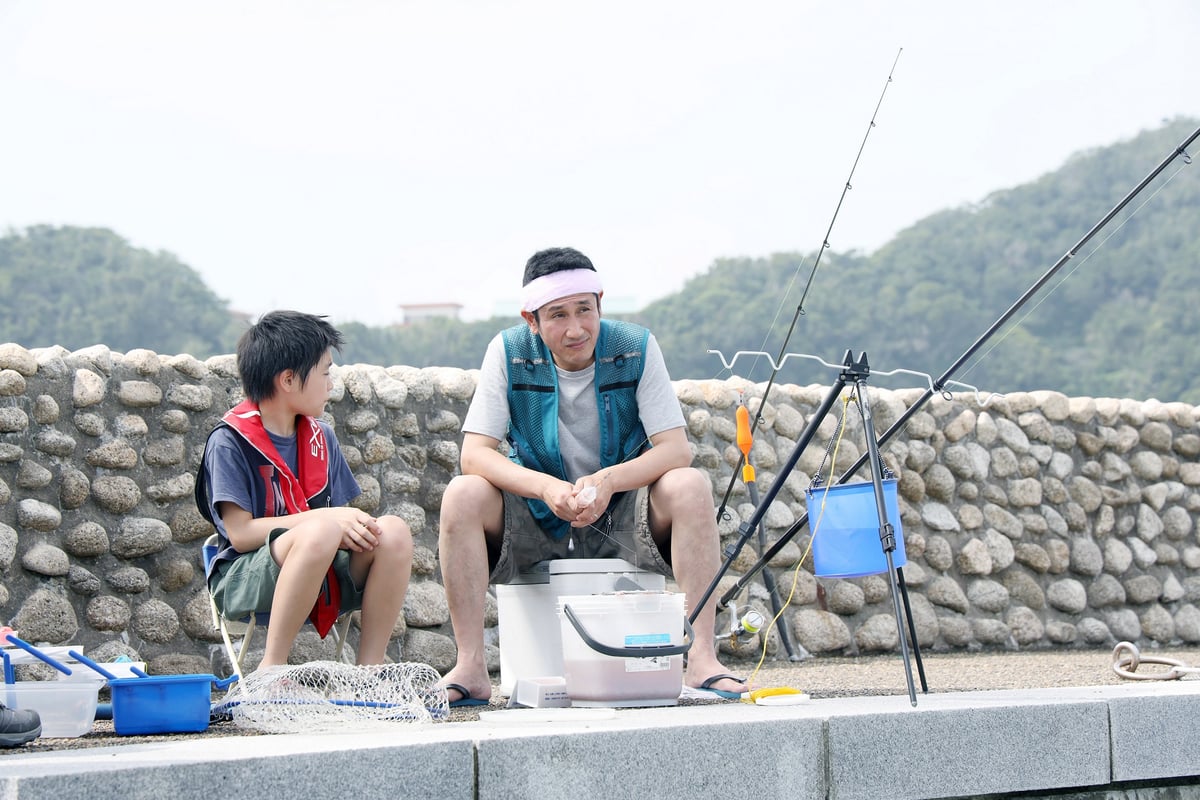
It is obvious that Fumi has taken a liking to Goro Shinada, but she still installs an obstacle between them by telling him two lies: she introduces Kohei as her own son and confesses that her husband is working on a whaling ship in the Antarctic sea. Why does Fumi install such distance between herself and Goro? Can she eventually allow herself this romantic happiness? Is meeting him the encounter that will keep her sober yet drunk on love?
Kohei has, besides a romantic problem, a familial problem: he has not fully accepted the presence of Sadao, his mother’s new husband. Kohei’s refusal is, eventually, echoed in a discussion between his mother and Sadao he happens to overhear. The cause of the discussion is the desire of Sadao Kushimoto (Kiyohiko Shibukawa) to relocate for his work to Niigata without Naoko and Kohei. Naoko, who married him in full knowledge that a relocation was in the cards, cannot but receive his wish as an injury and insult. She rightly confronts him with the fact that his wish is merely an attempt to escape his ongoing failure of establishing a parental bond with Kohei. Yet, Kohei has not truly given Sadao a chance to assume a fatherly position with respect to him.
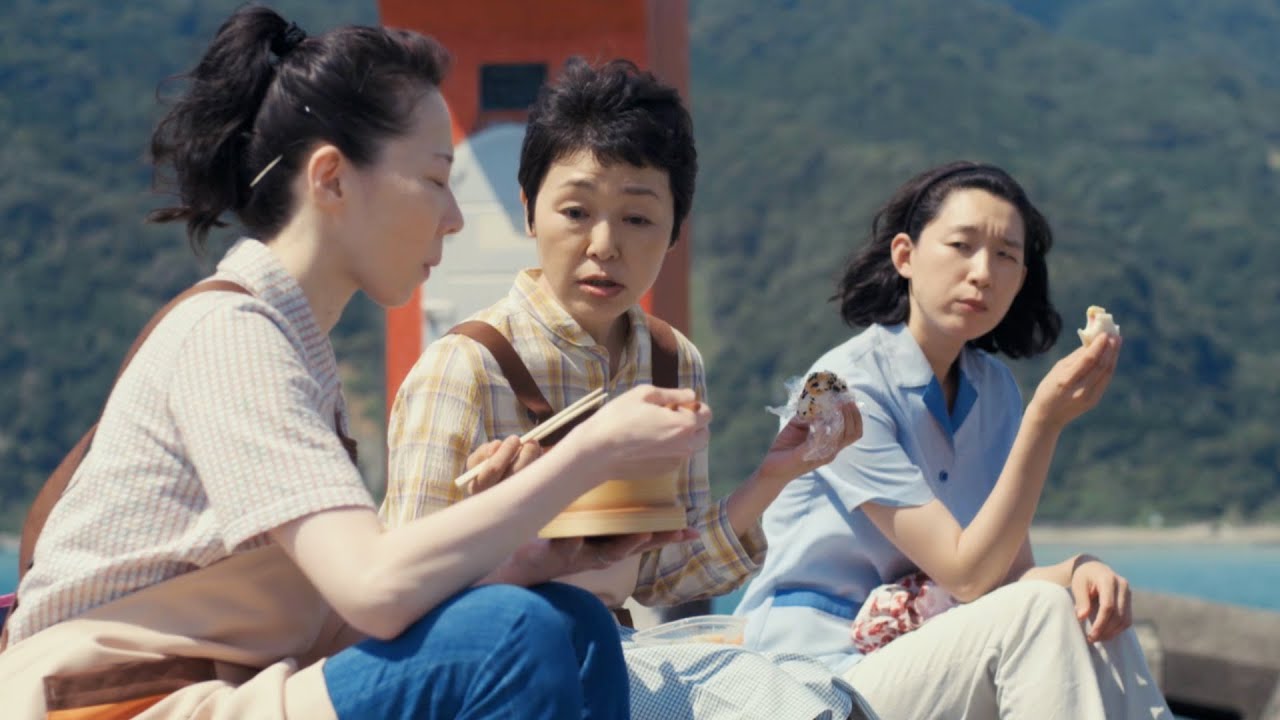
Some years after her husband’s passing, Kikuchi (Noriko Eguchi), a colleague and friend of Fumi, secretly starts dating Junichiro Kikushima (Hakushi Togetsuan), a monk at the temple where her late husband’s grave is. While it is not explicitly touched upon, Kikuchi keeps her relationship secret to avoid the prejudiced gaze of the rural Other, to elude the gossip behind her back about pursuing romance as a widow. Yet, will this continued secrecy not eventually create an obstacle to the future of her new relationship?
The composition of Tsuyukusa is a standard pragmatic affair. Hirayama combines static and dynamic shots in a good way to give his composition a pleasant rhythm that helps engaging the spectator. On the other hands, the way shots are combined reveal that the main reason for the narrative’s visual flow lies in a simple need for variety rather than the communicative potential of the visuals as such. Hirayama thus offers a composition that is easy-to-watch, but does not truly tap the power of composition to deepen the emotional impact of certain moments (Cine-note 1).
Luckily, this visual absence is counteracted by a good use of musical accompaniment and a concatenation of naturally flowing conversations. Hirayama does not overly-rely on music to determine the emotional fabric of given scenes, but uses it elegantly and unobtrusively to indicate the emotional quality of certain interactions as to foreshadow the emotionality that echoes in the interactions that follow.
That the conversations play such an important part in making Tsuyukusa a pleasant cinematic experience is not simply due to their good conversational structure, but due to the way the cast breathes life into those structures. The great chemistry between the cast-members allows the conversational flow to attain its naturalism but also infuse the vocalized signifier with the power to put a smile on the spectator’s face.
Tsuyukusa is a narrative of subtle affection, of emotionality that slowly seeps out of interactions – verbal as well as physical. That this slice-of-life-like narrative succeeds in warming the heart of the spectator is all due to the layered performances of the cast. The chemistry between the cast-members does not merely make the conversations come alive, but enables the subtly woven fabric of emotions to touch the spectator and echo the importance of allowing oneself a chance at a new beginning.

Notes
Cine-note 1: There are, nevertheless, some moments in the composition where Hirayama exploits the communicative power of images and utilizes the beauty of dynamism to deliver a pleasant visual moment.
 psychocinema