Introduction
Just like for Ebirah, Horror Of The Deep (1966), Toho desired to have an island themed adventure with a smaller budget. As the more experienced crew was busy to work on King Kong Escapes (1967), they once again relied on their less-experienced talents – Jun Fukuda as director, Sadamasa Arikawa in charge of the special effects, and Masaru Sato as composer.
While Shinichi Sekizawa is credited as the screenwriter, the earliest draft of Son Of Godzilla was written by Kazue Shiba. This sudden shift at the writing table offers a clear sign that Sekizawa was struggling to come up with new ideas – it seems that he did everything with Godzilla that he wanted to and could do.

Review
Somewhere in the Pacific Ocean, on an island called Sollgell, a team of scientists led by professor Kusumi (Tadao Takashima) are trying to perfect a weather-controlling system to turn uncultivable land fertile for the World Food Planning Organisation (WFPO). Yet, lately, strange mantis-like creatures have started to roam the island and something has been causing regular interference.
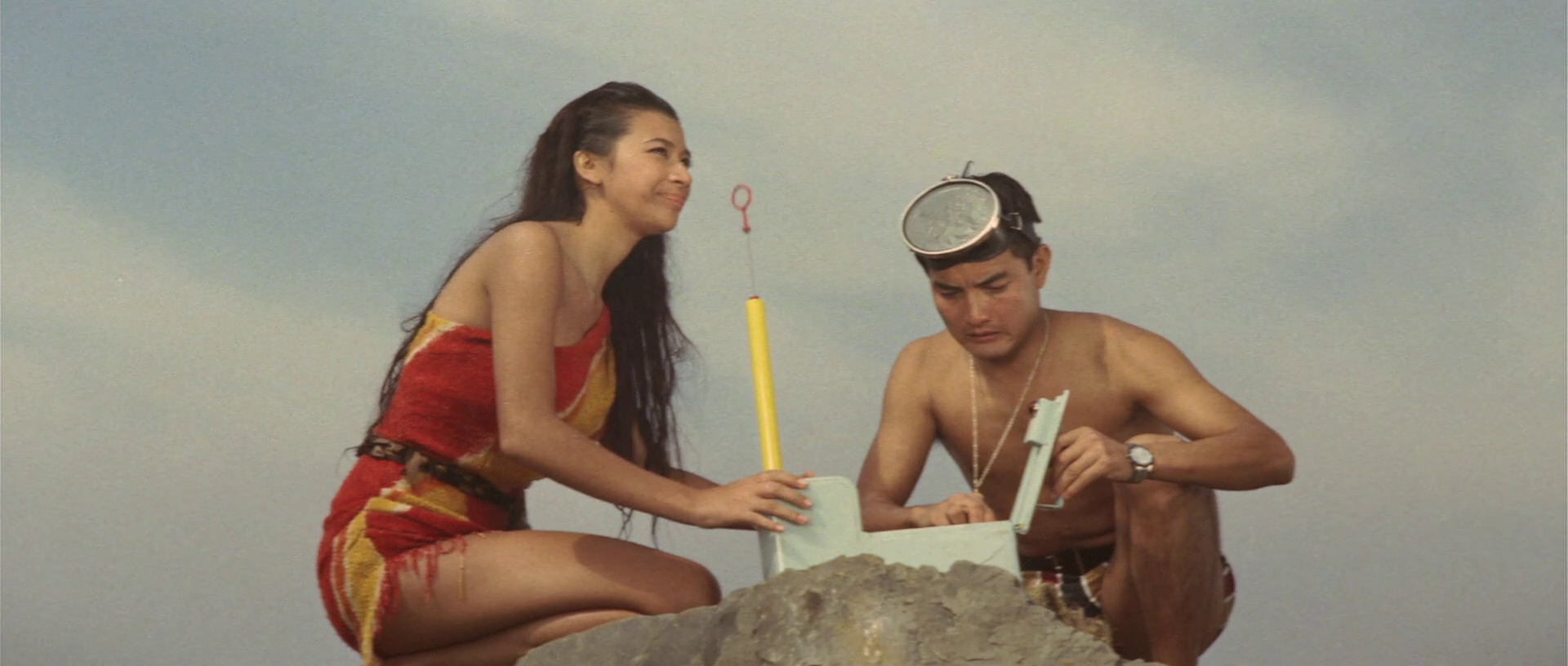
One day, an unwanted journalist, Goro Maki (Akira Kubo) arrives on the island. While, at first, they want him gone – they do not need any PR, they soon allow him to stay to do their cooking. On one of his trips to gather herbs, he sees a mysterious woman, Saeko (Beverly Maeda), swim near the coast. A few days later, Kusumi orders the conducting of the experiment. While, a first, everything goes according to plan, a sudden burst of interference causes the scientists to lose control over the solar-heat-absorbing radiation unit and the towers.
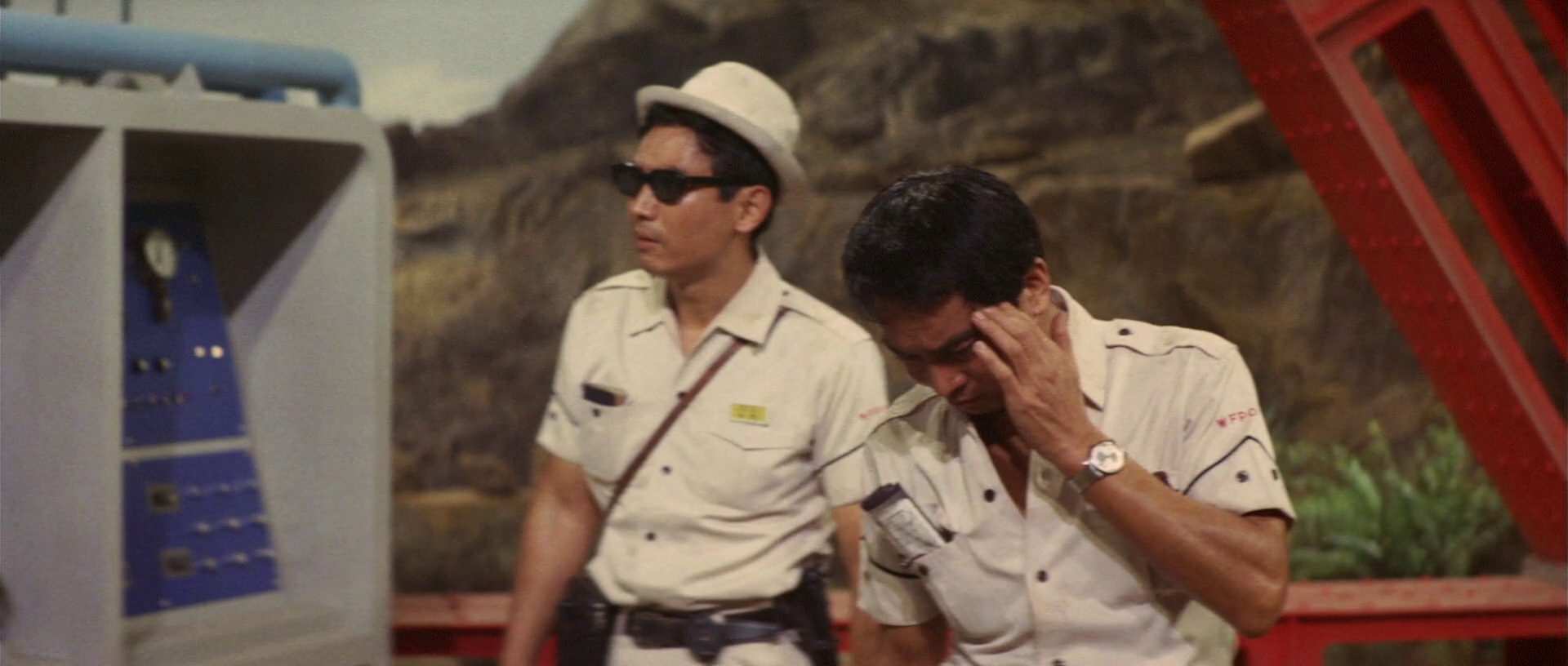
The mere sight of the title of the eight Godzilla narrative immediately squashes the hope that Shinichi Sekizawa and Kazue Shiba would return to questioning the fracture-lines within Japanese post-war societal fabric with his monstrous beings. Yet, while the mere reference to Godzilla’s anthropomorphisation emphasizes that our beloved kaiju does not function as the return of a horrifying repressed truth anymore, such emptying does not necessarily imply that the narrative is devoid of societal critique.
Yet, while Ebirah, Horror Of The Deep (1966) touched upon Japan’s imperialistic tendencies within the pacific and the growing fear of the red monster called China, Son Of Godzilla does not seem to critique anything in particular. The aim of our scientists is not to destroy or conquer, but to create something that can benefit humankind. Yet, one can argue that, with Son Of Godzilla Sekizawa reveals that, even if man is driven by a noble goal, his blind scientific search to control and exploit the earth will ultimately deregulate the natural equilibrium and bring about a variety of natural disasters. Due to the interference that short-circuits their experiment, our scientists do not only create extreme weather, but also cause, by exposing fauna and flora to radiation, the mutation of the mantises into Kamacuras.
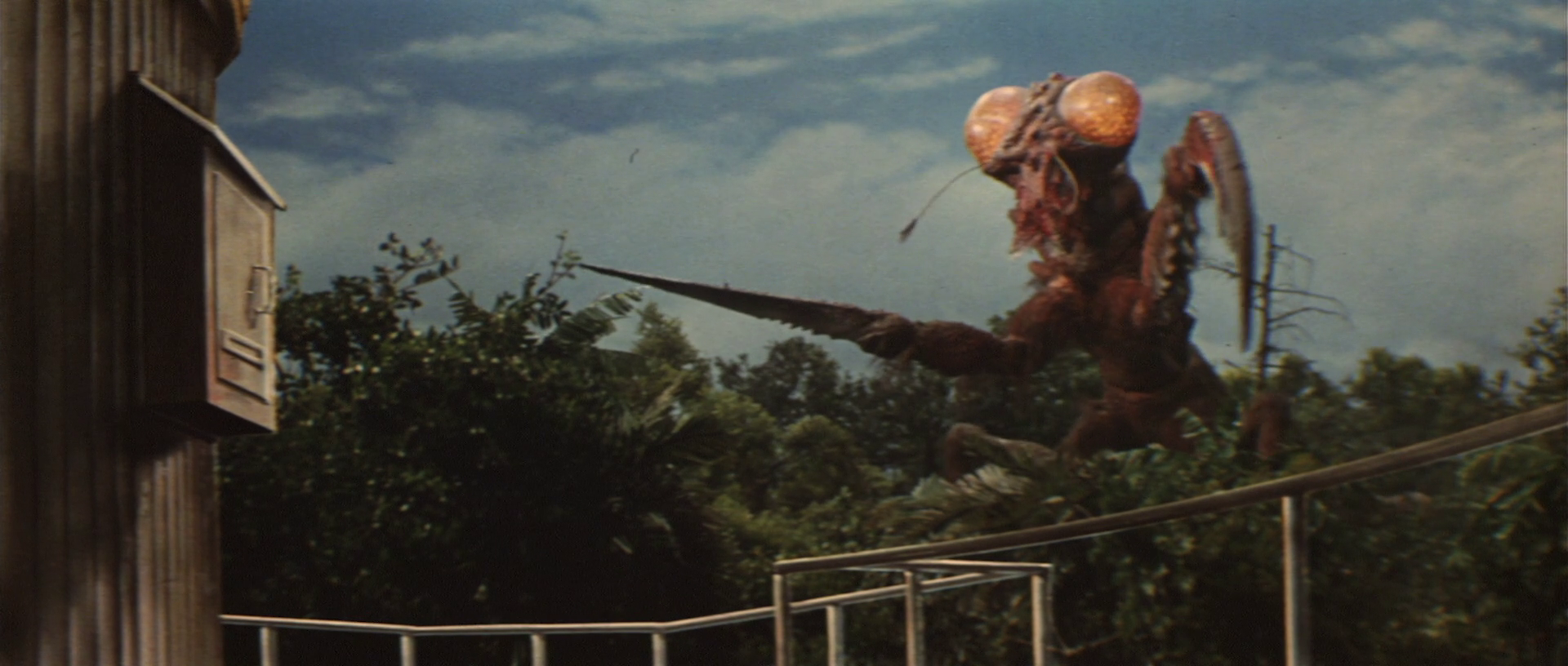
Yet, as the narrative quickly shifts to the exploration of the dynamic between Godzilla (Hiroshi Sekita, Seiji Onaka, Haruo Nakajima) and the baby (Marchan the dwarf), this echo of this critical comment quickly dies out. Sekizawa refuses to elaborate the problematic dimension of science more deeply within his narrative. Moreover, the ending of the narrative can be read as a justification of such kind of scientific play and its unwanted consequences as mere collateral damage (Narra-note 1).
From the opening of the narrative, it is established that Godzilla is attracted by a brain-wave-like thing that causes interference around Sollgell island. Yet, just like in preceding narratives, this event that ‘awakes’ Godzilla is a decontextualized one, an event that is radically cut off from any kind of societal dynamics. In this case, the cause of Godzilla emerging from the ocean is nothing other than the call of one of his progeny. While Godzilla’s destruction of buildings built for the experiment fleetingly emphasizes that humanity should not play god through science, he merely appears on the island to answer the call and assume a parental position.
The centrality of the parental bond in Son Of Godzilla is, furthermore, emphasized by the lack of any conflict, the lack of a phantasmatic enemy that demands an equally phantasmatic unity. In short, the world of kaiju is shown as being radically cut off from the human societal field. Son Of Godzilla does not only affirm Sekizawa’s attempt to turn Godzilla in an empty thematical vehicle, but inaugurates, via its anthropomorphising of monstrous shapes, a radical split between monster and human.

Jun Fukuda’s dynamic composition, while very straightforward, succeeds in keeping the spectator engaged throughout. The main aim of the composition, however, is to create an effective spatial and temporal continuity. Luckily, Son of Godzilla, building on years of experience, does not disappoint. Not only are the many colourful miniatures, the beautiful miniature sceneries, the great sets, monster-designs, … etc. fluidly sewn together but the myriad of effective yet dated composite images ensures that the spectator can fully submerge himself within this phantasmatic world of kaiju.
Yet, spectators will also realize that, despite the effective creation of a sense of continuity, the quality of the special effects, the miniatures, and the destruction is not as high as in Mothra (1961) for example. While the lack of explosive destruction can be explained by the pacific setting of the narrative, such explanation does not suffice to clarify why the many landscapes that form the battle-arenas for our monsters are so bare.
While many of Godzilla’s battles are quite decently staged, there are many moments that will make those spectators longing for a more serious narrative roll their eyes. While the baby Godzilla looks cute, its initial helplessness is as endearing as it is silly. It is, moreover, be evident that the mere possibility of using signifiers like cute and endearing proves the radicality of Godzilla’s decontextualization and the evacuation of any kind of traumatic content whatsoever from its monstrous body. In fact, the mere existence of an anthropomorphised baby Godzilla counteracts everything Godzilla ever reverberated about the fracture lines within the post-war Japanese societal field (Narra-note 2).
The musical accompaniment is quirky and playful and, thus, emphasizes the whimsical echo that marks the interactions between the fatherly Godzilla and the child he adopted. The music, in other words, radically deflates the horrifying dimension of these monstrous beings.
Son Of Godzilla might have many fun moments, Fukuda’s second narrative nevertheless constitutes an infantilisation of the evocative and metaphorical dimension of Godzilla. The eight film is the series affirms the creative bankruptcy of Shinichi Sekizawa, the screenwriter, and corroborates Tomoyuki Tanaka and Toho’s thirst to exploit their monster to attract new audiences – e.g. children and the then popular ‘date crowd’.

Notes
Narra-note 1: This view on science, which Sekizawa and Kazue Shiba evoke within his narrative, can also be utilized to justify the testing and the creation of the atomic bomb. Son Of Godzilla, thus, delivers a highly ironic message – one that does not merely go against the metaphorical nature of Godzilla, but radically evaporates it.
Cine-note 1: One time, due to a wild camera-movement, the sense of spatial and temporal continuity is disturbed by offering the spectator an unintended glimpse of what hangs above the set. This happens around 34:20.
Narra-note 2: Due to the fact that baby Godzilla can roar and use the iconic atomic ray beam, Godzilla is radically reduced to being merely one entity of a species, rather than a spectre
 psychocinema
One Comment Add yours