Introduction
When genius programmer Isamu Kaneko was found guilty for creating Winny in 2004, it did not only cause shockwave within Japan, but also around the world. The judge’s decision, obviously given to serve the greater good, however caused more damage for the blossoming technology industry in Japan.
Now, 12 years after the case found its ultimate resolution, Yusaku Matsumoto (Noise (2017), It’s All My Fault (2022)) offers a filmic account of the tragedy that befell Kaneko and Japan. Can this historical bio-pic leave a lasting impression?

Review
One night, programmer and computer engineer Isamu Kaneko (Masahiro Higashide) releases a peer-to-peer file sharing program called Winny online. Nearly instantly, Winny is turned by Japanese netizens into a very popular tool to illegally share films, music, and games.
Of course, this success and the loss of profit it brings with it leads to calls for stricter regulations and more severe punishments for violating copyright. And not much later, the first arrests are made. Besides Masahiro Ida (-) and Kyohei Minami (-), who uploaded a lot of illegal material, the creator of the software is questioned and asked to write a pledge in which he falsely confesses knowing his program would proliferate piracy. Six months later, he is arrested on the charge of aiding and abetting piracy. A court battle ensues between Kaneko’s lawyers Dan (Takahiro Miura), Hayashi (-) and Akita (Mitsuru Fukikoshi) and prosecutor Seiji Isaka (-) of the High-Tech Crime Task Force, who tries all kinds of tricks to make sure Kaneko is convicted.

Winny should not be seen as a simple court-drama, but as a slow-paced staging of a personal tragedy, of the very way the societal field can radically hurt a subject’s logic and destroy his trajectory – Isamu Kaneko’s life is put in disarray by the court-case. Rather than showing the spectator the dangers of technology, Matsumoto’s narrative reveals the dangers of the Other of the law, the fearful Other who does not know, on technological advancement (Narra-note 1).
The narrative turns around a simple question: Can a software creator be charged for the criminal way others exploit his program? Or, to put it somewhat differently, can the creation of Winny, a tool aimed to guaranty the freedom of speech, be seen as an act of technological and informational terrorism? While many spectators will immediately and rightly so say ‘no’, Winny shows that, in the early years of the blossoming of internet and technology, such answer was not obvious for the ignorant Other.
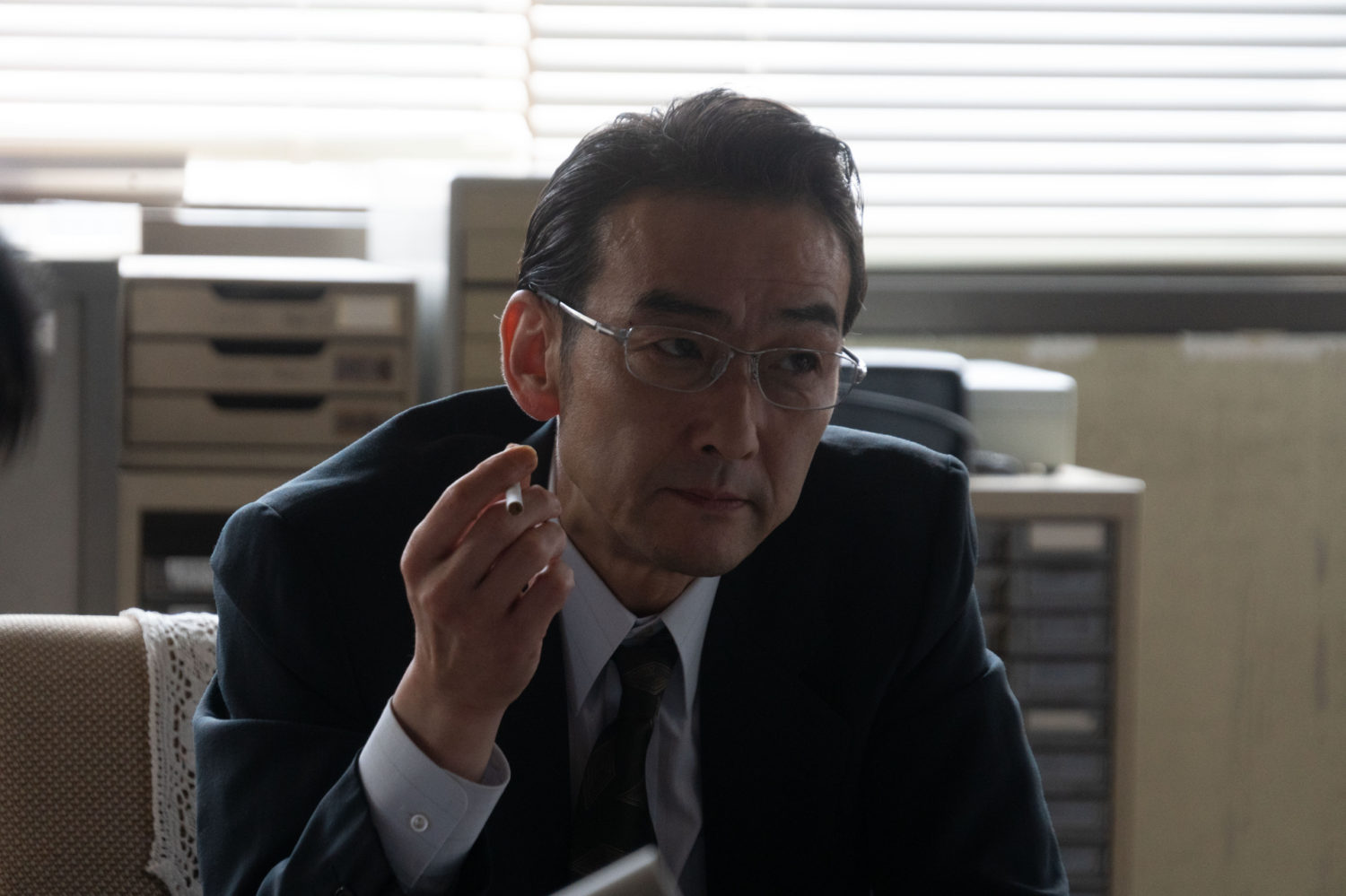
As the narrative of Winny progresses – and Kaneko finds himself more and more in an awkward position, it becomes apparent that the only chance for the court to be turned in his favour is by an event that proves that his brainchild is radically devoid of any illegal intent. To prove such thing, it is necessary that the association between Winny, sharing and illegality is radically rewritten for the Other of the law and its representative, i.e. the judge. While one can share illegal files and disturb the societal harmony by violating the copyright laws with Winny, it is entirely possible that some shared files expose the illegal rot that nests well-hidden within the societal field. Yet, can the mere revelation of such rot truly change the verdict?
The dimension of societal rot is closely linked with the riddle that structures the narrative. The riddle can be summed up in two questions: Why was Kaneko arrested in the first place and why in such a haste? And, what is the hidden agenda of the police force?
That the police has an agenda is underlined by the strange fact that the plaintiffs in the case are the police themselves. Kaneko’s case is thus not a damage suit based on a criminal complaint by a company that demands compensation for the loss of profit the piracy caused, but a case where the offense is decided by the authorities themselves.
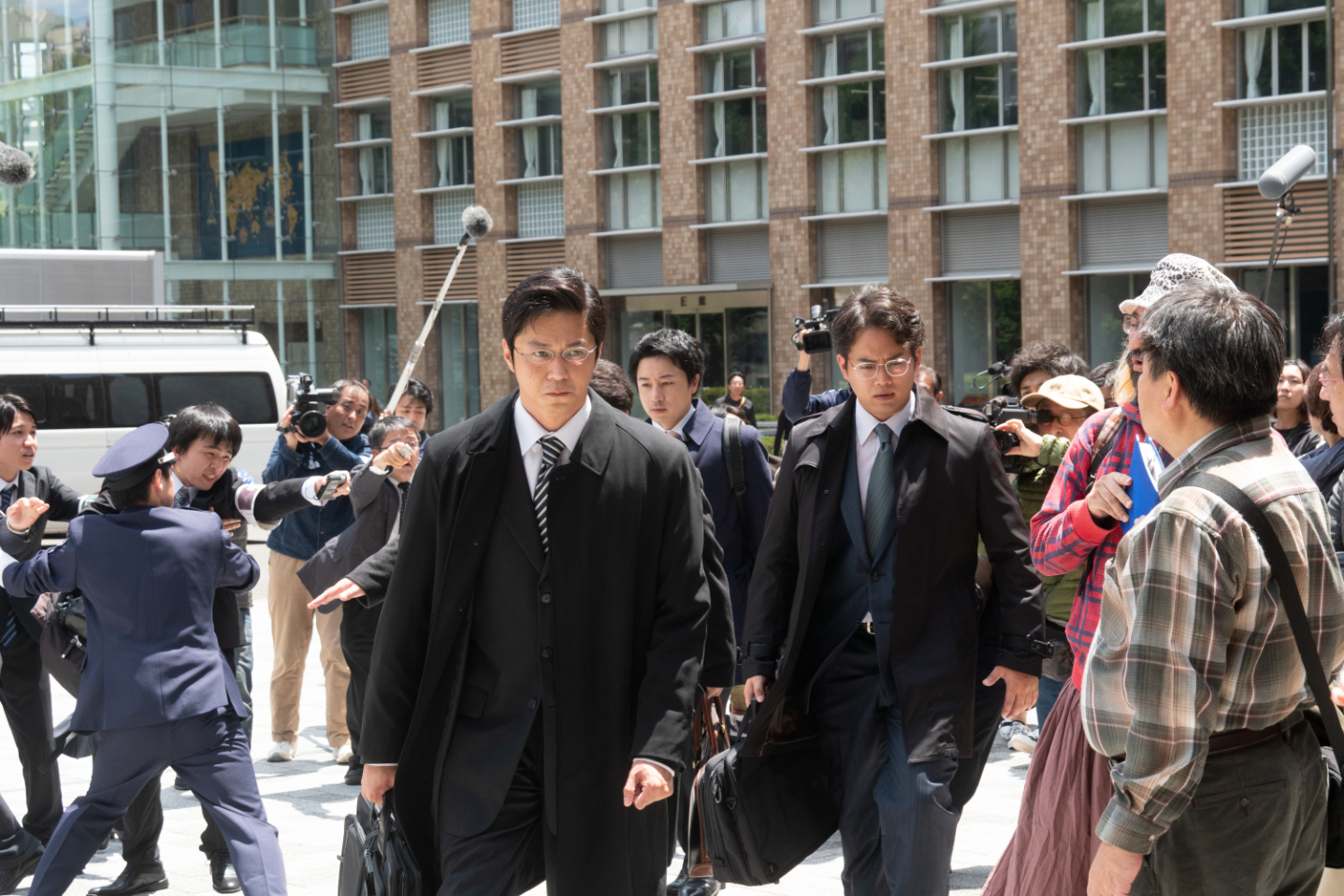
Winny exposes, just like Chauhan’s December (2023), the narrative truth of court-proceedings, the fact that all comes down to creating narrative fragments to direct the judge’s interpretation of the letter of the law. The battle within the court, in particular, comes down to the tactful creation and exploitation of narrative inconsistencies to not only diminish the power of the person on the witness stand but to slowly crack the other party’s narrative, one constructed by a framework of fragmentary pieces of evidence.
Matsumoto created an engaging rhythm for his composition by thoughtfully concatenating static and dynamic shots. While Matsumoto mainly relies on subtle dynamic movement (i.e. the slow spatial movement that is used abundantly) throughout his composition, there are a few moments of rougher dynamism in the visual fabric.
By having a quantum of fluid dynamism present, Matsumoto does not only succeed in making the few transitions to more rough or more floaty dynamism more fluid, but also reverberate how the creation of Winny comes to radically disturb the otherwise peaceful life of Isamu Kaneko (cine-note 1).
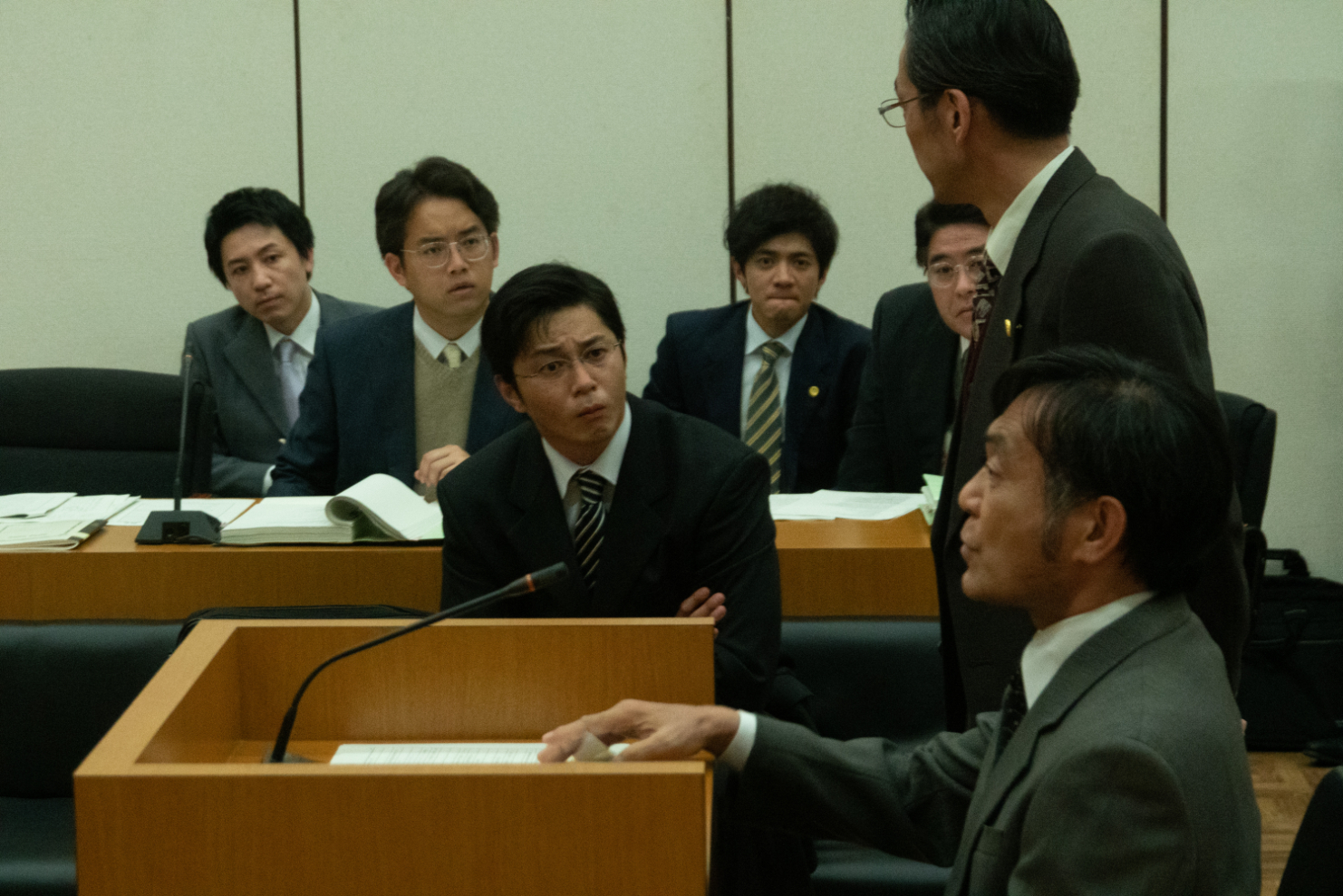
The static shots in Matsumoto’s composition often deliver a pleasant geometrical composition, hereby subtly heightening the overall visual pleasure of imagery (cine-note 2). By using dynamism in an effective way and not ignoring the power of visual tensions within static shot-compositions, Matsumoto succeeds in delivering a well-balanced visual fabric that pleases the scopic thirst continuously.
Yet, the visual appeal of Winny is not only due to Matsumoto’s fine composition, but also due to the effective colour and lighting design. It would not be wrong to state that, besides making the composition more aesthetically pleasing, the colours also heighten the impact of the narrative.
Music is also smartly used to infuse a subtle quantum of tension and emotionality into the way the game on signifiers unfolds, into the rhythm of enunciations and their retorts as well as into the verbally developed traps to exploit witnesses (e.g. expose their lies, … ) in an attempt to shift the judge’s opinion in one’s favour.
Masahiro Higashide impresses with his performance as Kaneko. By using a method-like devotion to bring the programmer alive – he gained 18 kilograms and integrated a variety of tics and mannerisms into his performance, he succeeds to bring the autistic logic of this talented programmer vividly and engagingly to life.
Winny is fantastic filmic narrative. Matsumoto smartly avoids the trap of overt melodrama so that Masahiro Higashide can make the tragical finality of the narrative functional and effective with his performance. By delivering, first and foremost, a character study with Winny rather than a dramatic court-drama with a overly dramatic rhythm, Matsumoto offers a serene insight in how the Other of the law curtails a subject and, indirectly, sabotages the prospects of a new industry.

Notes
Narra-note 1: While it remains quite indirect, Matsumoto’s narrative does forces the spectator to stand still with the impact the shackling of such programming genius has caused for Japan. What they destroyed was much more than Kaneko’s life, but Japan’s chance to be on the forefront of technological advancement in the digital age.
Cine-note 1: Due to this stylistic choice of shifting dynamism,Matsumoto makes the attempted arrest of Masahiro Ida by the Kyoto police not only more visually but also emotionally more interesting.
Cine-note 2: Matsumoto’s composition boasts many pleasing symmetrical compositions. The visual pleasure of certain shots is sometimes heightened by the pleasant use of depth-of-field.
 psychocinema