Introduction
People might or might not know that the popular game Corpse Party has two live-action adaptations, Corpse Party (2015) and Corpse Party: Book of Shadows (2016). Both were directed by the rather unknown and ‘underground’ director Masafumi Yamada, the director of Tsuburo no Gara (2004).
Review
One day, an injured woman (Yuko Hosoe) wakes up in room in an abandoned building. Upon exploring this strange environment, she suddenly discovers a living man (Hiroyuki Yoshioka) under a bed with a weird metal contraption installed on his back. The woman tries to find a way out, but the man seemingly knows it’s impossible. Sometime later, the phone in the room starts ringing.

Tsuburo no Gara is an underground cyberpunk narrative built around a myriad of intersecting mysteries or riddles. Why is there a contraption on his man’s back? What is wrong with him? Why are they both locked up? What is the woman’s purpose? Why has the man been there for so long?
Answers to some of these questions is formulated by the woman discovering things pertaining to the man in the locked room or by the fragmentary flashbacks. These flashbacks are either free-floating interjections of quite disturbing imagery or visual elaborations of the woman’s shocking discoveries. Yet, despite these few flashbacks, Yamada firmly refuses to give conclusive answers or any answers at all, allowing his simple narrative to maintain its disturbing and estranging feeling until its conclusion (Narra-note 1).

By exploring these riddles, Yamada slowly puts the emphasis on the dynamic of their relation. Initially, the dynamic is between a subject who wants to escape and a subject who believes he’s locked up forever in this cyclic life of sleeping and eating medication. The clashing of these desires does not only cause these subjects to avoid communicating, but also creates a certain friction between them. Can their minimal conversations alter their desires and change their relationship? Will the woman succumb to the mental impact of the isolation and the presence of an estranging subject with the contraption on his back? Is here truly no way out?
Yamada’s composition of Tsuburo no Gara might be simple – a concatenation of static shots with some shakiness thrown into the mix, yet his careful mixture of estranging visuals (e.g. snails, machinery, … etc.) draped in bleak washed-out colours, eerie sounds and sensible silences, and experimental minimalistic musical pieces allows him to craft a claustrophobic atmosphere that makes the spectator feel ill at ease while also luring his attention (sound-note 1).
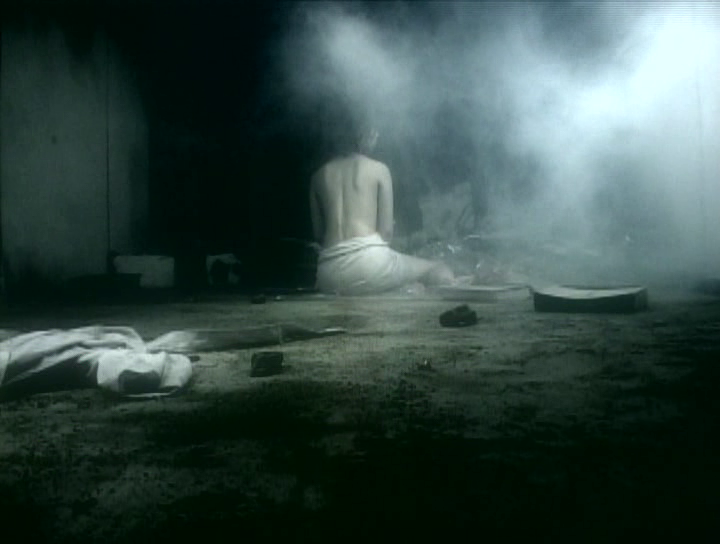
The reason why the spectator feels ill at ease not only function of Yamada’s focus on visual details and their textures through close-up shots (e.g. of moist-skin, concrete walls and blocks, bolts, act of breathing,… etc.), but also due to the fact that some of these images are presented in such way that these estranging visuals escape signification. Due to short circuiting the process of signification, certain images in Yamada’s narrative attain a haunting quality and will linger in the spectator’s mind long after the film has finished.
Yet, what compels the spectator is the composition of certain shots. It is evident from Yamada’s composition that he took some effort to deliver shots that are, despite their strengthening content, aesthetically pleasing. He succeeds in giving the spectator such moments of subtle visual pleasure, mainly, by playing with light and shadows, but sometimes by exploiting geometry.
Tsuburo no Gara might not have a low-budget or a complex story, but Yamada did succeed in crafting a very atmospheric film that keep the spectator’s interest while making him feel ill-at-ease. Anyone who likes cyberpunk cinema, should check Tsuburo No Gara out.

Notes
Narra-note 1: Some might argue that Yamada’s narrative explores the liberating power of sexuality, while others might contend that it offers a twisted take on the necessity to meet the other beyond his Otherness. Both answers are, in a certain sense, correct.
Sound-note 1: Silences either become sensible by the lingering of a noise that echoes silence as such or by being emphasized by additional sounds, like the ticking of a clock.
 psychocinema
Sounds very interesting!