Introduction
While Junya Satō started his directorial career in the yakuza genre, he only gained fame and recognition with the big-budget spectaculars he directed. Fans of Japanese cinema may know him from The Go Masters (1982), a China-Japan co-production, he co-directed with Duan Jishun or The Silk Road (1989), one of the highest grossing films ever in Japan.
While these movies are from the eighties, Sato’s shift from the yakuza genre to other genres, like action, started in the seventies with Golgo 13 (1973), an adaptation of the manga of the same name, and The Bullet Train (1975), one of the movies that inspired the American action film Speed (1994).

(Now available on blu-ray by Eureka Entertaiment.)
Review
One day, the director of Railway Security, Yoshinori Miyashita (Fumio Watanabe), learns that there is a bomb on the Hikari 109, a bullet train bound for Hakata, that will go off if the train’s speed goes below 80km/h. The mastermind behind the bomb is Tetsuo Okita (Ken Takakura), the owner of the now defunct Okita Precision Instruments, while Hiroshi Oshiro (Akira Oda), his former employee, and Masaru Koga (Kei Yamamoto), a radical activist, a bringing his elaborate plan to fruition.
Yet, a sliver of doubt about the success of his terroristic endeavour has settled within Okita. Shinji Fujio (Eiji Go), a criminal who forced himself on the team, was not only arrested one day ago, but is also present on the targeted bullet train. So, what does Okita want and can he, successfully, obtain it from his target? Or can, Aoki (Shinichi Chiba), burdened with the task to find the bomb on the train, avoid a disaster (General-note 1)?
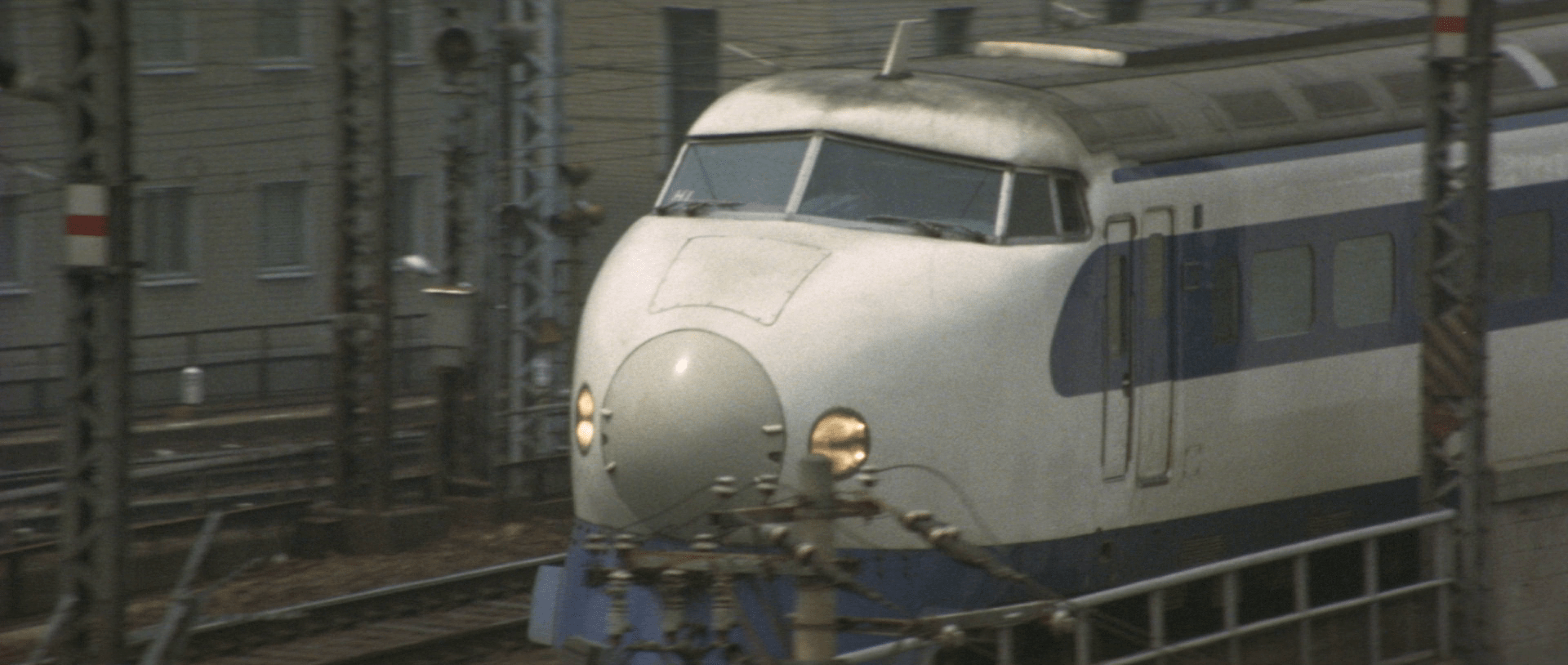
The Bullet Train, by being primarily a thriller narrative, does not offer that much thematical depth. Nevertheless, there are two thematical planes in the Sato’s narrative that elevates the narrative and sets it somewhat apart from other thriller and disaster narratives.
The first thematical plane concerns the conflict between the railway security and the police department, between the responsibility to ensure the safety of the passengers at all costs and the thirst to apprehend the criminals. This conflict does not only infuse more dramatic in the unfolding of The Bullet Train but is also used effectively to heighten the tension within the narrative.
The second thematical plane is introduced via flashbacks and concerns the birth of the plan to put a bomb on a shinkansen. The spectator learns, as the narrative unfolds, that its initial enunciation was due to the combination of three elements: Oshiro’s accident while working for Daito Construction, Koga’s fight to get some form of monetary compensation from the company and Okita’s fatherly feelings for Oshiro. By offering such revelations, Sato ensures that the spectator feels some sympathy for the trio of bombers – it is, in fact, impossible to qualify them as evil.
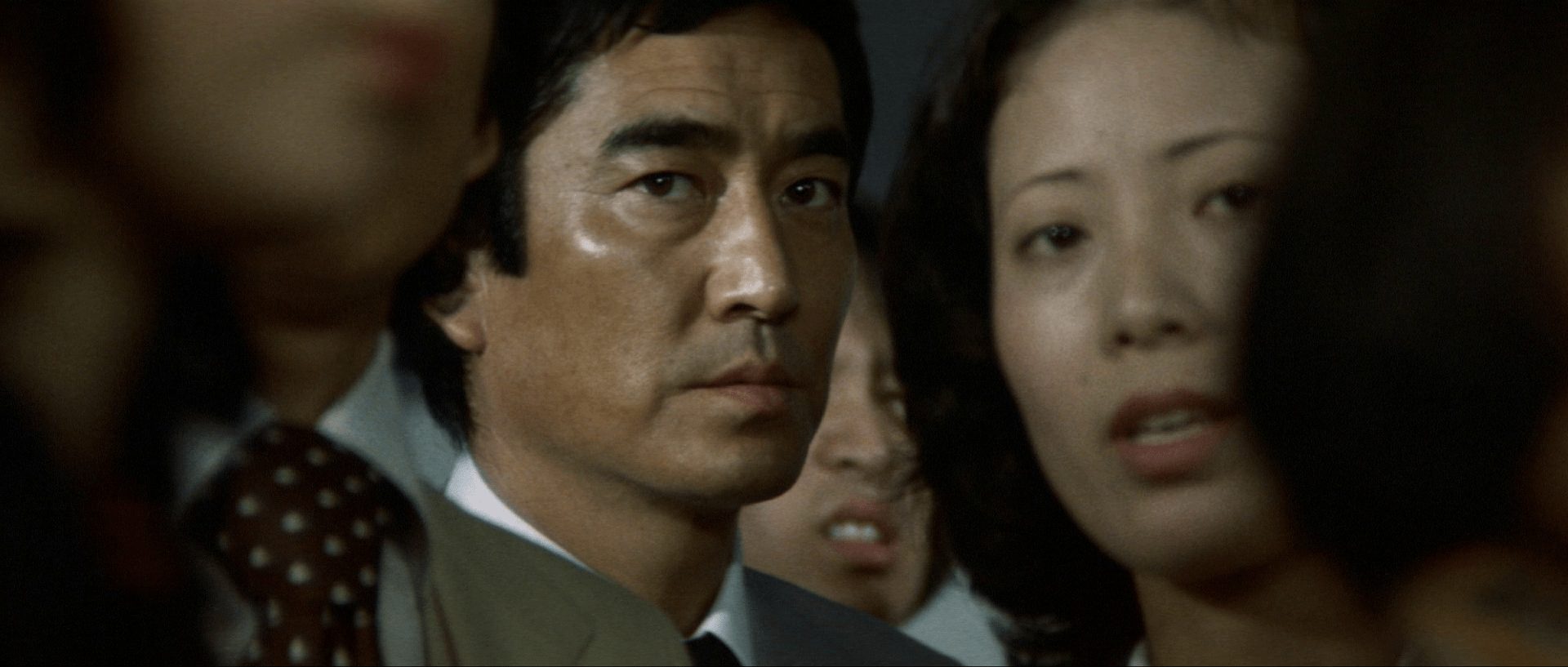
While The Bullet Train does not delve that deeply into the motives of our trio outside of these revelations, it is nevertheless possible to utilize these snippets and interpret their radical act. Rather than simply being an attempt to extort money from the government, Okita’s plan is, in a way, directed at the very failure of society to protect and support its citizens – i.e. Oshiro felt forced to drain his blood to get some money to survive, Okita lost everything when his company went under and Koga’s revolutionary reflex was violently squashed by a government that wilfully remains deaf for the discontent it produces.
Yet, this radical plan is ultimately a failure, a botched act of communication as the frustration with the societal equality remains fundamentally unsaid. Their singular focus on extorting money to ‘liberate’ themselves from the Japanese Other, i.e. society as such, transforms them into mere terrorists for the societal Other. The act fails to articulate their desire for societal change and their wish regain his trust in the societal system and the human beings that structure and regulate it. In the end, this well-orchestrated burst of frustration does merely ripple the fabric of society.
The dynamic composition does well in keeping the spectator on the edge of his seat through its entire runtime. This is, firstly, due to Sato’s thoughtful play with the rhythm of his composition. The flow of the imagery is both dictated by Sato’s shifts speed of cutting and by letting the speed of the movement of the characters on-screen dictate the pace of the tracking-movement.
The infusion of drama and tension into the narrative fabric is, secondly, due to Sato’s rich use of zoom-ins and zoom-outs to enliven his composition. Zoom-in movements are generally applied to emphasize the dramatic nature of a certain narrative revelations or obstacles to overcome. Yet, some of these shots serve a different purpose, e.g. to create a close-up shot that introduces a flash-back. Zoom-outs, on the other hand, are used to heighten the impact of a unexpected flash of violence, to add some dramatic flair to the unfolding of a given scene, or decorate the end of a flashback (Cine-note 1, Cine-note 2).
Other decorative elements are richly applied as well within the composition. Sato exploits bursts of shaky framing – i.e. hand-held shots – and more dramatic camera perspectives to heighten the impact of violence, be it crashes or explosions. By doing so, Sato makes the action more tactile and thus engaging for the spectator.
Besides heightening the dramatic flow of the narrative with visual decorations, tension is also infused into the unfolding of the narrative by delightful dramatic musical accompaniment. In fact, what makes The Bullet Train so engaging as an action-thriller is the very harmony between these dramatic visual decorations and the musical accompaniment, the way both elements, by reinforcing each other, build up the tension within the narrative.
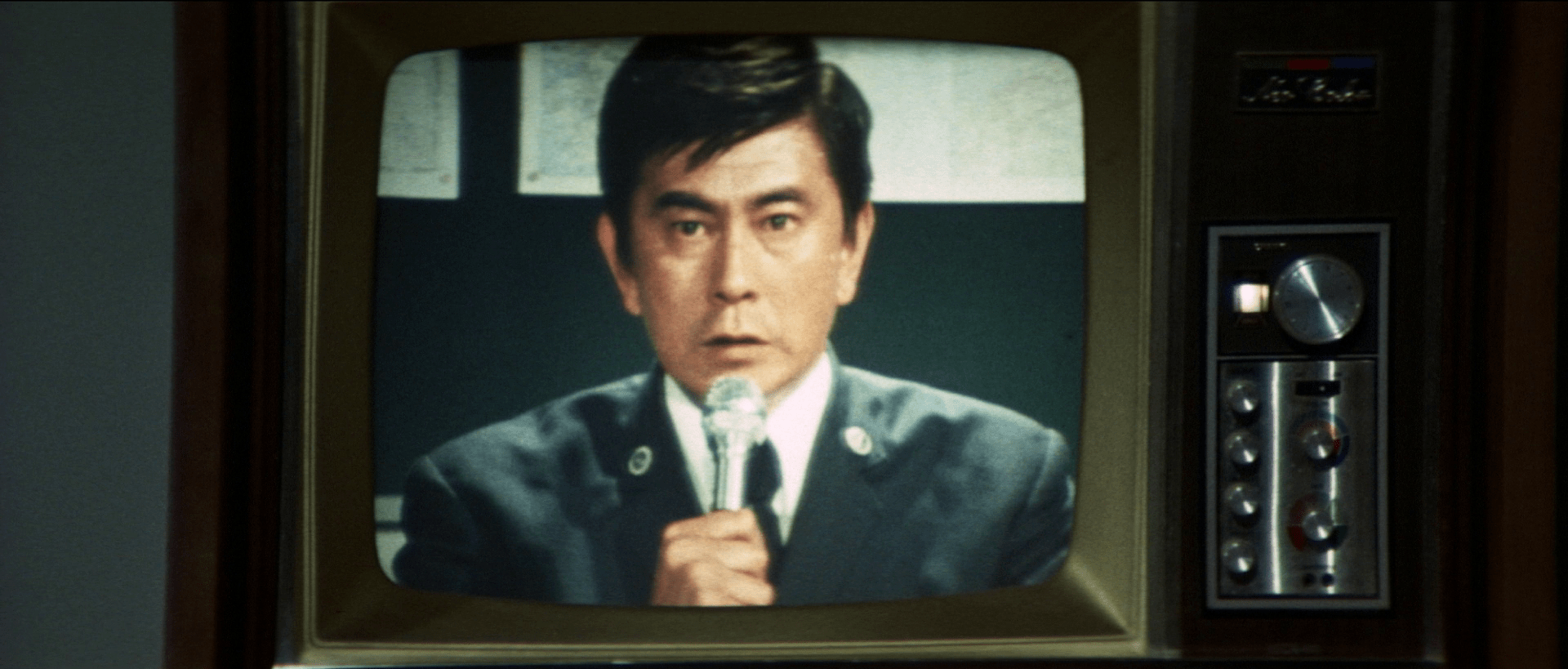
The fact that the build-up tension does not deflate is due to the engaging performances of the cast as well as the extras. Shinichi Chiba, for instance, does not merely instil fear in the spectator, but also echoes the gravity of the situation by indicating the very responsibility he feels as the bullet train’s conductor. Ken Utsui, who plays Kuramochi, also breathes out the responsibility that guides his conduct with a deliciously dramatic flavour.
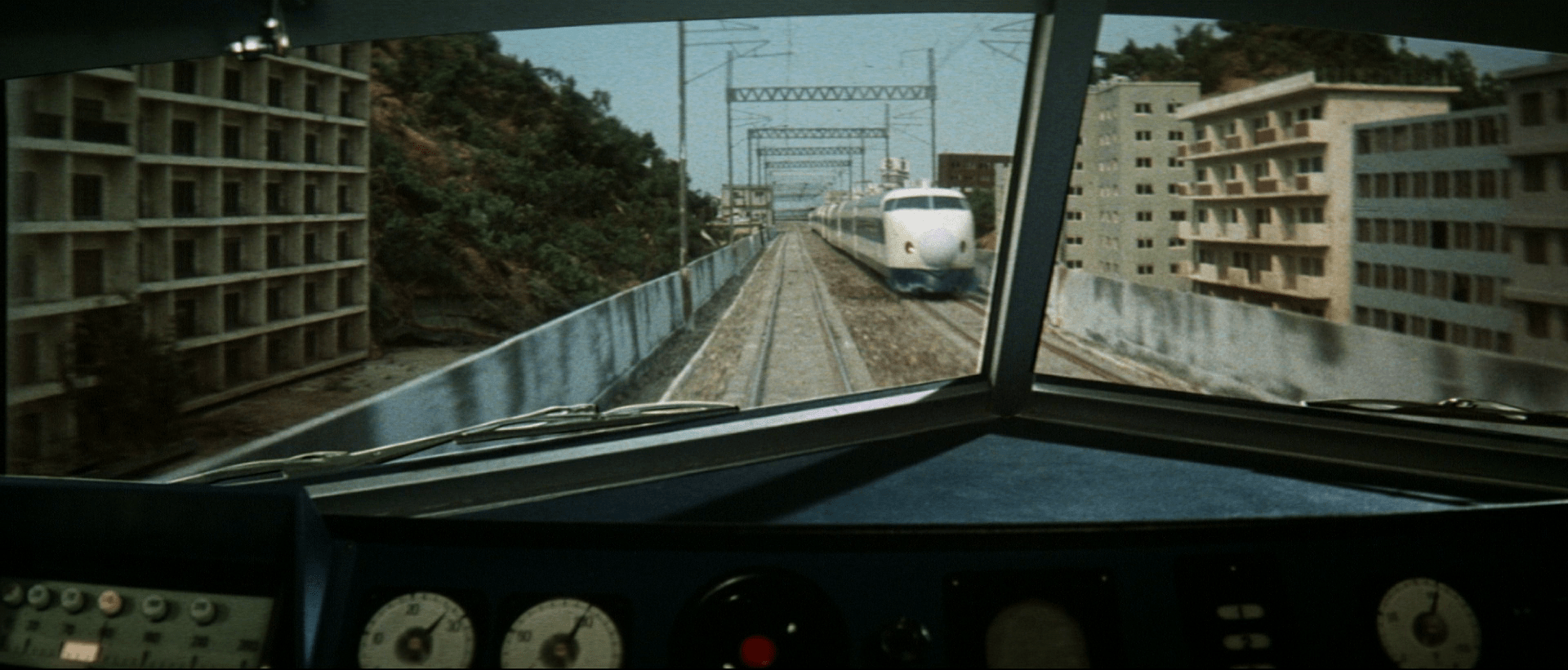
To bring this dramatic thriller to life, Sato and his crew had to rely on special effects as well as use miniature models and scenery. The Bullet Train heavily relies on composite imagery (the cockpit-shots) to support the fantasy of a bullet train that needs to keep its speed higher than 80km/h to avert the death of many. The models, on the other hand, are utilized to stage the more dramatic moments that, if gone wrong, could have ended in disaster. While the effects are, of course, dated and at times rough around the edges, the combined forces of the composition and the performances ensure that the spectator can suspend his disbelief and enjoy the dramatic flow of the narrative.
The Bullet Train is a highly engaging and satisfying thriller narrative. Sato does not only prove that he can manipulate the visual fabric in a way that ensures that the spectator experience tension throughout the twist-rich narrative, but also knows that, by granting space to his cast to breathe life into the fears and responsibilities of their characters, he can heighten the dramatic impact of the denouement of the narrative and ensure the spectator’s enjoyment.

Notes
General-note 1: The whole network of bullet trains (e.g. their speed, their direction, … etc.) is governed by the CTC, Centralised Train Control. Each bullet train is, up to a certain level, automatized by the ATC (automatic train control). The ATC ensures that the train does not exceeds its set speed and that it will stop if there is an obstacle on the train tracks.
Cine-note 1: The close-up and the visual emphasis on the facial expression created by the slow zoom-in and zoom-out movement also helps emphasizing visual elements (e.g. the burning of a cigarette, the stillness of a facial expression) that reveal a certain emotion of the character (e.g. Okita’s doubt) who has the flashback.
Cine-note 2: In certain instances, zoom-out movement is also utilized to heighten the dramatic flavour of speech-interactions.
 psychocinema
One Comment Add yours