Introduction
While Ebirah’s opponent was meant to be King Kong, as first pitched by Shinichi Sekizawa, the conflict concerning the director and special effects director between Toho and Rankin/Bass led to latter to pull out of the project.
Yet, as Toho liked Sekizawa’s script so much, they asked Sekizawa to replace the monstrous ape with Godzilla instead. They kept Jun Fukuda on board as director and gave Eiji Tsuburaya’s protege Sadamasa Arikawa the control over the special effects – yet, not without letting Tsuburaya supervise and forcing Arikawa to limit the expenses as much as possible.

Review
Not long after a fishing boat has gone missing in the south seas, Ryota Kane (Toru Watanabe), firmly believing the words of a psychic that his brother Yata Kane (Toru Ibuki) is not dead, tries to convince the police to organize a search a party. Yet, as no one believes him, he ends up searching for a boat himself.
Thanks to the help of Ichino (Chotaro Togin) and Nita (Hideo Sunazaki), two men he met at a Dance Marathon, he can steal a yacht – the one where robber Yoshimura (Akira Takarada) was hiding. During a heavy storm, their ship is attacked by a creature with a giant claw and they wash ashore on Devil’s Island. They soon come to realize, after encountering an escaped slave called Daiyo (Kumi Mizuno), that this island is used by a well-funded organisation called the Red Bamboo to create atom-bombs and other destructive weaponry.
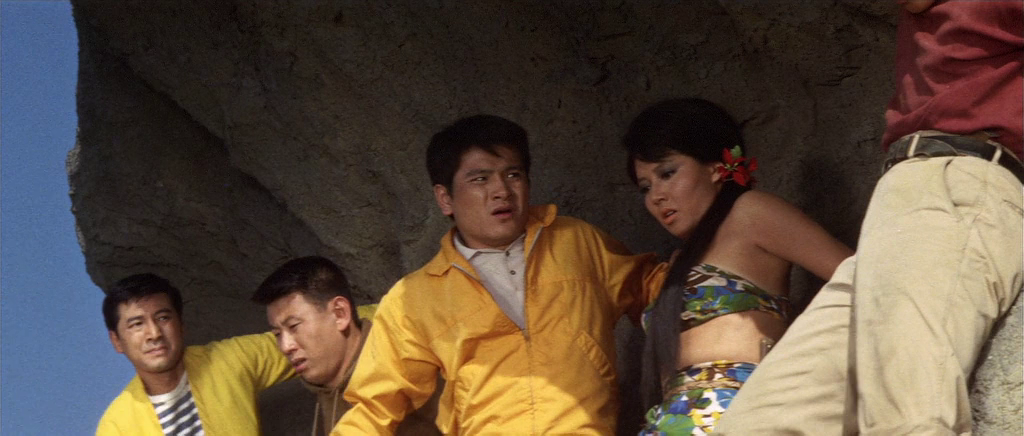
Just like in Invasion of Astro-Monster (1965), the narrative turns around a conflict between an instance that is marked by imperialistic tendencies and those who are subjected to and enslaved by their desire for power. While there are no explicit references to any historical events, the fictional pacific setting does, nevertheless, vaguely echo the destructive impact the Japanese empire had during the Second Sino-Japanese and Pacific Wars.
Has Shinichi Sekizawa, once more, shifted the focal point of his kaiju narratives? Is he trying to critically look at Japan’s war-time past. Sadly, this is not the case. Despite this vague association, one can only gain a grasp on what the terrorists group represents by asking the following question: What is the connection between the monstrous Ebirah and this imperialistic terrorist group? Or, to put it more crudely, is Ebirah utilized within the narrative to visualize a certain threatening societal dynamic? While one can surely associate this monstrous lobster with the imperialistic Other and its violent hunger, the spatial dimension of the narrative puts this vile desire outside the confines of the Japanese archipelago. In other words, Ebirah is not a representation of an internal threat to the societal fabric but an external threat, something that is Other to the Japanese societal field and thus endangers it.

The name of the terrorist organisation – the Red Bamboo – and their use of Shenyang J-6 fighter jets implies that this fictional group visualize the phantasmatic threat of the Chinese Other (General-note 1). As mentioned in our analyses of Ghidorah, the Three-Headed Monster (1964) and Invasion of Astro-Monster (1965), the establishment of such a dangerous Other – a danger due to its Otherness – merely aims to emphasize the need for an equally phantasmatic harmony of the Japanese Other.
As Sekizawa continues to structure his narrative around the imaginary dynamic of us against them, It comes surprise that he continues his decontextualization of Godzilla in Ebirah, Horror of The Deep. By letting Godzilla be discovered outside the Japanese archipelago, Sekizawa radically disconnects this monstrous being from the societal fabric (i.e. imperialistic Japan) that gave birth to him. The dynamic of Godzilla’s appearance and disappearance is, furthermore, shown to have no relation whatsoever to the internal frictions and conflicts that mark the societal Japanese field.
Yet, to turn Godzilla into a hero, such decontextualization was a necessary step. Ghidorah, the Three-Headed Monster (1964), Invasion of Astro-Monster (1965) and Ebirah, Horror Of The Deep (1966) all prove Godzilla’s can only attain a heroic shape by being radically thematically empty – all links to the post-war truth this monstrous being once embodied are effaced and repressed.
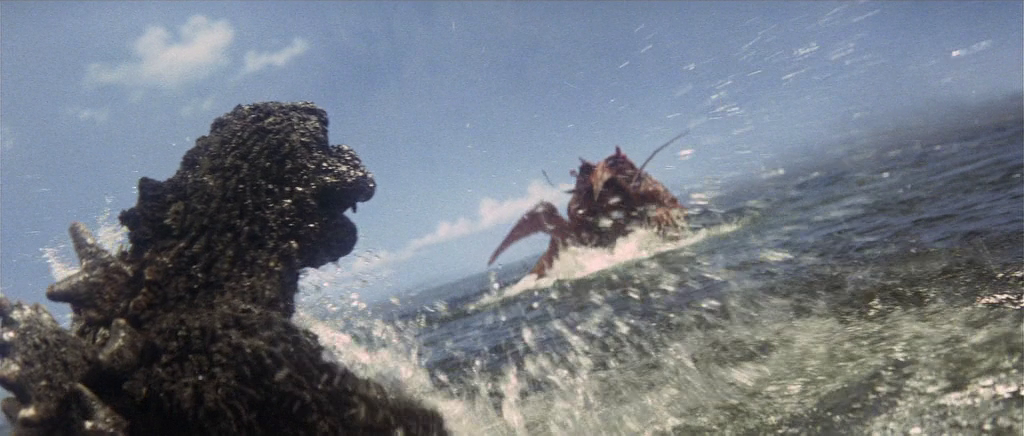
In the case of Ebirah, Horror Of The Deep, the waking-up of Godzilla is presented as a conscious choice on the part of the Japanese subjects. How can be read this kind of ‘weaponization’ of Godzilla? Just like Ebirah is a dangerous destructive tool within the arsenal of the Red Bamboo, of this external Other that needs to be feared, Godzilla is, based on the dynamic of association, presented as a monstrous weapon that can defeat any kind of external threat and thus protect the harmony of the Japanese Other. In this sense, the battle between Ebirah and Godzilla represents nothing other than the effect of the nuclear fear engendered within the Japanese societal field on the need to attain a false sense of uniformity and harmony (Psycho-note 1, general-note 2).
Yet, as the previous movies and Ebirah, Horror Of The Deep also prove, the decontextualization of these monstrous beings as effects of the societal conflicts and tensions goes hand in hand with the choice to anthropomorphize these kaiju. In our view, the emptying out of thematical depth and the erasure of the societal critical dimension is counter-acted by filling them up with more human-like elements. The humanization of the kaiju, which invites audiences to identify with these awe-inspiring beasts, is thus a response to their decontextualization and the sudden refusal to use them to cast a critical glance on the post-war societal field.
Moreover, it is the decontextualization, the disconnection of the kaiju from societal dynamics, that allows Shinichi Sekizawa to confine their monstrous beings to a space that follows their own ‘humanized’ dynamics. It is by echoing the presence of emotions unconnected to the world of humans, that the confrontation between Godzilla and Mothra avoids feeling non-sensical and contradictory. If Sekizawa had continued to utilize these monstrous beings as representations of clashes between societal discourses, this fleeting fight would have radically undone the hopeful import of Godzilla’s defeat at the end of Mothra Vs Godzilla (1964) (Narra-note 1).
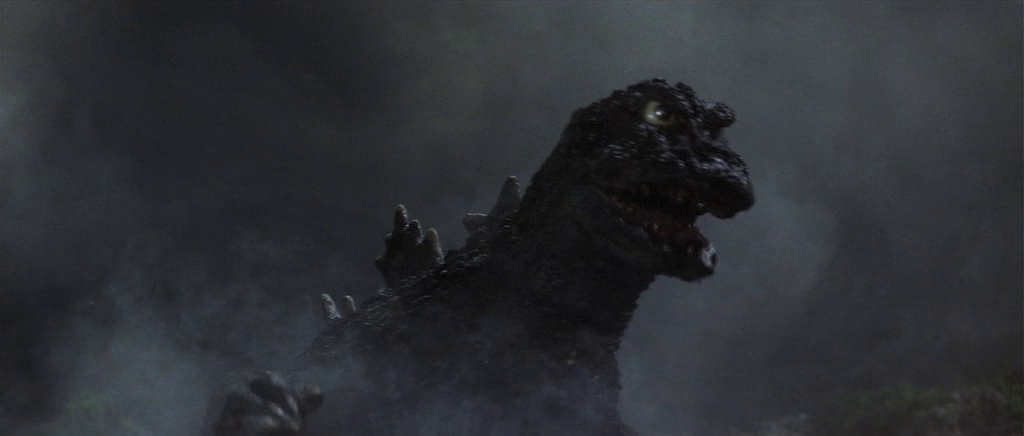
Fukuda delivers a composition that is equally enjoyable as Honda‘s work. He combines static and dynamic shots together well and gives, by utilizing the cut well, a nice visual rhythm to his composition. It is serviceable, carrying the spectator to the moments he desires to see – i.e. battling kaiju.
With Eiji Tsuburaya merely in the role of special effects supervisor and the Toho’s attempt to limit the effects budget as much as possible, one is quite right to fear that it would impact the overall visual feel of the narrative. Luckily, Sadamasa Arikawa’s work on the special effects does not disappoint. Spectators can expect a similar feel of spatial and temporal continuity that previous Kaiju narratives delivered. The storm-sequence is particularly convincing, with all the different shots – i.e. of the miniature yacht, the cast trying not to go overboard, the flash of lightning, and the claw rising up from out of the sea, fluidly sewn together. The limited nature of the effect budget is sensible in the fight between Godzilla and a giant condor called Ookondru – it is not only too short for its own good, but some short-cuts that were taken make it difficult for the spectator to fully suspend his disbelief.
Yet, to create such feel of continuity Arikawa mainly relied on the concatenation of a variety shots and not so much on composite shots – Toho, in fact, instructed him to avoid those kinds of shots due to their cost. Yet, the few composite shots that did make their way into the composition are utilized to great effect.
While Masaru Sato’s musical pieces are quite enjoyable, the playful musical piece that decorates Godzilla’s face-off – or dance-off – with the Shenyang J-6 fighter jets and, later, Ebirah feels somewhat misplaced. Nevertheless, this artistic choice does prove that, rather than being an object to critique society, Godzilla has transformed into an object that provides entertainment wile subtly echoing the importance for societal harmony.
Ebirah, Horror Of The Deep is a pleasant Kaiju film that continues to emphasize the imaginary dynamic of us (i.e. societal harmony) against them (i.e. the Otherness that threatens it) that Sekizawa introduced in Ghidorah, the Three-Headed Monster (1965). Yet, by echoing the atomic fears within the post-war society, Sekizawa avoids Ebirah merely being a reworked copy of his previous narratives.

Notes
General-note 1: There is a possibility that Ebirah and the terroristic group visualizes something of the fear that was lingering within the Japanese field concerning China. It was not a secret that China built uranium-enrichment plants in Baotou and Lanzhou and a plutonium facility in Jiuquan and the Lop Nur nuclear test site. Moreover, on 16 October 1964, two years prior to the release of Ebirah, Horror of The Deep, China conducted their successful first nuclear test, code-named 596.
Whether this echo was intentional or an effect of the societal Other on the unconscious of the screenwriter is less clear.
Psycho-note 1: While the fear is posited as external, an external threat to the societal harmony, it is nevertheless engendered within the societal field. In this sense, it is neither fully external nor fully internal – its both at the same time.
General-note 1: It is due to Sekizawa’s decontextualisation that Godzilla could easily replace King Kong in this narrative. As nothing binds Godzilla to the destructive ripples of the societal field, he can technically ‘show’ up everywhere.
Narra-note 1: One could, of course, try to make sense of this fight by positing that Godzilla, as a representation of the need to protect oneself against Otherness, still poses a danger to the societal field – the desire to obtain a false sense of unity by refusing any kind of Otherness within the societal fabric is not without any destructive consequences. Yet, nothing in the fabric of the film supports such interpretation.
What one can say about this fight is that it reveals Godzilla as being stuck within the imaginary. For him, Otherness is always a danger to him and needs to be squashed and annihilated. In this sense, Sekisawa does echo that the Japanese post-war societal field is radically marked by the same dynamic and that it is a mere field of superficial harmony that lashes out at anything that might endanger it.
 psychocinema
2 Comments Add yours