Introduction
The fact that by the early seventies the Matatabi film – films about wandering yakuza, identifiable by their flat hat and the blue striped cape, in the pre-Meiji period – had nearly disappeared did not stop Kazuo Ikehiro from creating a revenge trilogy. In fact, one could read this trilogy as a swansong to his own career and to the Matatabi film.
Review
One day, Jokichi of Mikogami (Yoshio Harada), who is suffering from a torn toenail, is helped by Kinu (Sanae Kitabayashi), a teahouse owner. Not much later, Kyubei of Nyoraido (Koji Nanbara), the Oyabun of a local yakuza gang, barges in the teahouse with some of his lads for some booze. While Kinu tries to refuse them – telling them she’ll close up for today, they refuse to leave. Furthermore, Jokichi’s presence impels one of the lads to start harassing her and make her give her body to him. Jokichi defends her, scarring Kyubei in the process. They see no other option than the run off together in the night.
A few years later, Jokichi works as an ornament carver to provide for his wife Kinu and his son Kotaro (-). Yet, his new life is radically taken away from him when he, on the way to Otsunomiya, runs into Kyubei’s goons. He decides to take revenge on those who have no qualms about killing children and women: Kyubei of Nyoraido, Chogoro of Kaiun (Shobun Inoue) and boss Kunisada Chuji (Ryunosuke Minegishi).

Trail Of Blood offers a rather nihilistic exploration of what violence, as ethical transgression, ultimately leads to and how volatile the imaginary dynamic of honour and dishonour is. In fact, the nihilistic dimension that marks Ikehiro’s first instalment can be summarized in the following sentence: a subject’s past will always catch up to him.
Due to his past acts of violence, Jokichi remains radically inscribed within an imaginary field of violence that escapes societal control and refuses the ‘good’ that is inscribed into the mundane symbolic law. His attempt to escape his violent past by inscribing himself in a ‘straight’ way into the societal field is a failure because it does not annul the fact that the other, who resides within the criminal field full of imaginary injuries (e.g. honor/dishonour), wants to exact an act of vengeful violence to erase this past ‘injustice’.
The injury that Jokichi gave Kyubei – i.e. the scar on his forehead – is thus not merely physical, but imaginary. It is, more than anything, an physical inscription of the gash inflicted on his ego. Without an act of revenge, the scar-tissue that adorns his head keep acting as a reminder of the humiliation that his phallic ego was subjected to. Not only does the scar imply that Kyubei, as swordsman, lacks skill and finesse, but Jokichi’s ‘theft’ of Okinu confronts him with the fact he is not a man a woman desires (Narra-note 1).
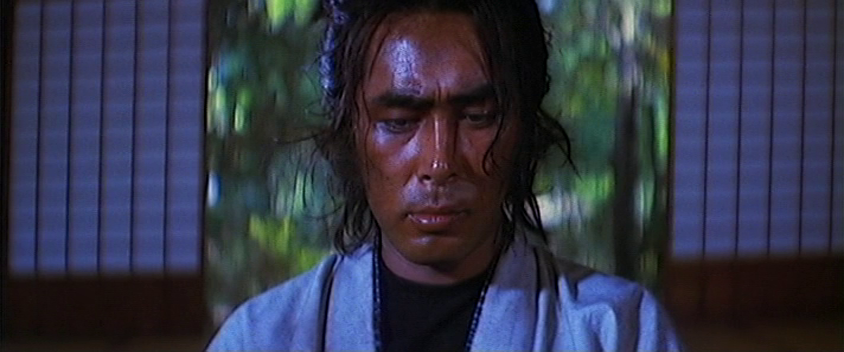
Some spectators might be left wondering as to why Kyubei does not kill Jokichi when he catches him. He is not only saved by the rules yakuza follow to ensure that their volatile field has some structure and order, but also by Kyubei’s desire to inflict the same kind of humiliation on his ego. Kyubei orders the smashing and castration of two of his fingers to fleetingly enjoy the fantasy of being superior and to create a physical reminder of it (Narra-note 2).
It comes to no one surprise that when Jokichi’s anchor to the mundane way of life (i.e. the presence of Okinu and Kotaru) is radically taken away that he drifts off in the same imaginary dynamic of vengeful violence. Yet, there is one radical difference between him and his enemies. Jokichi’s violence is not aimed at extracting pleasure by violating the other as body and castrating him as ‘perceived’ image. Rather than assuming the position of The Thing to enact one’s selfish law of pleasure, Jokichi calls a halt with his deadly sword to those who exploit the other.
Yet, despite the ethical difference of his violence, is the result of his bloody trail not similar? Even if Jokichi’s violence is driven by the fantasy of eradicating the ‘evil’ that took away his chance at an honest life, even if its ultimate aim is to short-circuit the exploitative tendency that structures the criminal other, the rippling of the dual imaginary field caused by his razor-sharp katana only fuels the cycle of revenge, only leads to imaginary injuries and bloody violence (Narra-note 3). Yet, as the gangs Yokichi faces are so hierarchically structured, the slashing down of their leaders might dissolve such structure and annihilate the violent imaginary dynamic of honour and dishonour that helped holding it together.
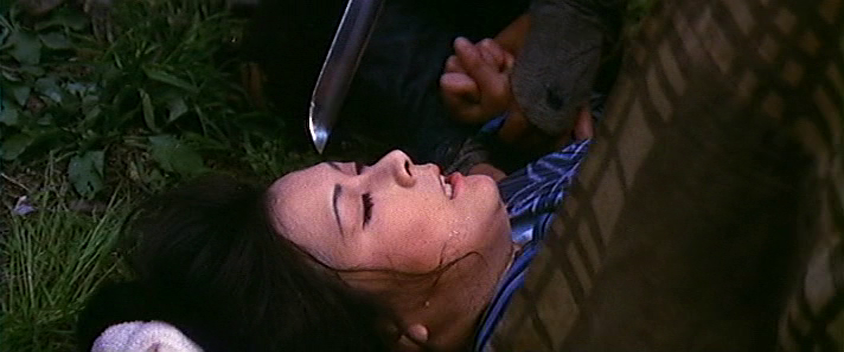
That lingering nihilism within Trail Of Blood is not merely carried by the depiction of violence acts and decorative blood splatters, but also by Yoshio Harada’s convincing performance. With his commanding physical presence and powerful facial expressions, he does not only reveal the strength of someone driven by a desire to exact revenge, but also succeeds in echoing the traumatic emptiness that marks Yokichi and his character’s acceptance of his tragic fate that awaits him.
Yet, due to the importance of the nihilistic dimension in the narrative, some spectator might be surprised by the jazzy-funky soundtrack that decorates the film. In our view, the nature of this music is the most evident sign that Ikehiro created a celebration of the Matatabi genre. Despite the fact that Yokichi’s bloody trail is deeply tragic, the music celebrates the filmic existence of the character of the wandering yakuza/gambler.
The composition of Trail of Blood offers a balanced mix of static and dynamic moments (Cine-note 1). While most dynamic moments are fluid, there are some moments of shaky framing – either to evoke the anticipatory tension of certain characters or to highlight the debased amoral nature of the violence. Another visual element that Ikehiro utilizes to heighten the tension within his narrative is a sudden change of pace – i.e. a sudden quick concatenation of shots.

Ikehiro does prove that he can create stylish moments – stylish surges to celebrate the filmic fantasy of the wandering yakuza/gambler. Not only does he visually please the spectator with nicely composed shots, but he also delivers striking colour-contrasts. While the contrasts are mainly attained by exploiting colours like blues and reds to silhouette the foreground, Ikehiro also utilizes other elements of lighting, like the floating dance of burning lanterns, to create a similar stylish effect. Ikehiro’s composition also integrates visual elements that are more evocative – i.e. the image of the death bodies of his wife and son is elegantly exploited to highlight the haunting nature of this tragedy.
In sword-fighting scenes, the composition remains in almost all cases focused on Jokichi and the violence he inflicts. This focus does not only keep the spectator oriented, but also allows the rough fighting choreographies come to its full right. Static moments, for that matter, are elegantly integrated to offer the spectator a subtle visual flourish of bloody violence.
With Trail Of Blood, Ikehiro stylishly celebrates the Matatabi film of the past and offers the chanbara-enthusiast enough sword-fighting action to satisfy him/her. Yet, what makes the first instalment so engaging is its radical nihilistic flavour of its narrative. Ikehiro reveals the volatile and destructive nature of dual imaginary dynamics (honour/dishonour) and illustrates that violent transgressions, even if they are ethically defendable, will always invite more Real destruction, more Imaginary anger, and more subjective sadness.

Notes
Narra-note 1: The way Kyubei talks about Okinu reveals that he considers her as being merely an object with little to no agency – I decided that Okinu be my wife. For Kyubei, the act that injures him is not her initial refusal of his romantic approach, but her choice to escape with Jokichi. Only the latter truly destroys the fantasy of being considered the object-of-her-desire by her and compels him to order her murder.
Narra-note 2: The laughter that accompanies the violence and abusive acts Jokichiundergoes emphasize that it is also a matter of extracting pleasure from the fantasy of being superior to what they reduce to an object-of-trash to be enjoyed.
Narra-note 3: Let us also note that the rippling effects of Jokichi’s violence – i.e. the murder of villagers by his enemies, further complicate Jokichi’s ability to re-attain a place in mundane society. So, while his violence has an different ethical fabric, the transgression of murder pushes him outside the mundane dynamics of the societal field.
Cine-note 1: The opening of Trail Of Blood falls prey to dynamic excess. This sequence is full of unnecessary decorative dynamic fat that could’ve easily been cut away to improve the visual flow of composition – and the spectator’s first impression.
 psychocinema