When Fukasaku’s Message From Space was released in the United States, it was not well received. Many western critics, perceiving the similarities with Star Wars (1977), George Lucas’ loose sci-fi ‘retelling’ of Kurosawa’s The Hidden Fortress, dismissed Fukasaku’s film as a mere indolent attempt to capitalize on Lucas’ surprise blockbuster hit.

Many years have since past. The time is thus ripe to grant Message From Space another chance and submit Fukasaku’s space opera to a fresh analysis. Our re-evaluation will, moreover, allow the spectator to grasp why Star Wars grew into a world-wide phenomenon and Message From Space failed to capture the imagination of audiences around the world.
Before delivering our critique of Fukasaku’s sci-fi opera, let us first have a deeper look at the similarities between Star Wars and Message From Space. Many spectators and critics have noted the resemblances between both narratives (e.g. Darth Vader’s Deathstar and the dead star Jillucia have a similar function, Meia strangely rhymes with Leia, …etc.). Yet, rather than merely copying Star Wars, we want to argue that Kinji Fukasaku, Shotaro Ishinomori and Masahiro Noda offer the spectator an exploration of the different stages of the Japanese society during and after the second world war in the form of a sci-fi fantasy.
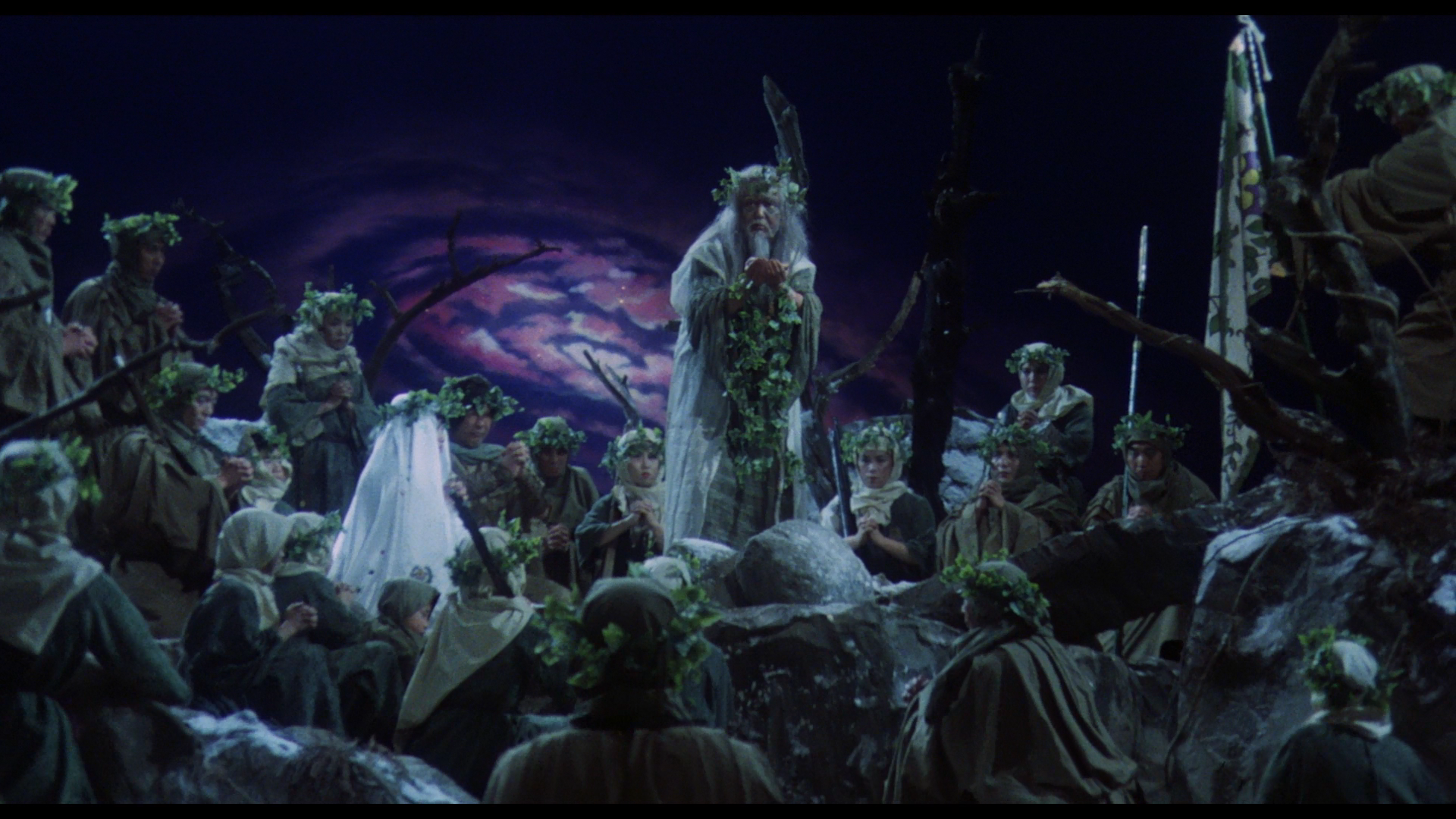
To make our assertion plausible, we must analyse the visual and narrative oppositions within the narrative to unravel what the various factions and their relationships ultimately represent. The opening sequence of the narrative introduces the spectator to the first relational couple – Jillucia and Gavanas – as well as the first opposition – nature against technology. We are introduced to the natives of Jillucia, who are led by Kido (Junkichi Orimoto), and learn that they are fighting a losing war against their oppressors, the more technologically advanced empire of Gavanas, led by emperor Rockseia (Mikio Narita) and dark Empress Dark (Hideyo Amamoto).
The occupation of Jillucia by the Gavanas echoes two different struggles within Japanese modern history. In the beginning of Message From Space, this situation is utilized to evoke the differences between Feudal Japan and the west concerning technology, religion, and economy as became apparent in the ending years of the Tokugawa Shogunate. We would go further and argue that what Fukasaku visualizes is nothing other than the phantasmatic materialization of the fear of being occupied that swept through Japan and inaugurated the end of the shogunate.
This contrast is utilized by Fukasaku to sketch out who the Jillucia represent – which side of Japanese society they represent. The spectator cannot fail to notice that the Jillucia have a Shinto-like closeness to nature and revere, as their signifiers underline, something that is not unsimilar to the idea of kami as essence. Their closeness to nature is visualized by their attire and their vitalistic thought is echoed in Kido’s act of addressing the holy spirit of the universe to send out eight holy Liabe seeds to seek out eight brave warriors to help them end Gavanas’ deadly occupation. This visualization of the Jillucia does not only echo the continuing impact of Shinto on Japanese thought, but aims to sketch out the pacifistic ‘nature’ of the Japanese commonfolk and echo the phantasmatic harmony between subject and nature.
Emiralida (Etsuko Shihomi) and Urocco (Makoto Sato) are ordered by Kido to follow the seeds and, eventually, end up on Milazeria, where four seeds have found an owner: Shiro (Hiroyuki Sanada, Aaron (Philip Casnoff), Jack (Masazumi Okabe) and General Gulda (Vic Morrow).
With the introduction of Milazeria, Fukasaku duplicates the first contrast – nature against technology. As the first contrast allowed us to uncover what the Jillucia represent, the duplicated contrast will help us to unveil what Milazeria represent. What does Milazeria visualizes if the Jullicia are a symbol of the Japanese commonfolk? In short, the US army.
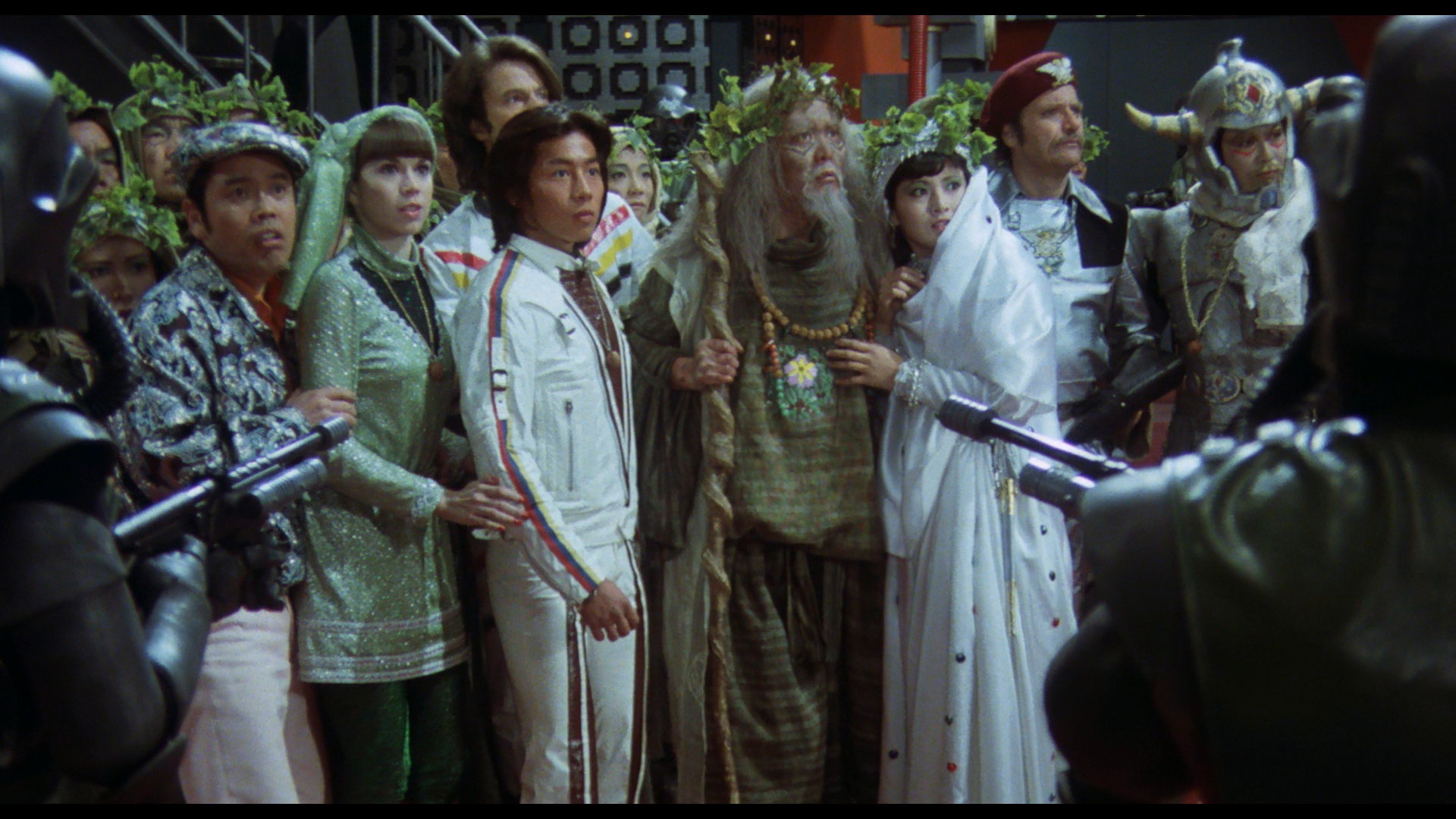
There is not only a striking resemblance between the Milazerian symbol and the symbol of the Us Army, but the fictional signifier Milazeria echoes the English signifier military quite clearly. They are, moreover, the only ones to utilize nuclear weaponry. Yet, if the Japanese commonfolk reach out to the US Army for their survival, from who do they seek protection?
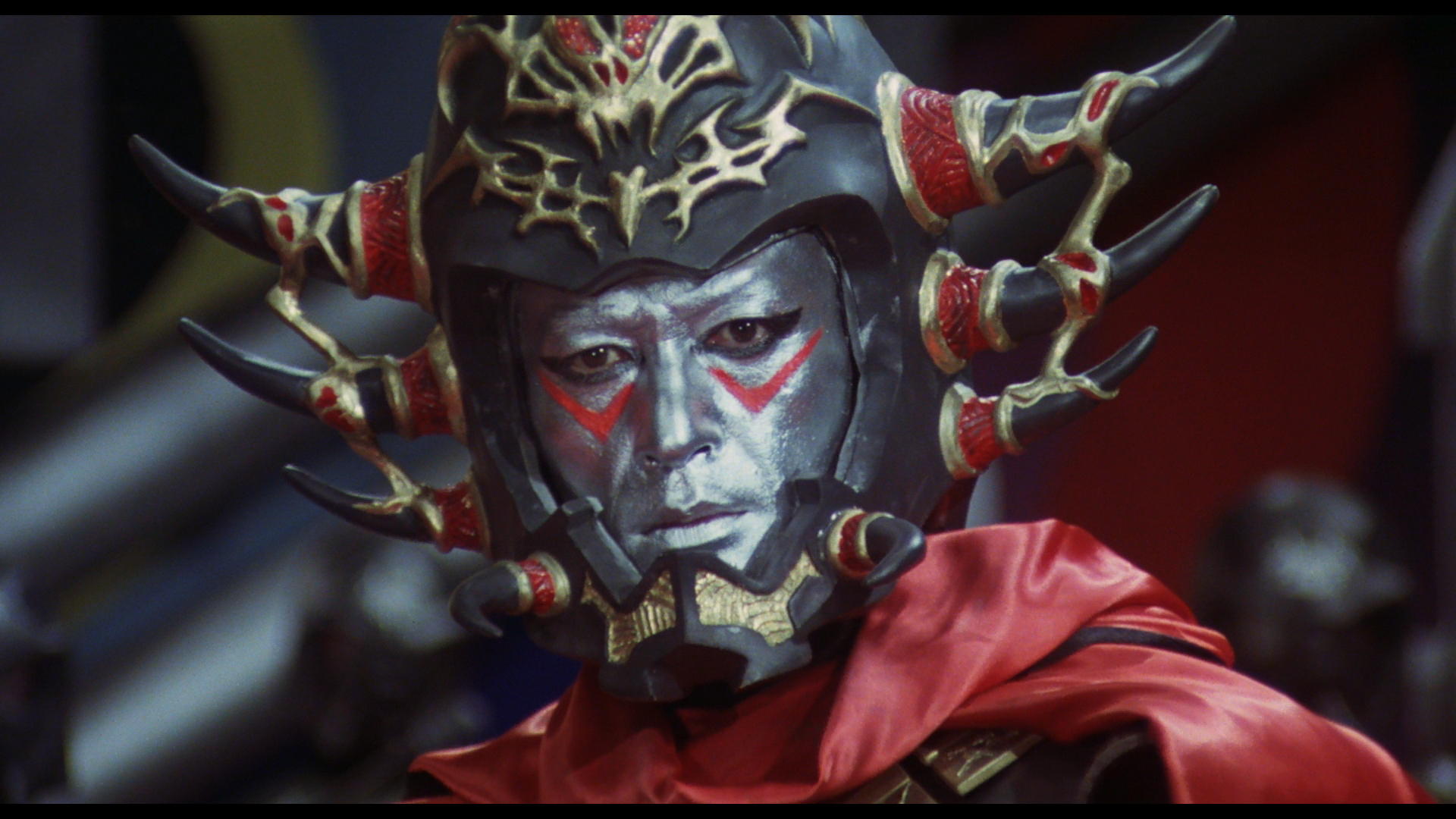
This question leads us to the third and final contrast – Milazeria vs Gavanas; technology vs technology. By determining who the Gavanas represent within Message From Space, we will have the final puzzle piece that allows us to unfold the main thematical message of Fukasaku’s space opera. First, Emperor Rockseia’s attire vaguely resembles samurai-armour. Secondly, despite an overabundance of gold, there is a subtle emphasis on white and red colours within their symbols and architectural style. Thirdly, there is a fleeting reference to Japanese imperial iconography within the Gavanas’ command centre.
While the opening half of the narrative might have pursuaded some spectators to assume that the Gavanas represent the American occupational forces, the association of three visual elements implies that the Gavanas visualize the imperialistic politics that brought Japan on the brink of destruction in the second world war – i.e. the Japanese elite as poisoned by imperialistic ideology. The visual motive of skull and bones, a visual reference to death and destruction, allows Fukasaku to imply in an easily perceptible yet highly indirect manner that the occupation of the Japanese psyche by imperialistic and nationalistic thought was nothing other than destructive.
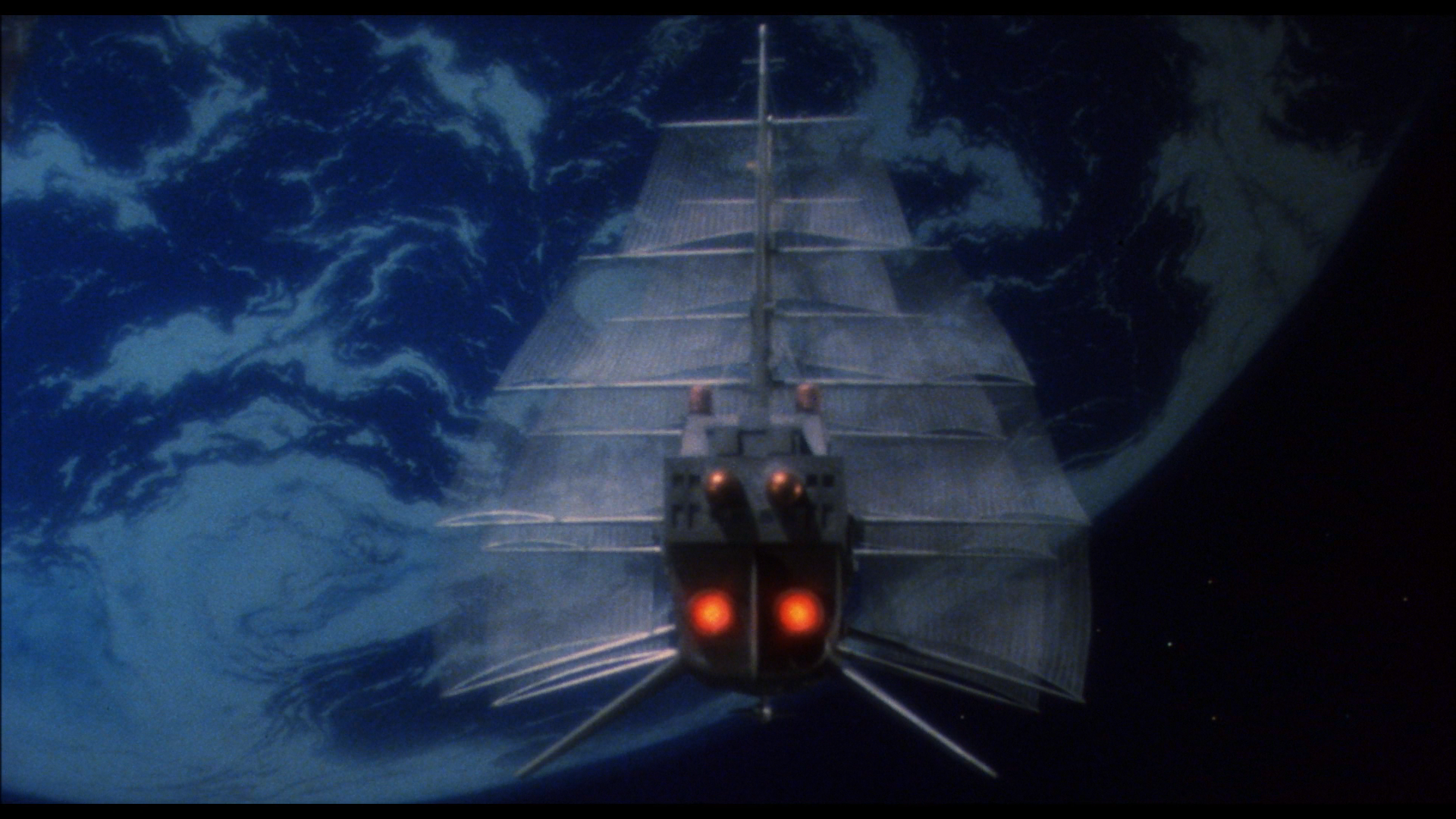
What Fukasaku’s Message From Space reformulates in a sci-fi setting is thus nothing other than the resolution of the second world war, where the intervention by the U.S.A. barred Japan from orchestrating its own destruction – the penultimate goal of its imperialistic ambitions. By visualizing the war between Imperialistic Japan and the American forces in a phantasmatic way, Fukasaku shows his audiences that the veritable victims of Japan’s imperialistic thirst – a thirst for geopolitical power and subject others to their rule – are none other than the Japanese commonfolk, i.e. those subjects living in harmony with the seasonal rhythms and in accordance with the traditional values shaped by being subjected to the whims of nature.
Having unveiled the specific cultural-historical frame that structures Kinji Fukasaku’s Message From Space, we are now ready to deliver our critique of Fukasaku’s film. One can best describe Message From Space as a space opera with two faces. While the way the narrative set-up is delivered is confusing and, often, borders on the ridiculous, the action and effect-rich finale is well-orchestrated and satisfying.
The reason why Message In Space flirts with the ridiculousness is not due a lack of narrative cohesion, but a lack of narrative fluidity, as caused by outlandish visual contrasts and strange musical tonal shifts. The hotchpot of different clothing styles and haphazardly thrown-together sets often fail to visually please the spectator because these visual elements do not blend well together and lack a sense of other-worldliness. The spectator often feels like he is watching a parade of ill-chosen second-hand-bought clothes and tools without a futuristic vibe to harmonize it all (General-note 1). Due to these strange visual choices and awkward contrasts, it can be, at times, quite challenging for the spectator to suspend his disbelief.
What stands out in the use of music is not so much the pieces that subtly echo the musical style of Star Wars, but the more eccentric retro-musical decorations (e.g. the space-race sequence is decorated with rock-and-roll music). Yet, while these atypical choices create some moments of pure unadulterated fun, these sequences do not fit well within the overall tone of the narrative – they end up feeling out of place (Music-note 1).
The ultimate consequence of these retro contrasts and musical shifts is that Fukasaku’s film cannot escape the grasp of earthly mundanity, therefore complicating the spectator’s desire to suspend his disbelief and invest in the sci-fi fantasy. Star Wars, which is devoid of such strange off-putting contrasts, captured the spectators’ imagination simply because its costume and set design fully embodies a galaxy far far away. The ‘alien’ timelessness of the designs fostered the spectators’ desire to invest in Star Wars as a fantasy space.
The visual effects are arguably the best part of Message From Space. While the effects might not be entirely up to par to what Hollywood produced, they are quite effective. The few false notes in the ‘slower’ composite shots (e.g. the swim in space to catch space fireflies) cannot derail the visual harmony that Fukasaku and Nobuo Yajima created with detailed miniature models and convincing landscapes. The spectator will have no problem in enjoying the various set-pieces (The space-race, the spaceship-fights, … etc.). In fact, Fukasaku’s Message From Space is most pleasing – and most effective in engaging the spectator – in those sequences that rely on visual effects. These moments even succeed in washing away much of the sourness caused by the exposition of the narrative and the way the finale is set up.
Message From Space is like a poem that is not up to scratch. For the greater part of the narrative, Fukasaku, as poet, struggles to rhyme the different elements together and, thus, fails to establish a fluid and engaging poetic metre. Yet, any spectator who perseveres, swallowing all the visual discordances and false notes, will eventually finds pleasure in the action and effect-rich finale.

Notes:
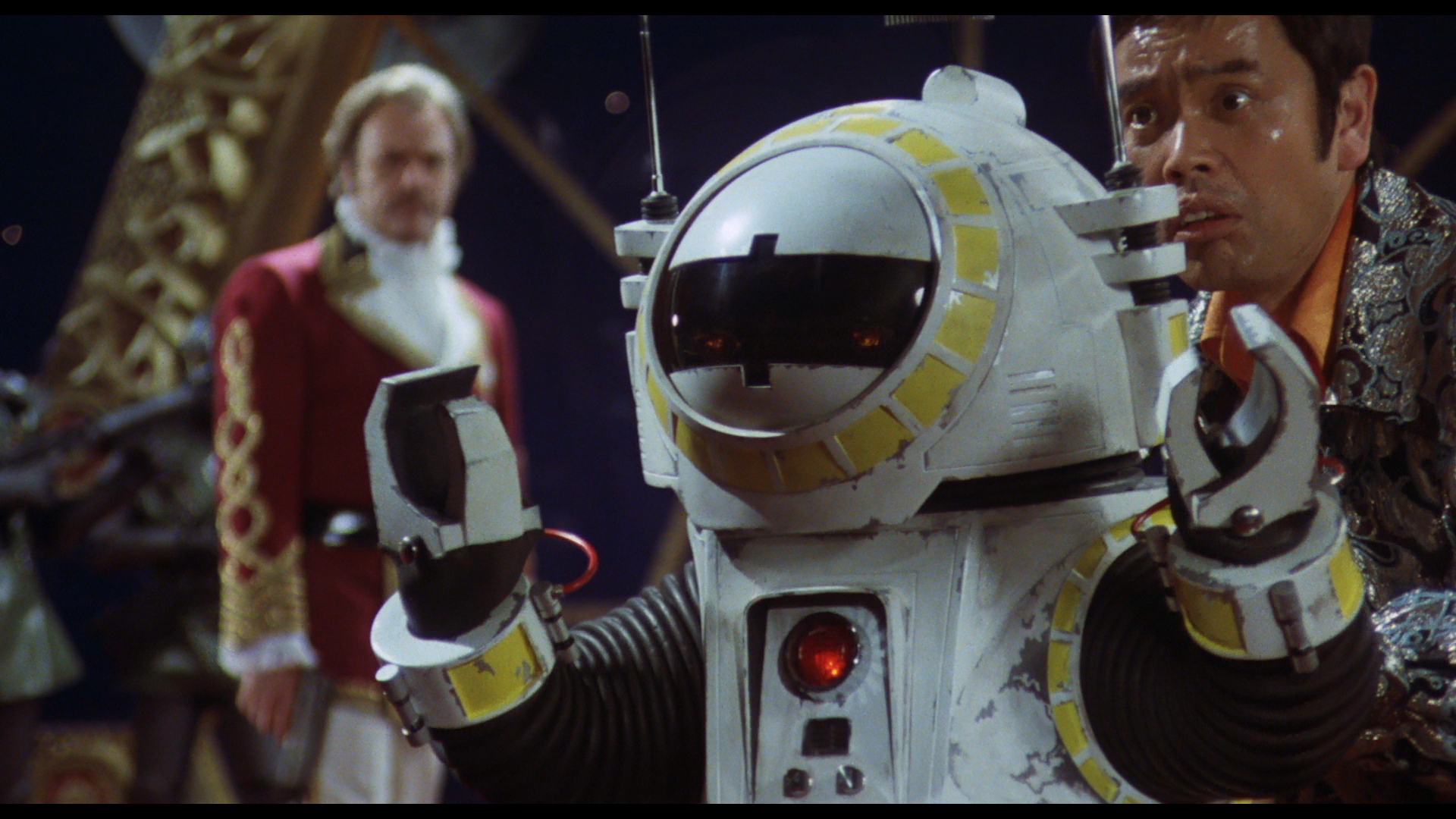
General-note 1: The robot Beba-2 will vaguely remind the spectator of Doraemon. And this is in all probability not be a coincidence.
Music-note 1: The rock and roll music perfectly evokes the naive youthfulness as well youthful longing for a freedom to enjoy.
 psychocinema