Introduction
While Kazuyoshi Kumakiri has directed many different movies since the late nineties, he has not had any narratives that put him truly on the international map. Yet, he did helm narratives that are vastly underrated, like Freesia: Icy Tears (2007) and Sketches of Kaitan City (2010). Maybe his latest narrative, a horror-thriller, can convince audiences to explore and reevaluate Kumakiri’s oeuvre.
Review
The night before his wedding with Sayuri, Shunsuke (Yuto Nakajima) is treated on a surprise party by his co-workers. After drinking a lot of alcohol, he parts with his colleagues and starts walking home. Yet, as the drunkenness manifests itself, he starts staggering and ends up falling into a manhole.
He attempts to crawl out the manhole, but due to the miserable state of the integrated ladder and his leg injury, he fails. He succeeds in finding his phone, but he cannot reach his soon-to-be-wife or anyone else. Luckily, not much later, his ex-girlfriend Mai Kudo (Nao) calls back.

#Manhole is a narrative that starts off simple – a man falls into a manhole, but the conflicting fragments of information that are revealed slowly increase the mystery surrounding this event. The first riddle the spectator is confronted with is the one of his location. If he is not in Shibuya like his phone’s GPS shows, where in the world is he?
Yet, within this spatial conflict, this disorienting fissure, looms a deeper and darker enigma. Given his drunken state, he could not have staggered much farther than the place his phone’s GPS pinpoints. Yet, if he does not find himself in Shibuya, the logical conclusion is that someone transported him to a forlorn manhole with the sole goal to imprison him. Yet, who would go so far and for what reason? Is it because he broke some hearts before settling down or is there a different more twisted reason for this vengeful act?
What unfolds in the social media space of Pecker is nothing other than an uncomfortable and confronting exploration of Shunsuke’s subjective position, a rough tearing away of the superficial deceitful social facade, of the body-image, to unearth the rotten and self-centred nature of his ego and his subjective logic, which determines the dynamic of his social interactions.

Kamukiri’s narrative also grants the spectator a look at the inner-workings of social media as a fictive narrative machine. #Manhole illustrates that from a few fragments of information, often of dubious gossipy and deceptive nature, a haphazardly constructed narrative is formed, preparators decided and verdicts are joyously served. This kind of socially fabricated justice – and this is important – takes places outside the confines of the letter of the law and is driven by the subjective push to enjoy. Social media, whether it functions as the place where the masses hold their investigation and trails or not, is merely an imaginary pleasure machine to please one’s own ego and gain pleasure through the signifier.
Yet, the narrative should ultimately be read as the tragedy of the frustrated desire to be recognized by the Other. #Manhole beautifully shows that the subject is connected to the societal Other via the image. If this Other does not satisfy, at a certain level, the subjective desire for symbolic recognition and to have one’s bodily presence and image affirmed, the repercussions on the ego and the subjective logic that animates the subject in the social field are profound.
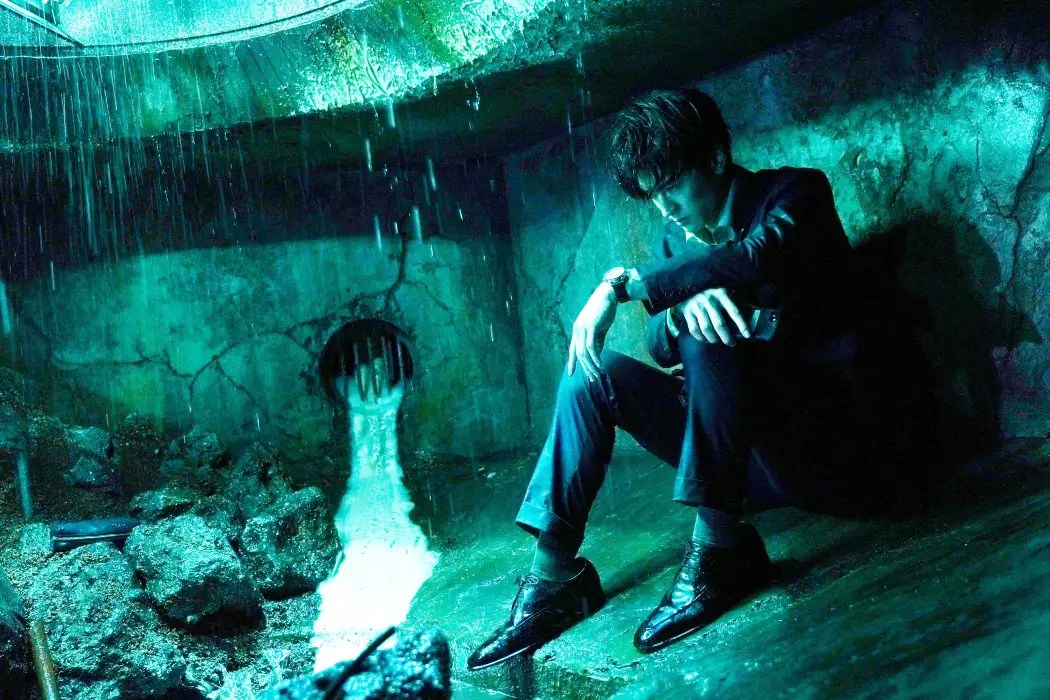
The composition of #Manhole is full of subtle and creeping dynamism (Cine-note 1). While there are, of course, many static moments and some powerful static imagery (e.g. the bottom-up shot of the manhole) within Kumakiri’s narrative, the engendering of tension and the creation of a mysterious atmosphere largely depends on the way dynamism is exploited.
While the slow pace of Kumakiri’s dynamism plays an important role in infusing tension in the narrative fabric, it is not the pace as such that creates it. Like in many similar narratives, it is the mysterious and subtly threatening musical pieces that grants the slowly paced dynamism its power to further heighten tension of the musically-evoked filmic atmosphere.
Some might argue that the darkish colour and lightning-design also plays a role in determining the atmosphere. But as #Manhole illustrates, colour and lighting are merely a frame upon which tension can be painted. In other words, whether colour and lightning contrasts becomes a support in the creation of the narrative’s atmosphere depends on the interaction between composition, music, and acting-performances.
While all the compositional elements are present that elements that rhymes them together is nothing other than the performances of the cast. Luckily for the spectator, Yuta Nakajima does not disappoint. With the little space he has – the manhole-space, Yuto easily succeeds in breathing life into the very emotions Shunsuke feels in that dark forlorn space under ground.
#Manhole is a highly engaging and twist-rich narrative that beautifully illustrates the continued importance of the image for the subject as well as the disastrous effects of the frustration of the desire to be recognized. While Kumakiri ensures that a certain mysterious atmosphere lingers with his composition, what truly breathes life into this harrowing experience are the performances of Yuta Nakajima and Nao.

Notes
Cine-note 1: There are many subtle tracking moments and slow spatially moving shots
 psychocinema
One Comment Add yours