Introduction
Daishi Matsunaga might not have a large oeuvre, but the few narratives he has made were well received, be it his drama Pieta in The Toilet (2015) or his Hanalei Bay (2018). Yet, successes in one genre do not ensure that a director’s attempt at a new genre will be successful. Can Matsunaga turn his excursion into the action-genre in an exciting cinematic experience?
Review
Daisuke Tateishi (Dean Fujioka) is an expert action actor working at Edo Wonderland. Yet, ever since his set-accident in the U.S.A – his trauma, he has not been able to perform well on stage. Therefore, he is mainly responsible of operating the sound-effects panel to provide the finishing touches to the other live sword-fighting choreographies.
To celebrate the departure of one of their colleagues Miura (-), they hold a party. At the party, their group are suddenly approached by a chinpira called Saeki (Ryutaro Ninomiya) who encourages them to use a nasal test – the Pure Japanese test – to find out how Japanese they are. Yet, Tateishi refuses, angering the hot-headed and reckless thug.
Saeki is part of a local Yakuza gang who, together with politician Kurosaki (Tetsuya Bessho), started to buy up lands in the neighbourhood to develop a new touristic hot spring resort, Yet, one elderly guy named Ryuzo Takada (Tetsu Watanabe) refuses to sell his land, hereby sabotaging their plans and their violent thirst for profit. To pressure him into selling, the yakuza start harassing his grandchild Ayumi (Aju Makita). One day, at the local bar, he stops Saeki from violently pressuring Ayumi, angering Saeki even more. Not that much later, he is asked by the stage manager to attend the town meeting.

Pure Japanese is a decent narrative that fleetingly explores the fiction of purity and being Japanese to deliver a bloody and highly deadly finale – a finale blending western and jidai-geki action. Matsunaga’s narrative is straightforward and its structure – the story of resisting a greedy villain that wants to profit from the locals – is far from new, yet he gives his story a fresh twist by giving Pure Japanese a dark atmosphere that foreshadows the bursting forth of bloody violence.
Yet, despite this enticing darkness, Pure Japanese fails to deliver on its promise. While the film channels tropes of classic western and Japanese action-narratives, it never harmonizes these elements in a whole that fully satisfies the spectator. This failure is, in our view, not only due to the fact that the nicely choreographed action-pieces are somewhat lacklustre, but also because the narrative does not engender any other emotions than the violent darkness that marks Tateishi.

Tateishi is an expert that cannot show his expertise to the audience due to an incident on a foreign film-set in the past. Yet, it is evident from his acts and signifiers that he, despite the incident that complicates his functioning, remains fully invested in the image of the samurai action-actor. To put it differently, it is because his ego is radically structured around the ideal of such kind of action-performer that he cannot escape it – it is this ideal that gives his ego its shape, his life its rhythm and its meaning.
That Tateishi seems, at least according to the nasal test, to be 100 precent Japanese does not only give his identification with the ideal of the samurai action-performer a Real support, but also infuses his acts, signifiers, and beliefs with a certain righteousness – I follow the path of the true Japanese (General-note 1). The latter is highlighted by the speech that he utters after he finds out his highly unusual result: Knowing what you action will make you become and yet, being unable to turn back is the Yamato spirit.

In more concrete terms, the test-result reveals to him that opposing greed and protecting those in need, if necessary, with violence are essential elements of what makes one pure Japanese. This revelation resonates with Yukio Mishima’s statement, as evoked by Ryuzo: “I cannot put my hopes on the future of Japan. (…) if things continue as is, Japan may cease to exist. If it does, there may remain in its place (…) a great economic power that is inorganic, hollow, and isolated”. Is it not the capitalistic greed that can be said to be the cause of the hollowing out of the Japanese Other and the subjectivity it shapes?
Yet, inhibited as Tateishi is, can this test-result help him overcome the inhibition that complicates his functioning as action-performer and short-circuits his thrust to stop the violence of those who are poisoned by greed? Yet, as Ryuzo warns Ayumi about the homicidal insanity he perceives in Tateishi’s eyes, what danger lies in him resolving his inhibition (Narra-note 1, Narra-note 2)?
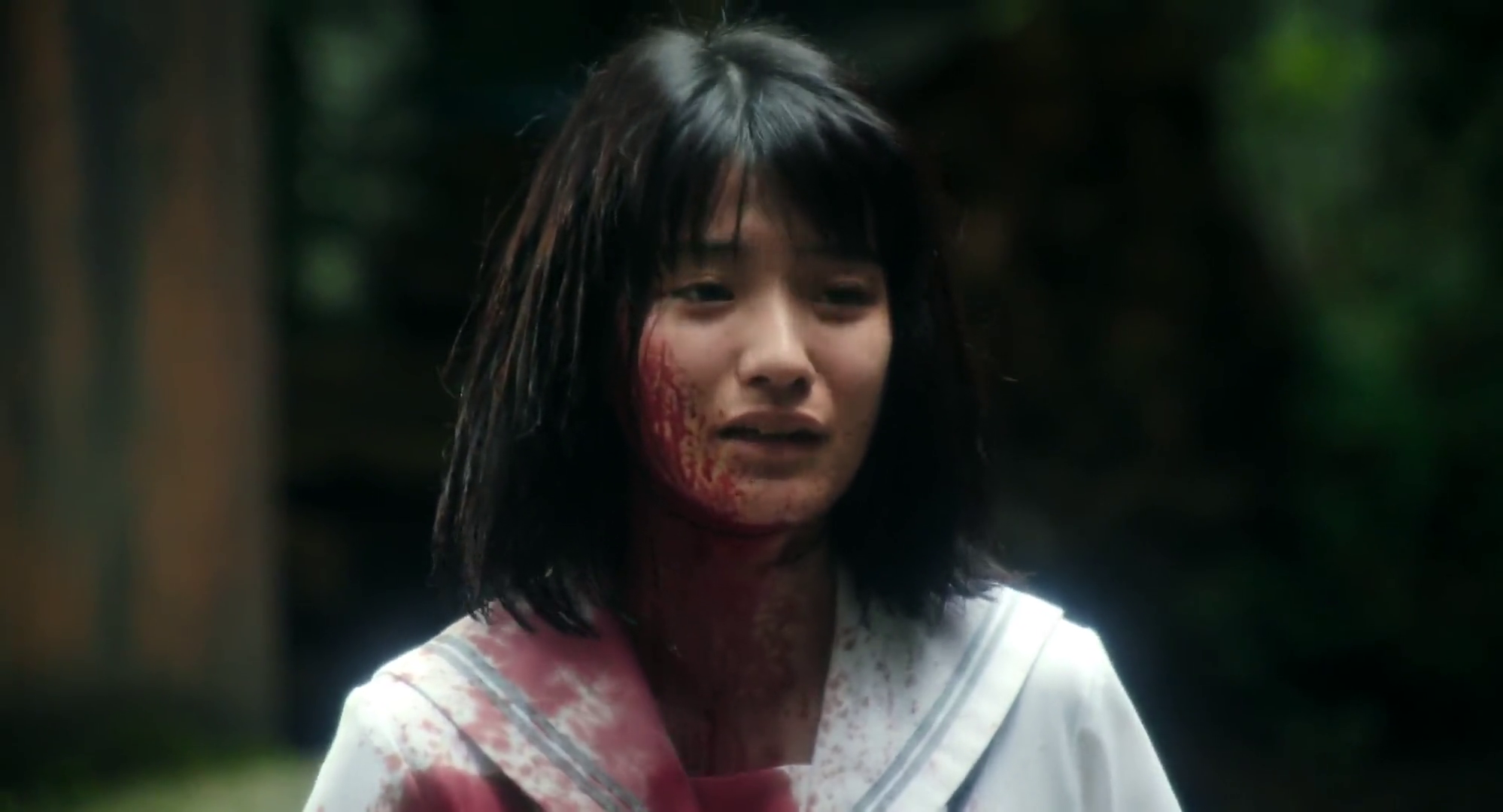
To bring the narrative of Pure Japanese to life, Matsunaga relies heavily on dynamic movement, tracking as well as spatial movement. Yet, that does not mean that there are no fixed moments in the composition. Such moments are, beyond introducing the spatial context of the narrative, either utilized to offer a fleeting moment of visual beauty or to heighten the dramatic flavour of more action-driven scenes (Cine-note 1). The visual pleasure of the narrative is furthermore heighten by using some nice colour-contrasts.
Pure Japanese is a decent action-narrative that delivers a nice commentary about the fictional nature of national identity and the dynamic of the ego. Yet, by not engendering a variety of emotions, Matsunaga’s narrative lacks the glue that would put all the parts fluidly together and create a truly impactful action experience.

Notes
General-note 1: This nasal test wrongly implies that there is a kind of biological ground for the societal construction of the ego-image that one might call Japanese. How Japanese the subject is, how well one inscribes him- or herself in the fictional ideal of being Japanese – the Yamato-spirit, is presented as being imprinted in the flesh of the subject.
This is, eventually, touched upon in the narrative – the test is scientifically unsound, leaving the spectator with the following riddle: how do you define being Japanese? The vehicle that allows the birth of a culture and society that can be called Japanese and a subject to identify with the fiction of Japanese-ness present in the Other is, as rightly implied in the narrative, nothing other than Japanese language. It is language and nothing else that structures the Other and forces the subject to find its own logic in it.
Narra-note 1: Yet,the insanity that Ryuzo perceives in Tateishi’s eyes is, logically speaking, also something pure Japanese. One cannot be pure Japanese without one’s ego hiding some form of insanity.
Narra-note 2: It should also be clear that the aim of every signifier and every act by Tateishi is to realize the fiction of being Japanese. The true trauma of the past is not the incident on the set, but the bullying he was subjected to – his subjective trajectory has been a long attempt to prove to his past bullies that he is, after all is said and done, Japanese.
Cine-note 1: The reason why fixed moments are able to heighten the drama of more action-driven scenes is because by compositionally following the rhythm of the sword-fighting action, a rhythm of movement and pauses, Matsunaga can emphasize (or dramatize) the flow of the action.
 psychocinema