Introduction
Yusaku Matsuda started acting straight after graduating from high school.Moving throughseveral theatre companies, he eventually joined the Bungakuza theatre group, one of major Shingeku theatre troupes.In 1973,he finally got a chance to start a career as screen actor by receiving a role as junior police detective Jun Shibata in the popular TV detective drama Taiyō ni Hoero! (1972-1986).
Yet, in 1975, due to two violent quarrels – one with journalist and one with a student who attacked him with a wooden Kendo sword, Matsuda nearly sabotaged his own career. Luckily, the encounter with director Toru Murakawa, which eventually resulted in a long standing collaboration starting with the Game-trilogy, gave his career a new breath of life.
[This film is part of the Game-Trilogy blu-ray box set by Arrow video]

Review
Five years after a successful assassination of the chairman of the Tozan Group, Shohei Narumi (Yusaku Matsuda) encounters his daughter Akiko (Kahori Takeda) in a bar somewhere in Tokyo. Much to his surprise, she expressed her gratitude to him for executing her controlling father. Yet, before he can ask more, Ninomiya (Daisuke Koewabara), a member of Kotobuki gang and her boyfriend, tries to pick a fight with him. He merely apologizes and walks away.
Not long thereafter, Narumi is approached by Bunta (Kai Ato) who asks him to work together as debt collector. While he wants to refuse, the lack of money forces him to accept this unwelcome invitation. On one of his rounds, he happens to encounter former mistress and secretary of the assassinated chairman Misako Tsuyama (Naomi Oka), who, five years ago, escaped his gun’s bullet by mere luck.
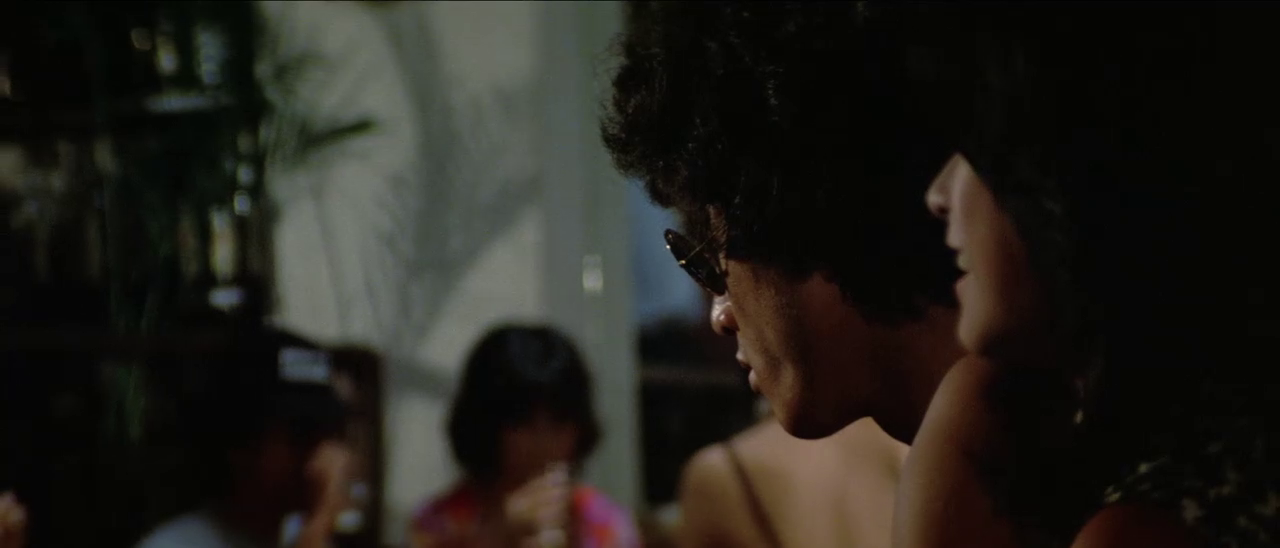
The Killing Game trades the field of corporate competition and conflict in for a more straight-forward conflict between yakuza-clans. Yet, despite this superficial shift, both narratives deal with the same phallic dynamic, the same desire to gain more power. It is this thirst to gain more power that leads Katsuta (Kei Sato), the boss of the Kotobuki-gumi and a sworn elder brother of the Hanai-gumi’s leader Manji Hanai (Kojiro Kusanagi), to dream about its destruction. Yet, as the Hanai-gumi controls the complete western kansai-region, he is unable to act to make his phallic dream come true.
Narumi gets introduced to Katsuta when he tries to meet the chairman’s former mistress woman again. Katsuta quickly deduces that the only reason why Narumi knows Misako, the madam of club Arabica, is because he is the hitman that killed the Tozan chairman. As his hands are tied, he offers Narumi twenty million yen to assassinate the leader of the Hanai-gumi.

Some spectators will, of course, wonder why Narumi avoids getting into any kind of conflict. He does not only hide his face when walking past some quarrelling yakuza, he is also reluctant to enter the bar and escapes the bar before Ninomiya can physically confront him. So, rather than flaunting the phallic fantasy he clothes himself with, he does his best to avoid the eye of the violent and seductive other – everyone that gets close to me dies (Narra-note 1).
Such anxious behaviour has but one aim: the protection of his position of lone wolf. The only weakness a hitman can have is to have any meaningful relationships. Any bonds that give him a more grounded place within the societal field can be exploited to provoke the hitman to act rashly and endanger himself and the other. In fact, in The Most Dangerous Game (1978), Narumi’s misogynistic behaviour towards Kyoko has the same function. He is violent towards her to destroy her desire towards him and to chase her away before she ensnares his desire.
While it is less pronounced than in The Most Dangerous Game (1978), Narumi’s acts and signifiers as hitman are still marked by the phantasmatic phallic dynamic. The fantasy of maleness he clothes himself with and reflects towards the other subtly echoes in the way he addresses those that are in need of his services. As Narumi knows that he is the solution that can professionally erase the human obstacle that hinders the realization of their phallic ambition, he can play with their demand and manipulate their lack to fleetingly enjoy his phantasmatic position of phallic power.

In the beginning of the narrative, the importance of feeling desired, of having what the other desires, is also illustrated by his objectifying gaze (e.g. nice ass) and his thirst for sex. This gaze, which divides the female body into various separate sexualized parts, is the reason why he fails to recognize some of the women he encountered in his past. His thirst for sex, on the other hand, leads him to fleetingly abandon his attempt to evade the gaze of the societal Other (Narra-note 2).
The ending of The Killing Game, on the other hand, illustrates the radical phantasmatic nature of such phallic belief well. Even though Narumi, by tipping richly, succeeds in surrounding himself with women that are eager to satisfy his fantasy of desirability, he ends up showing his ‘castration’ by having no money left to cover the bill.
The killing Game is littered with crude brawls and satisfying shoot-outs (Narra-note 3). And, of course, the dynamic of malicious deception and the betrayal, once again, structures the twists of The Killing Game. One of these twists, the one that puts Narumi in an unforeseen predicament, ultimately illustrates that, when the lack of the criminal other is resolved, the need to play along with the phallic game of the hitman disappears. Due to this, Narumi gets confronted with the very limits of his assumed phallic position and the phantasmatic nature of his fantasy’s support. The claws of an all-powerful criminal Other that punctures his ripped body seemingly dooms him to a radical kind of castration – death or even worse. Or can he, by mere luck or due to his phallic prowess, avoid his fate (Narra-note 4)?

The composition of The Killing Game is, just like the composition of The Most Dangerous Game (1978), highly dynamic and visually interesting (Cine-note 1). The rich use of dynamic movement creates a pleasant and engaging visual flow and the moments of visual pleasure, which are, in most cases, a result of the interaction between Murakawa’s elegant play with geometry (i.e. the way various visual elements are arranged within the frame) and an effective lightning-design (i.e. the interplay between light and shadow), create many moments of cool stylishness within the visual fabric.
The use of shaky framing, which echoes the visual style of documentary film, emphasizes the hard-boiled roughness of the violence on display and heightens the sense of tension. The resulting sense of realism enhances the stylish coolness of Narumi’s calculated and precise acts of gun-violence and his signifiers.
While Yuji Ohno’s jazzy tones are not that prominent as in The Most Dangerous Game (1978), his music has nevertheless the same function in The Killing Game. Ohno’s sultry tones are fleetingly utilized to evoke a sense of noirish stylishness and hard-boiled coolness, to infuse various moods (e.g. mystery) into the unfolding of Narumi’s killing game and enhance the compositional rhythm. Ohno’s musical pieces, by making many visual compositions more striking, grant the imagery the seductive power to pull the spectator into the narrative.
The Killing Game benefits from Yusaku Matsuda’s demanding acting performance – he simply owns each visual frame. The way he brings Narumi to life via his detached facial-expressions and cold-blooded body movements are not only cool, but form the true highlights of the narrative. Just like in The Most Dangerous Game (1978), Matsuda’s performance, whichchannels the male fantasy of desirability with style, allows the spectator to savour an image of impossible male desirability.
With The Killing Game, Murakawa delivers a satisfying sequel to The Most Dangerous Game (1978). While the narrative consists out of the same elements, conflicts and dynamics, they are shuffled around well enough to create a fresh experience that critically develops the repercussions of the male phallic fantasy of desirability. Yet, by underutilizing Yuji Ohno’s jazzy tones, The Killing Game ultimately lacks the noirish moodiness that made the presence of Narumi in the first film so impactful for the spectator.

Notes
Narra-note 1: The Killing Game illustrates that the misogynistic violence of the first narrative was not a means to exert and satisfy the phallic fantasy of maleness, but to radically distance himself from the other as to protect him and the other party.
Narra-note 2: Some spectators might wonder why Narumieventually sexually approaches Misako, the current mistress of Katsuta. There is but one reason: by enjoying her female body he can castrate Katsuta imaginarily – you do not have what she desires – and, thus, reinstate his sense of realizing the phallic fantasy of maleness.
Narra-note 3: The Killing Game has less misogynistic violence than The Most Dangerous Game (1978). Moreover, the perpetrator of such violence is not Narumi, but a goon of the Kotobuki-gumi.
Narra-note 4: Just like in The Most Dangerous Game (1978), the key that solves Narumi’s predicament is held by the mistress of his target. The Killing Game emphasizes, once more, that the weakness of a ‘phallic’ man lies in the female support he needs.
Cine-note 1: The decorative technique of slow-motion is, just like in The Most Dangerous Game (1978), utilized to heighten the coolness of Narumi’s shooting poses.
 psychocinema
One Comment Add yours