Introduction
Another young animation director that deserves international interest is Moe Wakabayashi. While she already showed her interest in animation with her graduation work In The Sleepless City (2015), she further honed her skills by completing the animation course at the Tokyo University of the Arts. This amination short is the result of her growth.

(Click the logo for more information.)
Review
Way down the Ocean, in the stomach of a fish, a family lives. The father of the family (Ken Hirayama) was born on land and raised on a pig farm. While his fate was either to become pork chop, ham or cutlet, he truck that would bring him to the slaughterhouse had an accident and he ended up in a big fish’s stomach. Much to his surprise, someone was already living there. Both stuck in the stomach, they soon grow close together and end up marrying each other. Not much later, the couple welcomes their first-born child, a tadpole (Megumi Abe).
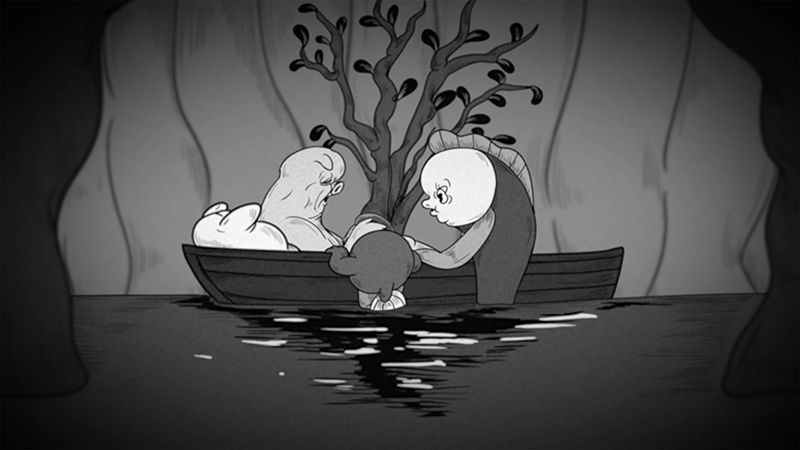
3 Intestine Road, Fish Island is an absurd but charming narrative that explores subjective difference and the importance to respect the Otherness that defines the other subject.
The aspect of subjective difference is, first of all, visually introduced by letting a pig fall in love with a fish. It does not matter that both Hogert Hoggard, the father, and Fishelina Fisher (Yuriko Nagano), the mother, were meant to serve the same purpose – i.e. to satisfy the hunger of the other with their flesh and meat, the fact that Hogert enjoyed the land and Fisher was imprisoned in the belly most of her life echoes the irreducible difference that separates them as subject.
While their radical difference stays hidden for the most part, it rears its head when their child, the tadpole, refuses to eat. Yet, one day, a strange fruit drifts along them. Hogert Hoggard, who has known the joys of eating this fruit from his childhood, tries convincing Fishelina Fisher to taste it, but she refuses. Due to her prolonged imprisonment, she has become afraid of anything new that comes from the outside and thus the Otherness that marks her husband and, as it turns out, their child. Can Hoggard find a way to share his Otherness with his wife? Can his wife become more open to what is Other to her? Can their child, a mixture of both worlds, muster up the courage to try and fulfill his father’s wish?

The animation of 3 Intestine Road, Fish Island is quite good. While there are, of course, many static elements, Wakabayashi keeps the spectator engaged by integrating enough animated and dynamic moments (e.g. zoom-in). Yet, what sets her animated narrative apart is its charm and the evocative flavour of certain images. While much of the charm of 3 Intestine Road, Fish Island is due to the drawing style – a style resembling old-school black-and-white Disney shorts – it is also function of the pleasant rhythmical flow created between the elements of animation and the voice-over. Of course, the musical accompaniment, whenever it is utilized, further enhances the visual flow.
3 Intestine Road, Fish Island is a splendid animation short. Wakabayashi does not only please the spectator with her charming retro-style and evocative stylistic decorations, but also impresses with her ability to create a quite moving narrative. Wakabayashi beautifully evokes that the societal field would be a better world if everyone could accept some of the other’s Otherness.
 psychocinema