Takeshi Beat/Takeshi Kitano needs no introduction. However, while he is known among international audiences for his contributions to cinema and yakuza film in particular, his popularity in Japan is due to work as a comedian – either as part of the Manzai Duo Two Beat or as host of Takeshi’s Castle. With his latest film, Broken Rage, Takeshi Kitano seeks to deliver Yakuza drama as well as the brand of comedy that made him famous.
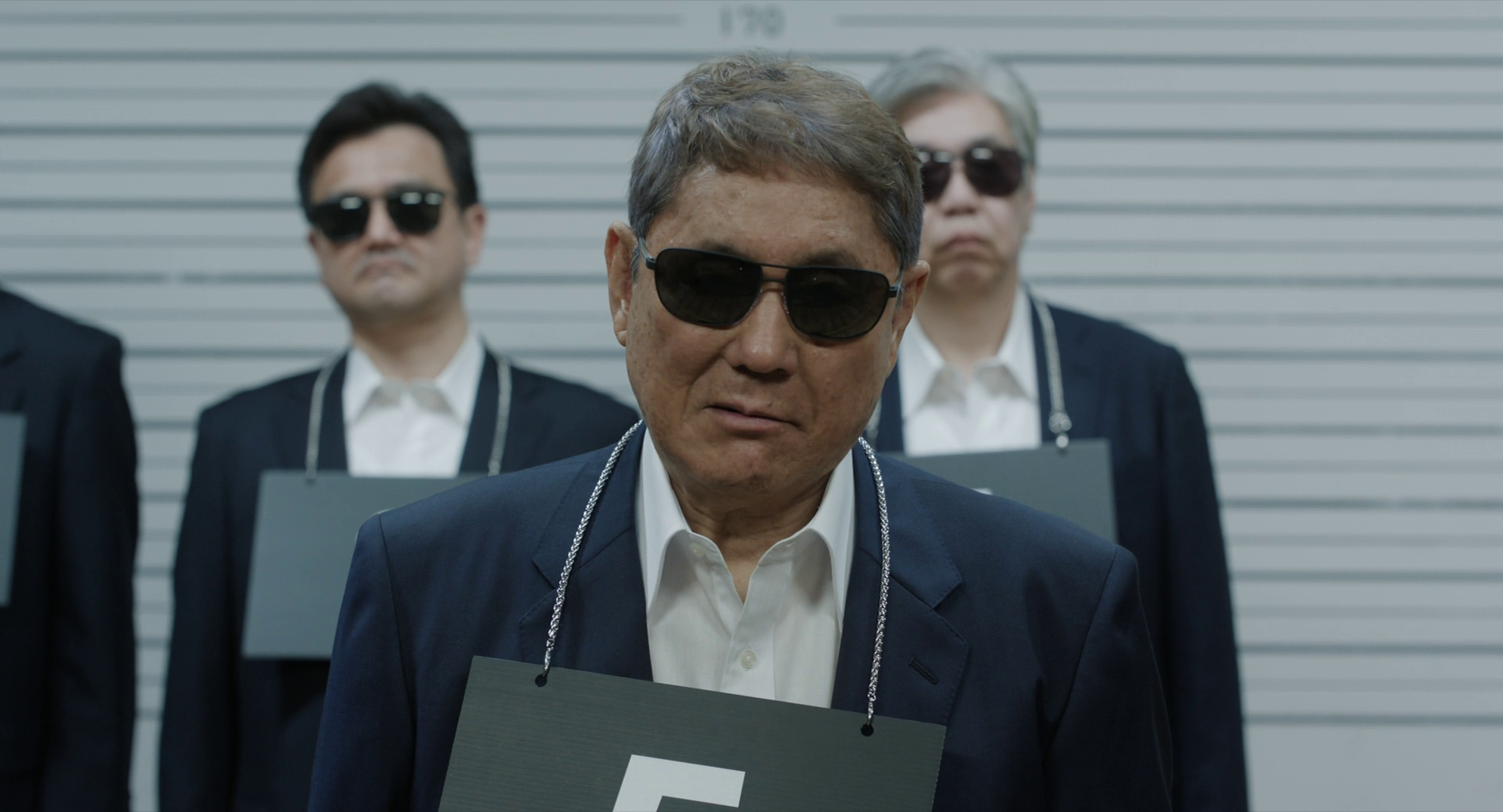
Takeshi Beat opens Broken Rage by introducing the spectator to the daily rhythm of the older hitman called Nezumi (Beat Takashi). He collects an envelope with information about his next target, he carries out the murder, burns the contents of the envelope in an astray in his apartment, acquires an envelope with his cash-payment.
Yet, one day, his daily rhythm is brutally broken when two police detectives Inoue (Tadanobu Asano) and Fukuda (Nao Omori) approach him in Cafe Lake and arrested on suspicion of murder. Things only get worse when two witnesses identify him as the killer at the identity parade. However, he refuses to cooperate and confess. He does accept their proposal to acquit his crimes by infiltrating a drugs ring.
A little before the first half hour ends – Nezumi’s infiltration has finally reached its conclusion, Takeshi Beat surprises the spectator with a rather puzzling intertitle: Spin Off. While the first shots that follow the title imply that this Spin Off will offer but a mere retelling of the same noirish murder turned infiltrate narrative, the intrusion of comical events (e.g. Nezumi being hit by the door, Nezumi falling through a chair, … etc) overturn the seriousness that marks the darkish atmosphere.

The retelling of the narrative does not only seek to comically subvert the expectations of the spectator – the injections of slap-stick humour deflate the serious tone of the narrative, but also to contrast Nezumi, who acts in accordance with his phantasmatic belief of having the imaginary phallus, with Nezumi whose attempt to act in accordance with this fantasy is continuously thwarted to expose his castrated truth.
By overturning the tone of the narrative, Takeshi Beat does not merely offer a tongue-in-the-cheek self-relativizing punch-line, but also offers a brilliant illustration of the truth that animates the comical: the hero acts as if he has the phallus, yet the audience knows he is (symbolically) castrated just like everyone. The comical effect lies in the fact that he pretends to wear the phallic robe while strutting around naked as well as in his continued attempt to affirm the impossible, to prove that he has what he cannot have. Spin Off must, in this sense, be considered the truth that exposes the phantasmatic lies presented in the first half an hour. The final twist within the narrative, on the other hand, radicalizes the idea that symbolic castration is constitutive for the neurotic subject.
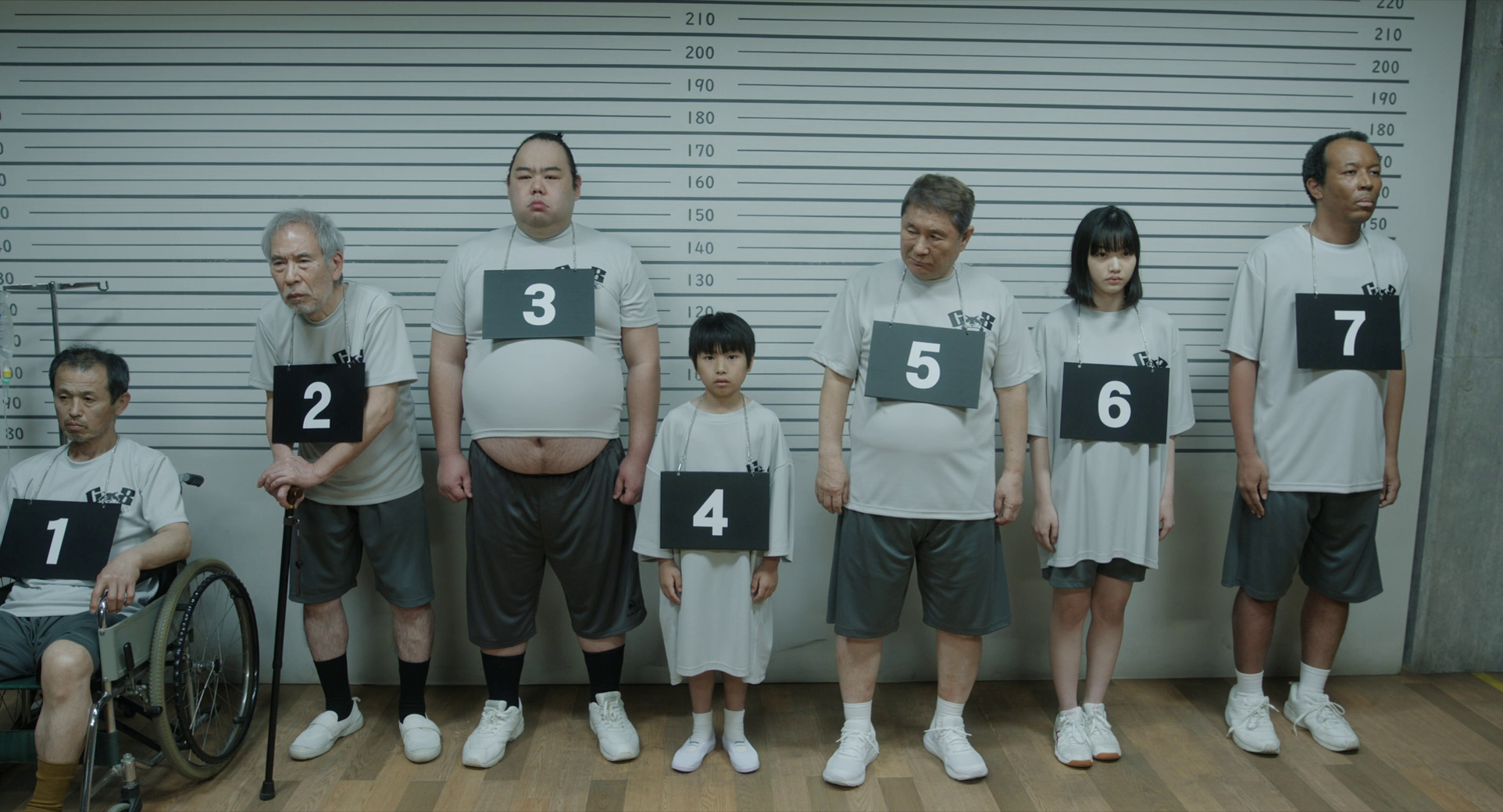
However, the serious tone of the darkish atmosphere is also compromised by a different kind of comedy: the intrusion non-sense – non-sensical visual elements (e.g. e.g. mouse-costume, bat-costume, the wrestling mask) to disrupt the ‘sense’ of the narrative as well as the film’s spatial continuity. The spectator, however, will not have any problem to discern that certain comical moments play on both – the intrusion of non-sense as an illustration of the symbolic castration we seek to deny.
The rhythm of Takeshi Beat’s well-balanced composition is determined by one general guideline: mirror the movement of the character in focus. When Nezumi moves, the camera is dynamic. When Nezumi comes to a rest – or moves towards the camera, the camera becomes static, irrespective of the movement of other characters around him (Cine-note 1).
While this guideline determines the basic flow of the composition, there are a few exceptions to this rule. Early in the narrative, for instance, Takeshi Beat utilizes a tracking shot that follows the movement of the bartender of Cafe Lake to emphasize the envelope he is about to give to an already seated Nezumi. Some time later, he interweaves a zoom-in shot to heighten the dramatic impact of what the contents of the envelope imply, but also to smoothen the transition from Nezumi’s apartment to the hostess bar where Oguro is enjoying himself and is about to be killed by the older hitman. Another notable exception is Takashi Beat’s use of a slow-motion dynamic shot to follow Nezumi’s second target’s path from the sauna to the pool.
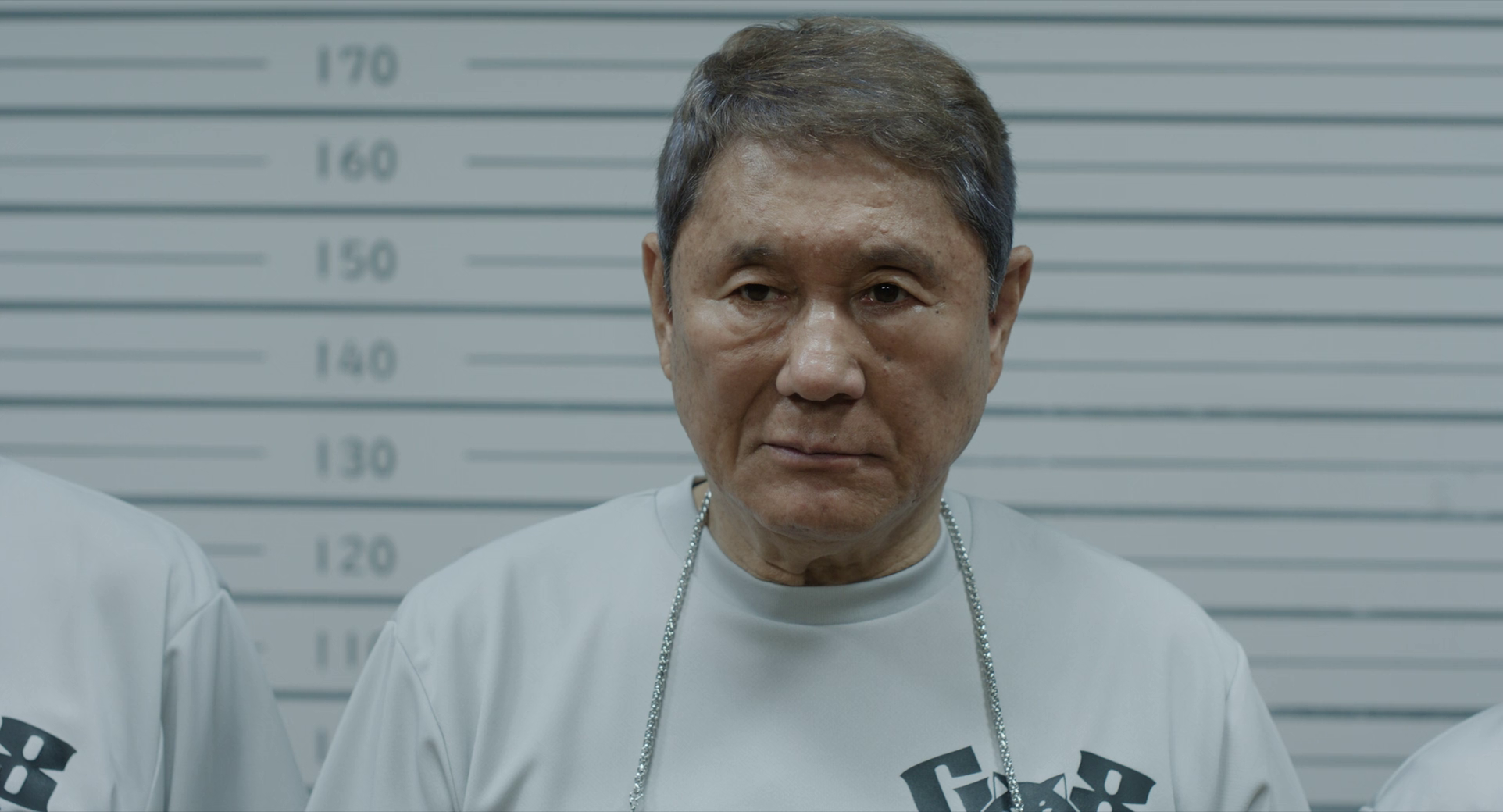
Takeshi Beat opts to give the atmosphere of Broken Rage a darkish quality, utilizing faded colours and overly-present shadows to evoke the seedy criminal truth lurking at the societal surface. By keeping the same darkish atmosphere in the retelling of the Nezumi’s narrative, Takashi Beat seeks to heighten the farcical effect of the comedy of castration by evoking the seriousness by which Nezumi seeks to perform as if he has the phallus.
While the use of music within Broken Rage is quite straightforward – e.g. a tensive piece to decorate Nezumi’s flight from the crime-scene, a jazzy piece to evoke a noirish mood, there is one moment where the music elevates the imagery, strengthening its impact while amplifying its inherent poetic quality (Cine-note 1).
Broken Rage might start off a simple noirish crime drama, but Takashi Beat elegantly plays his audience by turning his crime drama into a farcical exposition of castration. Takeshi Beat, however, does not merely return to his comical roots, but succeeds in offering the spectator a hilarious staging of what forms the root of comedy – in short, you will laugh.

Notes
Cine-note 1: In sequences without Nezumi, another character comes to fulfills the same function: e.g. Tomita.
Cine-note 2: The slow-motion framing of struggle of the yakuza boss as Nezumi pushes him under water attains a certain poetic elegance due to the classical music.
 psychocinema