Michihito Fujii has proved himself capable at creating effective romantic narratives (e.g. The Last 10 Years (2022), 18×2 Beyond Youthful Days (2024)) as well as filmic experiences that explore the complex tensions between subject and society (e.g. The Journalist (2019), A Family (2021), The Village (2023)).
Given his inclination to take on narratives that have a social critical flavour, it comes to no surprise that he was approached to bring Tamehito Somei’s novel Shotai (2020), a novel exploring the conflictual crossroads between image, politics, subjectivity, to life on the silver screen.

Fujii’s narrative commences with the well-planned escape of death row inmate Keiichi Kaburagi (Ryusei Yokohama). The police, obviously embarrassed by this blunder, vouches to carefully investigate and apprehend the escapee as soon as possible. Yet, 118 days later, Matanuki (Takayuki Yamada) and his team are not any inch closer at locating his whereabouts.
The opening sequence of Faceless introduces a contrast between Kaburagi’s escape and his subsequent attempt to blend in the societal field, a contrast that subtly invites the spectator to question the motive of his escape. Is it the mere dark looming threat of death that forced him to escape the suffocating hands of the law or does his escape have another aim? Luckily, the spectator does not have to wait long to receive a signifier that hints at his true aim. In a conversation between Matanuki and his subordinate (Goki Maeda), the junior fleetingly highlights that, despite receiving the death penalty, the escapee always kept denying the charges. Or to put it in reformulated manner, what if Kaburagi escaped to prove his innocence?
This sequence is also informative because it introduces the fictional dimension of societal truth – the narrative of Kaburagi’s murderous transgression might be wrong – and the importance of narratives to appease the public and safeguard the consistence and infallibility of the Other of the law. We are, in other words, introduced to an Other of the law who is overly invested in the image and how it is perceived by the societal field. The Other of the law is not only focused on following the letter of the law, but also on putting it to use to safeguard its own societal image and determine societal discourses (Narra-note 1). Image and message preside over justice, swift convictions over factual truth. This ‘political’ tension is, moreover, re-echoed within the side-narrative of reporter Sayaka Ando (Riho Yoshioka) and her father Junji Ando (Tanaka Tetsushi), the top-lawyer who fails to clear his name of the molestation charge.

The pressure Matanuki is subjected to by his superior, Seiichi Kawada (Yutaka Matsushige), is not simple because he must, at all costs, restore the calculation of the law – Kaburagi must receive the death penalty, but to repair the gaping imaginary wound inflicted by Kaburagi’s escape to the pristine fiction of the infallibility of the law’s representatives. While Matanuki, at first, does his job diligently – the escaped death row convict must be apprehended, the myriad of revelations, riddles, and confrontations sows doubt into his mind and ultimately forces him to make a choice between disobeying his superior and seeking justice or meekly playing his role as rook in support of the political dimension that perverts the Other of the law and the fiction of its infallibility.
Fujii re-emphasizes this societal fiction – the lack that structures the Other of the law – by confronting the spectator with the criminal exploitation and the transgressions that happen unseen at certain construction site (Socio-note 1).
Faceless, moreover, contrasts the social image of Kaburagi-the-murderer to the various faces of his subjectivity he shows to the others he meets during his escape. The first face of Kaburagi we, as spectator, are presented with – the unkept Benzo, emphasizes his sense of righteousness. The second version, writer Nasu, introduces a man haunted by the unwillingness of the Other of the law to believe his enunciations – the unwavering verbal affirmation of his innocence. And the final face reveals a man in despair, a man who is desperately trying to acquire the key that would affirm his innocence for the Other.
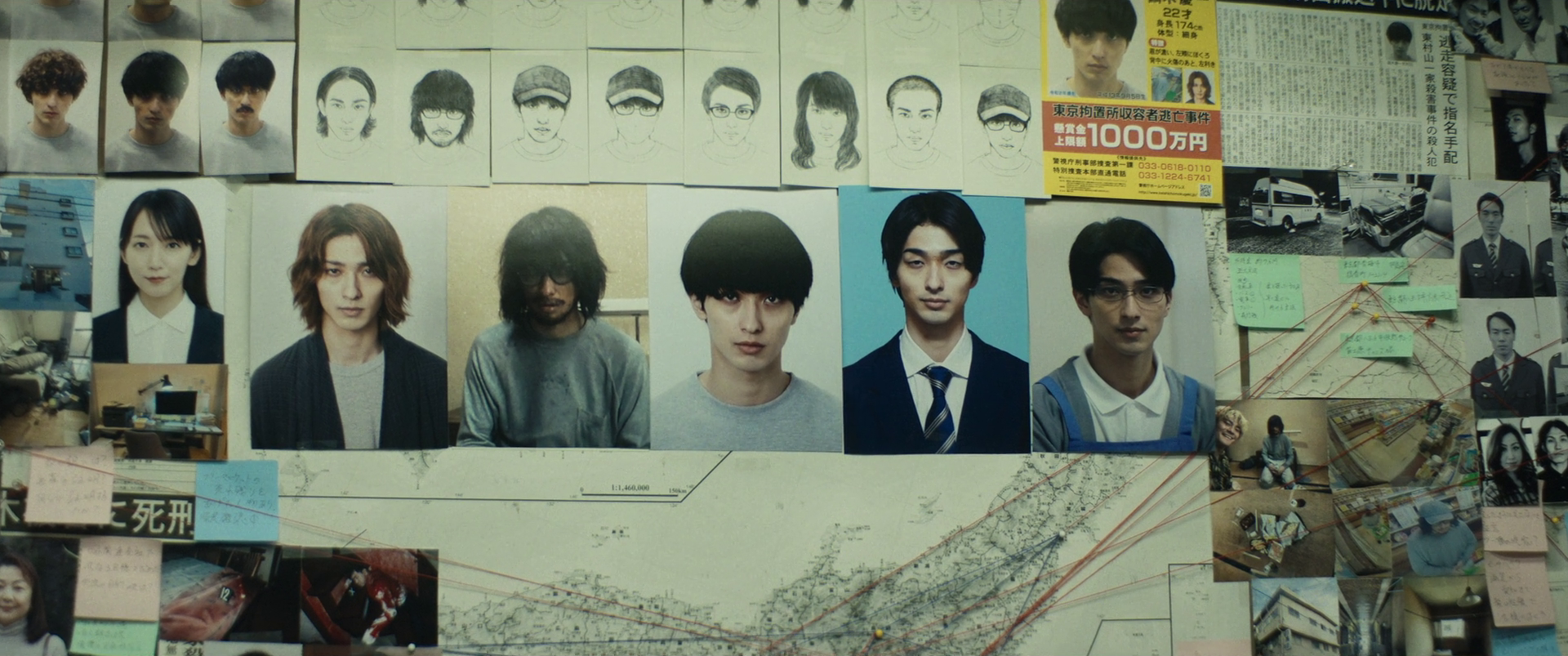
The concatenation of faces gives an explanation as to why people have trouble to see through his disguises and recognize him. The way he presents himself within the societal field to the other (i.e. as a subject fuelled by righteousness) does not accord with the image broadcasted within the media (i.e. the brutal violent convict). It is, in other words, because the lens by which the subject looks around him is primed by the mediatized fantasy of the murderous Kaburagi that people struggle to get the truth of his identity into focus (Narra-note 2).
What also hinders the subject from accepting the ‘wolf’ among the sheep is his pacifying belief in the moral consistency and the harmonious peace of his environment. This belief functions as a veil that supports the subject’s ego and represses any indications that signal the truth – the truth of the other’s Otherness and the transgressions that writhe underneath the veil.
The ending of Faceless, sadly, fails to deliver on all thematical fronts and bring the exploration of the subjective ravage caused by the Other’s political investment in the societal image and the transformative power of the encounter to a fully satisfactory end. While Fujii resolves the psychological dimension of Kaburagi’s trajectory in an effective with his emotional denouement, the melodramatic touch washes away the societal critical dimension that sustains the narrative. The univocal ‘positive’ resolution of the film – the hopefully naive outcome – allows the spectator to erase the confrontation with the political corruption caused by taking the image over justice. The sea of emotion washes away the fact – a fact indirectly implied by the ending – that fundamentally nothing has changed.
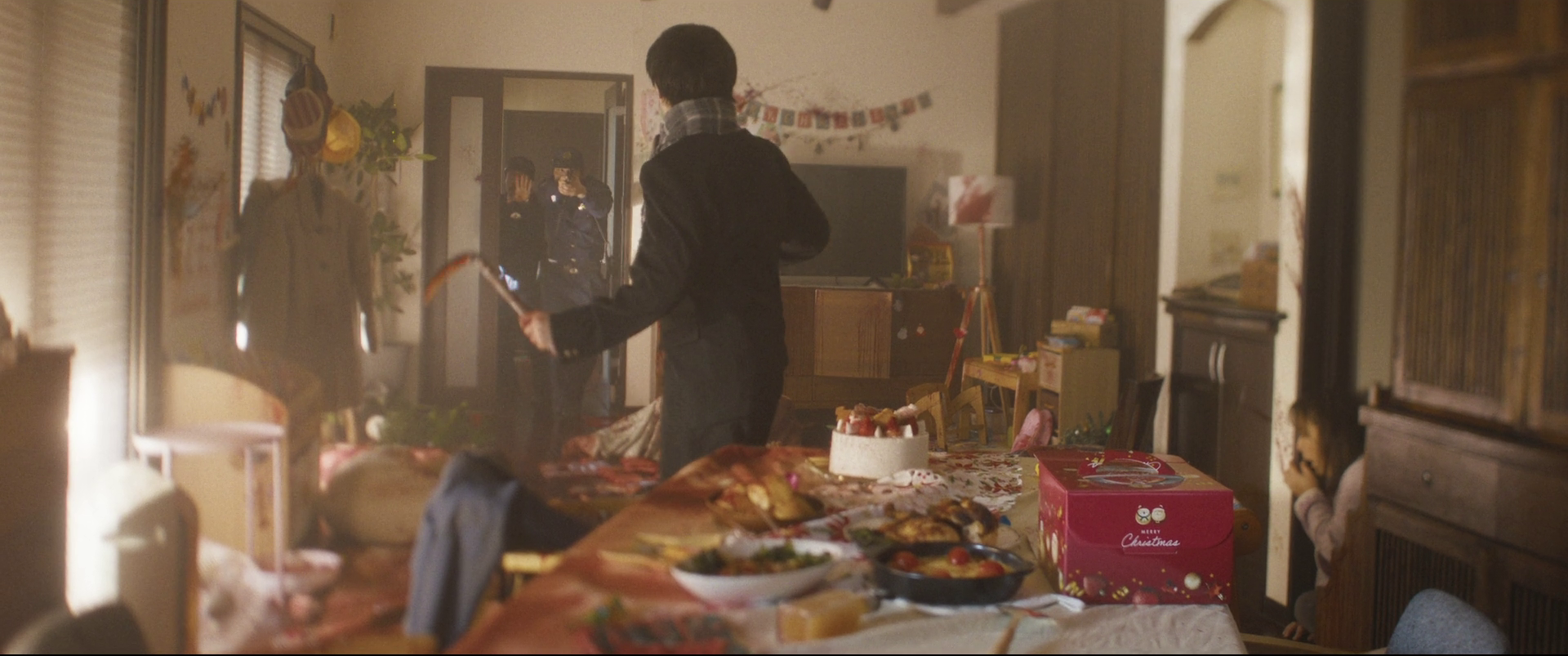
Fujii composes Faceless with an enticing sense of visual elegance. However, Fujii does not merely seek to deliver moments of visual beauty, but craft shot-compositions that sustain the film’s atmosphere and visually elevate the impact of the imagery and the enunciated signifiers. Fujii, moreover, takes great care in calling forth the dimension of the psyche by fluidly interweaving close-up shots of (partial) facial expressions indicative of mental strain and inner turmoil. Another stylistic tool the director relies on to evoke something psychological is the POV-shot. In an evocative dream-sequence, Fujii brutally equates the spectator’s gaze with Kasuragi’s inner-gaze to fleetingly subject the former to the traumatic dimension of not being believed the latter suffers from.
The impact of Fujii’s images and the narrative signifiers is ensured by the effective dramatic musical accompaniment. However, the music does not merely support the composition of the shot or the pace of the camera-movement, but also smoothens the visual flow, creating an elegant whole that pulls the spectator right from the get-go into the narrative.
Fujii also utilizes the sound-design in an effective way. He is not only attentive at emphasizing the spatial dimension of his narrative spaces, but also gives many enunciations a certain intimate closeness. Due to this aurally-induced intimacy, the spectator cannot remain a distant observer and is persuaded to invest in the mystery that surrounds the brutal murders and Kaburagi’s escape.
Faceless is a great thriller that beautifully shows the destructive role the image can play within the societal field. However, Fujii undercuts the impact of his film and its societal critical message by ending an emotionally satisfying, yet deeply naive denouement to Kaburagi’s escape.

Notes
Socio-note 1: The exploitation that Kasuragi or Benzo as he is called by his co-workers is confronted with is capitalistic in origin. The construction company attracts vulnerable people (e.g. Jump (Shintaro Morimoto) has a large gambling debt) to keep them in a suffocating stranglehold of dependency – they are forced to be grateful for the financial crumbs that can, at any time, be taken away. Or to put it differently, they have but one right, the right to be exploited.
Narra-note 1: Fujii also emphasizes within his narrative that the political emphasis on image and message is forced upon the police force by its superiors. Those in power overly invest in the political effect of their decisions – the image that emanates from their produced signifiers – to safeguard their own position of power. The police force is, in this sense, not tasked to serve the moral dimension of justice, but the societal Other and its representatives.
Narra-note 2: The destabilizing fear that creeps over Jump after recognizing Kasuragi as being the wanted man can only be understood as the effect of what the mediatized fiction of Kasuragi implies concerning his subjective logic – he has no qualms in murdering people.
The mediatized fiction, supported by the letter of the law, as well as the promised monetary reward of three-million-yen washes Jump’s immediate experience of interacting with Kasuragi, as Benzo, away.
 psychocinema
One Comment Add yours