Introduction
With Jokichi’s revenge left largely unfinished in Trail of Blood (1972), it was a given a sequel would follow. In fact, spectators did not need to wait that long to enjoy the continuation of his story as The Fearless Avenger (1972) was released in movie theatres in the very same year. With little time between the two releases, Kazuo Ikehiro of course returned to direct the second film of the Mikogami Trilogy. Yet, can he improve on his first narrative?
Review
After a chance encounter on a boat with some henchmen of Kaiun of Chogoro (Shobun Inoue), Jokichi of Mikogami (Yoshio Harada) learns that his next target is in Enoki to attend the Third Memorial Service for the First Generation Enokimatsu boss Goro. Jokichi bursts into the memorial service to ask for Chogoro’s life but is outnumbered and captured. Luckily, due to the intervention of Thunder Juzaburo (-), he is not killed on the spot but thrown into the river.
Not that much later, after getting once again into a row with some hoodlums, he is approached by yakuza boss Umezo (-), who asks him to escort Boss Juzaburo’s capricious daughter Oyuki (Ryoko Nakano) back home. Jokichi intends to refuse, but Umezo tells him that having the powerful Juzaburo in his debt will be a powerful aid to fulfill his desire for revenge. Can Jokichi utilize this opportunity to cut another murderer of his family down?
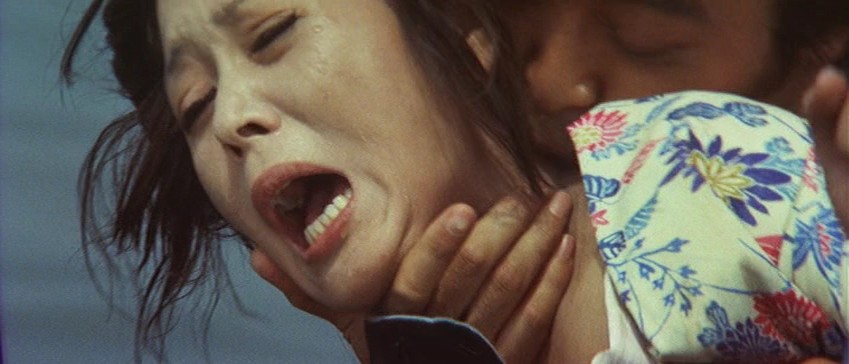
The first narrative of the Mikogami trilogy, Trail Of Blood (1972), made it clear that the violence of Jokichi, who was radically cut out from the societal fabric by Kyubei of Nyoraido and his criminal comrades, confronts the murderers of his wife and child with the amoral division they represent. While they hold a certain position of respect in the eye of societal Other, they utilize the blind spots within this eye to commit crimes, e.g. to murder women and children. In fact, they pervert their societal position of power by utilizing the law and the code of samurai in accordance to their own transgressive jouissance.
Of course, while such confrontation via violence is aimed at, it is not the goal of Jokichi’s trajectory of revenge. As a victim of such criminal abuse of bushido and the imaginary honor of the samurai, his final goal is to radically remove these perverted stains of jouissance from the societal field – his violence is, in this sense, more ethical. Yet, as Trail of Blood (1972) illustrates, the only way one can tread such bloody path is by being cut out from the societal field, by having nothing to lose at the level of the symbolic and imaginary – the only thing he can put into danger is his body as Real. This unanchored subjective position, this position of already wandering outside the symbolic field as a dead man, also explains why Jokichi disturbs the gathering of the Kanto bosses.

The proliferation of imaginary violence, of violent eruptions born from injuries to one’s ego (e.g. ‘you bumped in me’) within the societal field sketched out by The Fearless Avenger highlights an ever deeper problem within the Other, i.e. the lack of strong symbolic presence of the law. It is, in our view, such absence that causes the explosion of imaginary dual violence (i.e. the ego lashing out against his semblable to utilize it and its body to fleetingly perform one’s ideal-ego) and seduces subjects to utilize the law to protect and ensure their own enjoyment (Narra-note 1).
Yet, while there is no strong presence of the law, it is not completely absent nevertheless from the societal fabric. Its presence is underlined when Jokichi hears that Chuji Kunisada (Toru Minegishi) has been arrested and will soon be passing through on the Tanakura-kaido highway. Yet, the swift way Kunisada is freed by his henchmen confirms the weak state of the law within the Japanese societal field. The Fearless Avenger illustrates that the weakness of the law lies in the possibility to pervert it and to use in a way that one’s social facade remains intact while one’s jouissance can be satisfied.

The visual and compositional style of The Fearless Avenger is, unsurprisingly, a continuation of the style of Trail Of Blood (1972) – a balanced mix of static and dynamic moments to bring the second chapter of Jokichi’s tale of revenge to life. Yet, this time around, Ikehiro improves the dramatic rhythm of his narrative – the whole of emotional turns – by using the rhythm inherent to the compositional dynamism more thoughtfully. Besides momentarily heightening the pace of shots to infuse tension into a certain sequence, there are also many moments where the visual rhythm slows-down to increase dramatic feel of a certain narrative twist (Narra-note 2).
Within his composition, most dynamic moments (i.e. tracking shots, spatial shots, zoom-ins and zoom-outs) are fluid. Only a few times in the narrative, he utilizes the evocative power of shaky framing. In most cases, the trilling of the frame is exploited to echo the fear of those who soon will succumb to Jokichi’s vengeful violence or to emphasize the roughness of the sword-fights.
Ikehiro also offers many stylish moments in his composition. Ikehiro visually pleases the spectator with many finely composed shots – shots that use the geometrical dimension effectively – and a variety of shots that, by revealing the scenic beauty of nature (e.g. an impressive mountain range) and culture (e.g. rice-fields), celebrate the act of wandering. Yet, in contrast to Trail Of Blood (1972), Ekihiro does not utilize any stylistic moments with colour-contrasts or any other visual elements of excess.

Within the sword-fighting scenes, the composition remains focused on the important characters, like Jokichi or Chuji Kunisada, and the violence they inflict with their katana. This focus allows, by keeping the spectator firmly oriented, the satisfying fighting choreographies come to its full right. Within these scenes, swift dynamic shots are generally utilized to emphasize the velocity of the sword and the bloody impact of its streaks, while static moments are sometimes used to grant the spectator a better look at the bloody bodily injuries caused by the Jokichi’s sword.
The continuation of the style of Trail Of Blood also means that certain sequences in The Fearless Avenger are decorated by ajazzy-funky musical pieces. This kind of music aims, just like the previous narrative, to fleetingly celebrate the Matatabi genre and the filmic character of the drifter. Yet, in The Fearless Avenger, more emotional music is utilized and the tragic dimension of Yokichi’s bloody trail is touchingly emphasized as well. The tragic-heroic dimension of Yokichi’s path is exquisitely expressed by Yoshio Harada, whose commanding performance pulls the spectator right into the narrative.
The Fearless Avenger is a satisfying sequel to Trail Of Blood (1972) that delivers everything a fan of the genre desires – blood, betrayals and lots of sword-fighting. Moreover, Ikehiro’s choice to reduce the stylistic splurges in his composition and increase the visual focus on the act of wandering turns the second film of the Mikogami trilogy into am even more pure celebration of the Matatabi genre.

Notes
Narra-note 1: Even though the societal field jokichi wanders in is marked by violence, one can not see him as the protector of the ‘righteous’ law. First, his violence is solely directed to those who cut him out the societal field by molesting his left-hand and annihilating the familial bonds that gave him a sense within the mundane Other. Secondly, it is precisely because the law presents itself as being perverted by a few powerful men and their henchmen that he embarks on this nihilistic quest for revenge.
Narra-note 2: Some spectators might say the second narrative lacks focus and that its titular hero wanders around without much purpose – his heart might thirst for revenge, but his mind is not focused to make it happen.
Yet, the loose and seemingly episodic nature of the narrative is caused by Yokichi’s act of disturbing the commemorative party. The act does not merely affirm that he, as subject, has lost his societal place, but invites the criminal Other to purge him from the societal field. With no place to plan his revenge nor friends to aid him in enacting it, Yokichi is completely at the mercy of the wandering signifier whose signified might be true or deceptive in nature.
 psychocinema