Kinji Fukasaku is one of the most beloved Japanese directors, yet the admiration cinephiles have for his work is determined by a limited slice of his oeuvre, the five-part series Battles Without Honor and Humanity (1973-1974) or Battle Royale (2000). Yet, in recent years, thanks to the effort of Radiance Films, Arrow Video, and Eureka Entertainment, cinephiles can finally begin to fully explore and appreciate the richness of Fukasaku’s oeuvre.

The latest release by Eureka Entertainment introduces spectators to a somewhat unknown crime masterpiece, a brutal confrontational piece of social commentary: Wolves, Pigs and Men. The narrative, written by Jun’ya Sato and Kinji Fukasaku, offers a pessimistic answer to the following question: Can pigs attain humanity within a world of wolfs?
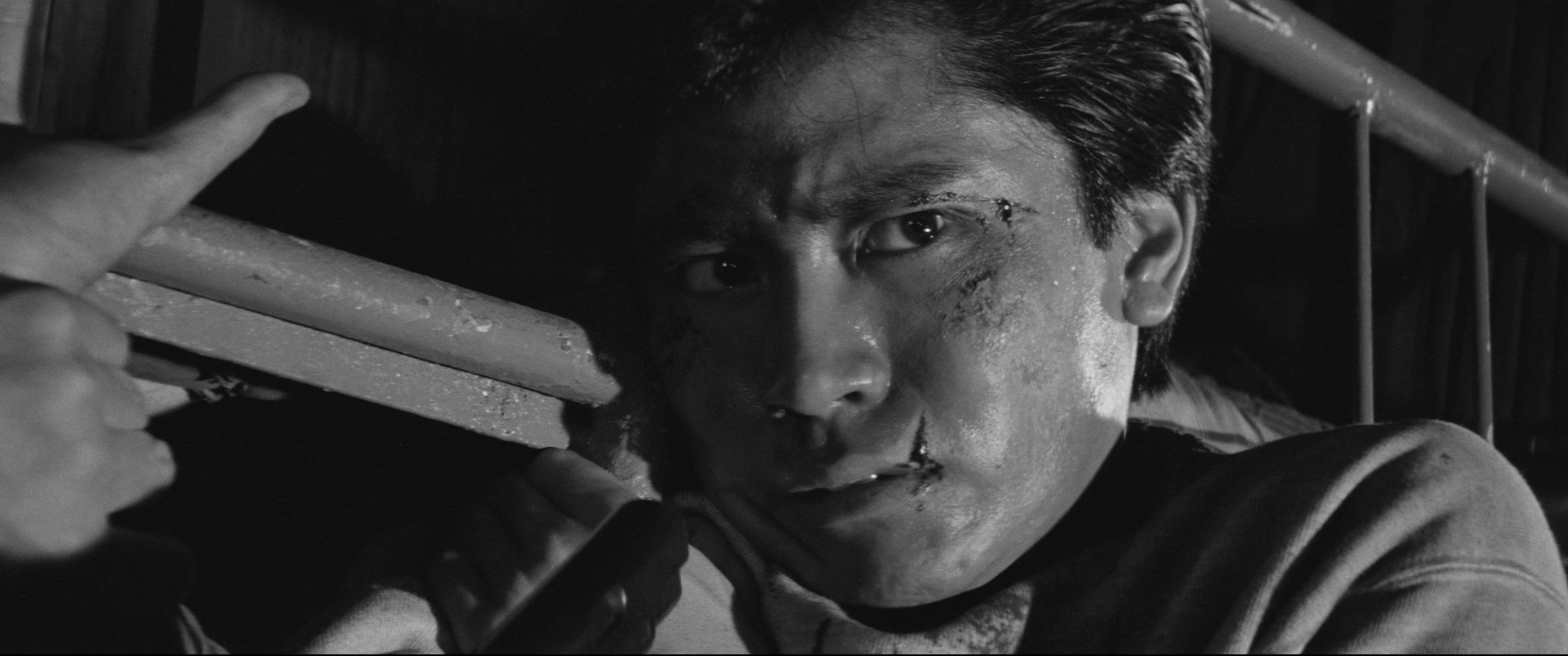
To deliver his answer to the spectator, Fukasaku tells a tale of Kuroki (Rentaro Mikuni), Jiro (Ken Takakura), and Sabu (Kinya Kitaoji), three brothers born in poverty. One day, Kuroki, the eldest, escapes the parental dump to join the up-and-coming Iwasaki-gumi. Jiro, the middle brother, quickly follows suite, abandoning his ill mother and youngest brother to dabble in all sorts of evil ways to gain riches. Sabu, the youngest, awaits his mother’s death to join a group of young troublemakers.
Fukasaku’s Wolves, Pigs and Men delivers a harrowing analysis of the certain post-war societal currents, yet Fukasaku’s shocking analysis can only be fully appreciated by reading the story of the three brothers through the lens of subjective desire.
The dimension of desire is present in Wolves, Pigs and Men from the get-go – it is the determining factor that made Kuroki and Jiro flee the run-down shanty town to escape their impoverished existence. Their successive escape from the parental pigsty is not simply in search for a better life, but in pursuit of desire. What separates the two fleeing brothers from the others is that they repudiate the idea that the path of desire is forbidden for them and that the post-war hardships are solely their burden to bear. By refusing to remain societal pigs within their muddy prison of poverty, Kuroki and Jiro radically reject the Other’s suffocating demand to suffer in silence and repress their desire, their existence as desiring beings.
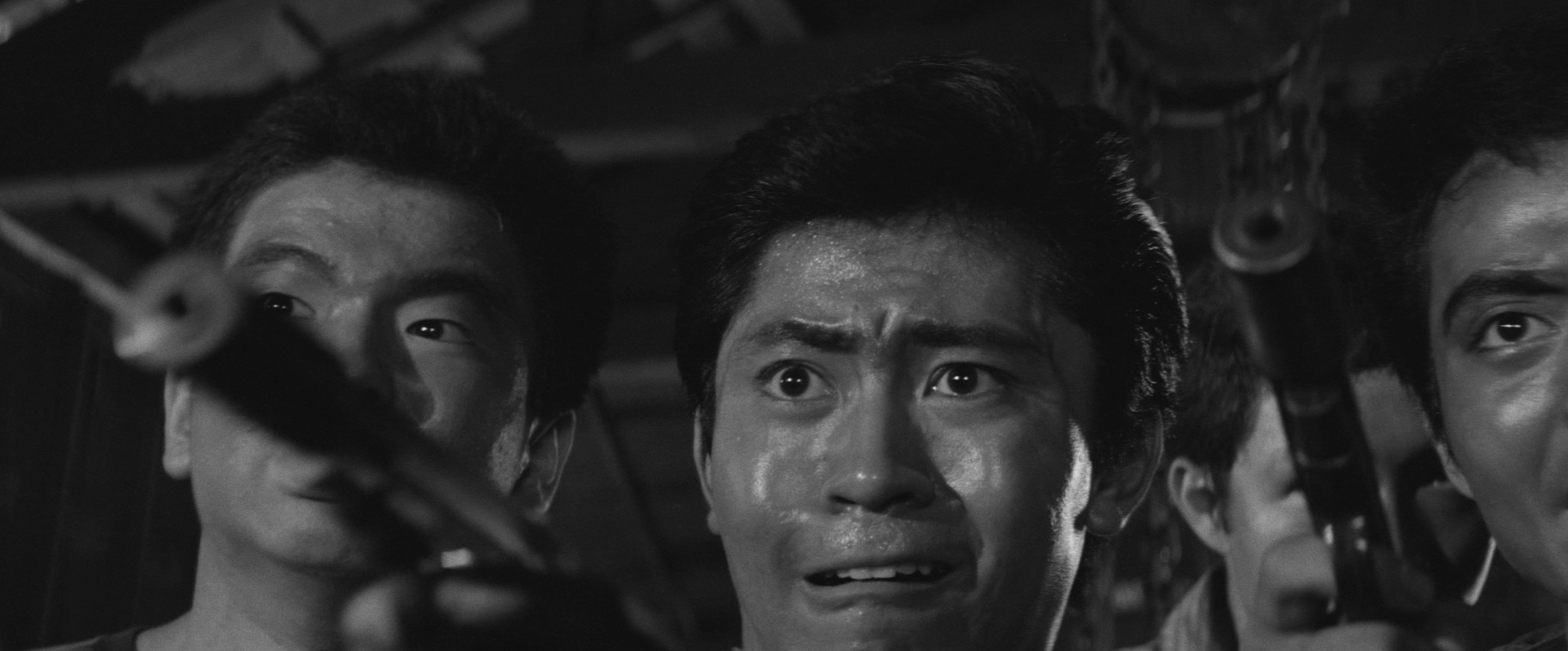
The escapees flee into the societal field to seek, beyond the confines of their pigsty, a place to desire from. Yet, the fleeing subject is immediately caught within a societal field perverted by a phantasmatic capitalistic positivity and, as a result, his desire is at risk of becoming corrupted – desire slowly transforming into a demand for money, wealth and power. A subject, who accepts the capitalistic and materialistic degradation of desire, either becomes a simply cog within the hierarchical structure of organized crime – a wolf by proxy, a capitalistic wolf who violently assumes the right to surround himself, by whatever means, with objects that close off his subjective lack, or a pig waiting to be slaughtered in conflict between hungry wolves.
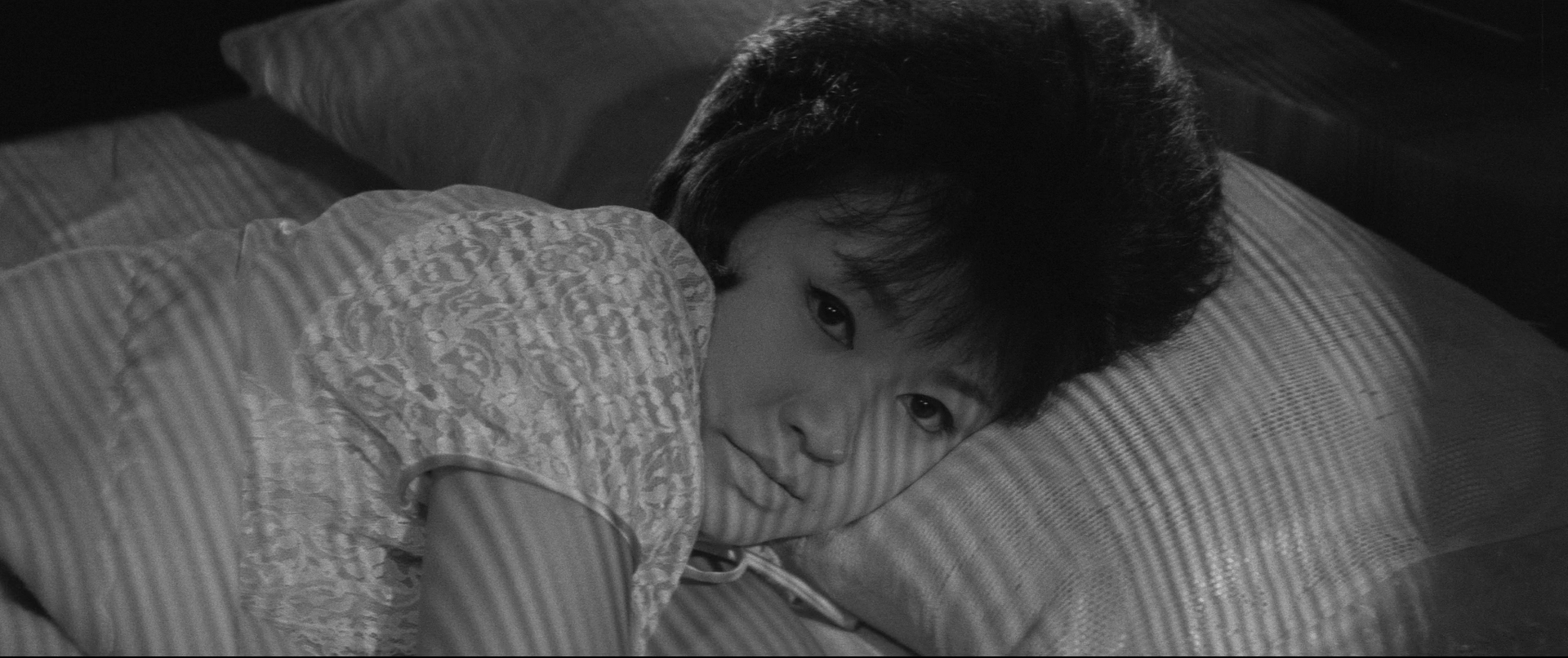
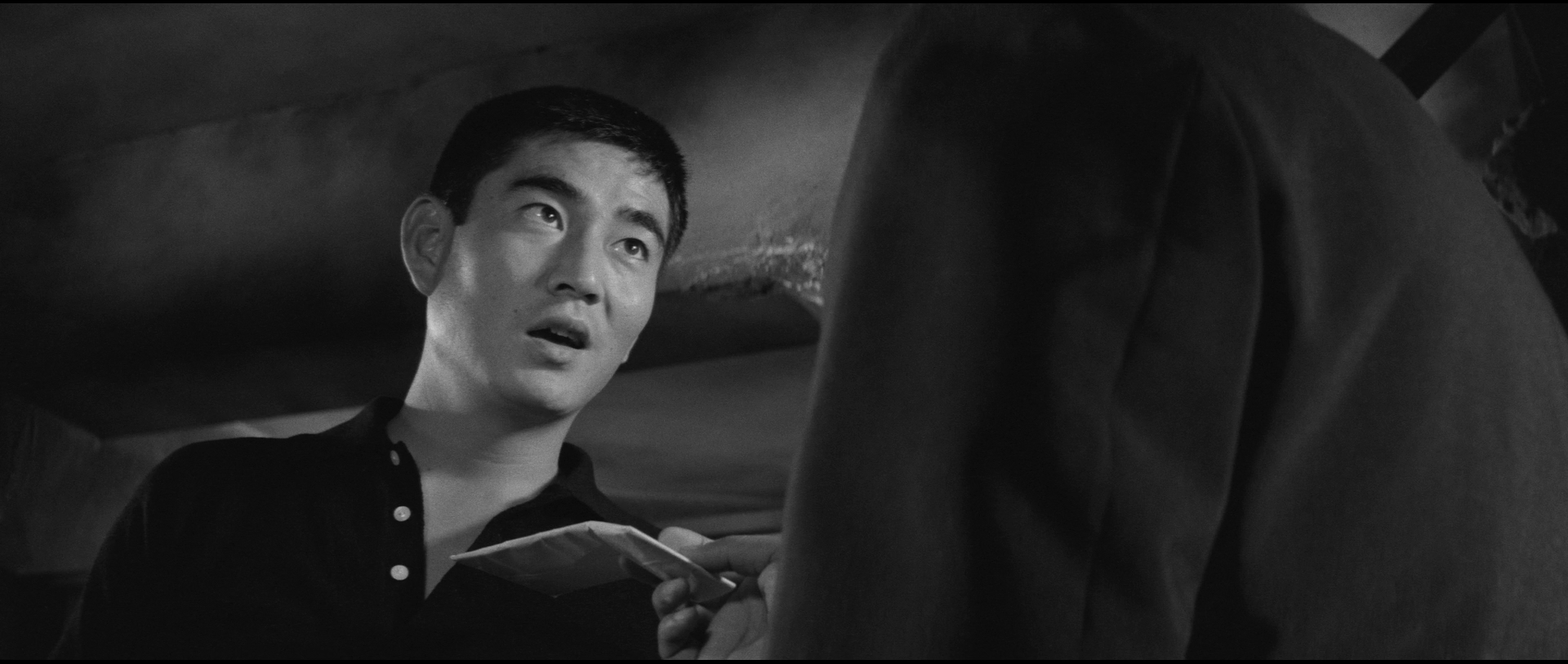
The attentive reader will have noticed that the signifier man is absent from the three outcomes – wolf by proxy, capitalistic wolf, or pig-to-be-slaughtered. Luckily, the subjection to the capitalistic phantasmatic prison can, in certain cases, give rise to a fourth outcome: a wolf seeking to shed his skin and pursue desire, his humanity. Within Wolves, Pigs and Men, this position is exemplified by Jiro and his desire to escape to the other side of the ocean. Jiro’s statement, which initiates the dramatic unfolding of Fukasaku’s narrative, reveals that the capitalistic machinery cannot silence desire – the enslavement to glimmering objects and the wolf-like hunger for more cannot fully negate desire. When Jiro tells his mistress Kyoko (Sanae Nakahara) that what he hopes to find across the ocean is freedom – “something we can’t get here”, he means nothing other than freedom for his desire. He wants to flee the capitalistic ideological system to find an Other where his lack can remain lack, where his desire can simply be desire. Or, to put it differently, by positing such phantasmatic space of freedom on the other side of the ocean, Jiro creates a support to help him on his attempt to bypass the capitalistic machinery and establish himself as a desiring subject – as a neurotic man.
The division of outcomes we developed can easily be utilized to qualify the two other brothers. Kuroki is a pure example of a wolf-by-proxy, a mere cog within the hierarchical structure of the Iwasaki-gumi. As a cog, he does not desire. He carries out the orders to avoid becoming a sacrificial object to appease the oyabun of the Iwasaki-gumi. In this sense, he is a non-desiring wolf afraid to be discovered as an impostor, as a pig pretending.
Sabu, on the other hand, is a pig who has no (phantasmatic) place to desire from yet. This subject-position is elegantly evoked in the song he and his friends sing at the improvised funeral of his mother: “I’m going somewhere. There is no destination. I’m leaving this place” (Narra-note 1). In contrast to Jiro, Sabu and his friends still believe that a desiring position can be obtained within the Japanese societal field. Our youths can maintain such belief because they wander within a peripheral space within the societal field – spit out like pigs by the Other yet also out of reach of its wolf-like ideological demands, a veritable a no-man’s-land. Yet, while this space grants our youths some freedom with regards to pleasure – e.g. chasing dogs with sticks, decorating their hangout with soft-erotic pictures, it offers no structural guidance to become desiring. This lack of guidance – the Other has abandoned them – fuels Sabu’s group’s vindictive anger towards the societal field.
The lack of a place to desire from is expertly exploited by Jiro to enlist Sabu and his friends to carry out the dangerous heist on the Iwasaki-gumi. What Jiro offers them is not merely money, but a deceptive materialistic finality that arouses desire and gives rise to a wolf-like hunger. He cunningly utilizes the phantasmatic promise of capitalism to pervert the true aim of his brother’s desire and support his own search for a neurotic desire.
Within this conflict, all must (temporarily) act as wolves.To get hold of the excremental object – i.e. the stolen money and drugs, each subject must repress their humanity and devote himself to the practice of greed. Wolves, Pigs and Men offers, in this respect, a harrowing illustration of the destructive effect of the capitalistic materialisation of desire’s goal on human interactions – the ‘demand-ification’ of desire. This is not only illustrated by the betrayals, the acts of deception, the verbal threats and the brutal violent excess, but also by the fact that every act and signifier, by virtue of each subject’s (temporary) submission to the doctrine of greed, becomes tainted with suspicion – nobody can be trusted (Narra-note 2, Narra-note 3).
However, as the brutal violence escalates, it becomes clear that only Sabu and his friends maintain a quantum of humanity. Our little pigs, stuck within this no-man’s land, retain some of their humanity because the capitalistic phantasy fails to determine the logic of their interactions – their relationship to the Other/other is not mediated by the object money (Narra-note 4). The thrilling and highly unpredictable finale is – without spoiling too much – structured around a heartfelt appeal to overcome the perverting hold capitalism has on the logic of certain subjects (Narra-note 5).
Fukasaku brings his tale of capitalistic dehumanization and short-circuited desire to life in a visually riveting way. The director does not only fluidly combine various kinds of dynamism (i.e. fluid and shaky) to create an engaging narrative flow, but also litters his composition with elegantly composed static shots and visual moments that leave a lasting impression on the spectator. Yet, the true power of Fukasaku’s noirish composition does not lie in its ability to visually satisfy the spectator, but in the way it turns the subjective logic of the brothers into a tangible experience.
By thoughtfully combining tensive musical pieces with expressive visual elements, Fukasaku ensures that many of his action-oriented sequences have an exhilarating quality. He expertly exploits tilted perspectives and sudden accelerations in compositional pace to accentuate the swift dynamism of the on-screen action and to evoke a sense of disorientation that heightens the tension. Other moments of violence are framed from a more objective perspective, allowing the brutal interpersonal violence, as born from the greedy fixation on the stolen money, unsettle the spectator.
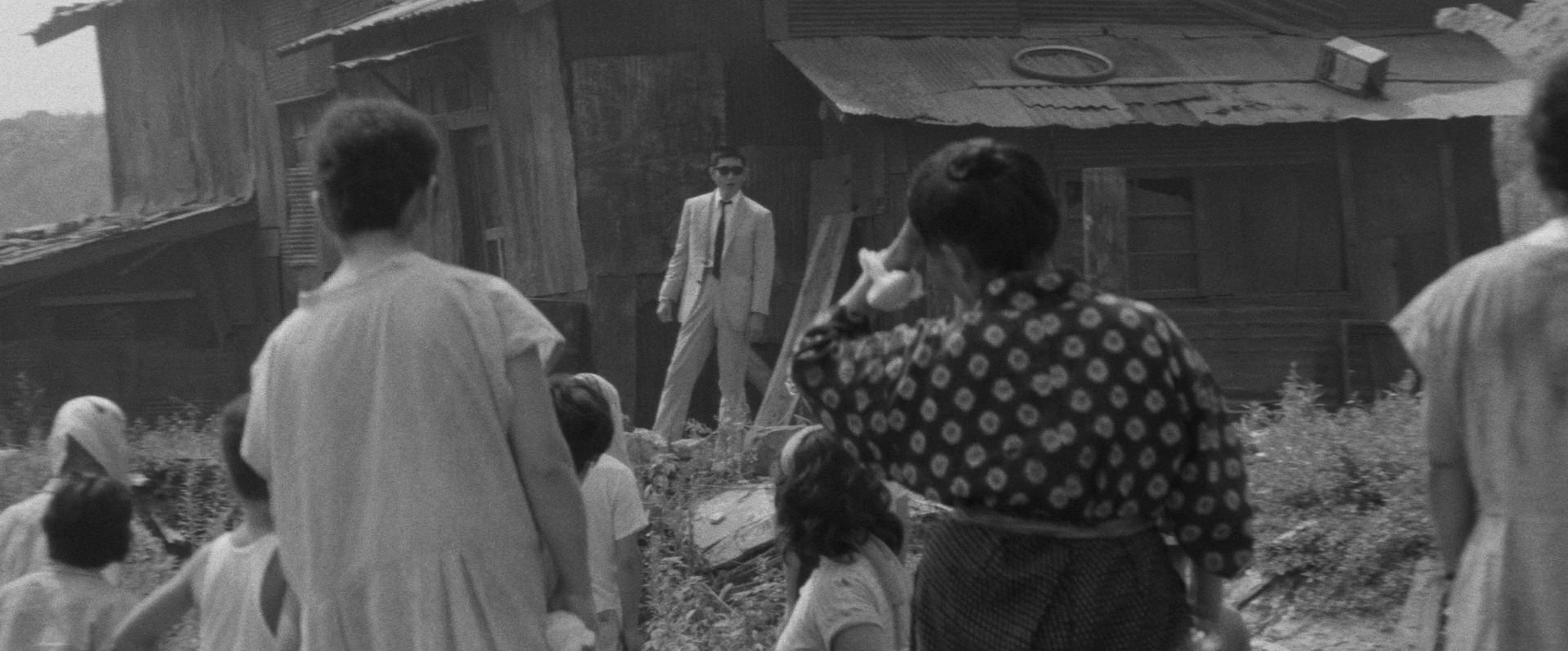
Fukasaku’s love for still photography is also evident in his composition. Yet, while Fukasaku would, in the seventies, rely on still photography to reverberate the factual basis of his jitsuroku narratives, in Wolves, Pigs and Men the still images are stylistically employed to deliver elegant jump-cut-like moments and to heighten the visual impact of a sudden on-screen movement. The title sequence, where he expresses his love for still shots, is not only a visual delight but also an impressive and gripping piece of storytelling.
Music is also thoughtfully employed within the composition. The jazzy musical accompaniment does not merely create a moody atmosphere, but also echo Jiro’s realization of the futility of desiring within a capitalistic structured societal system. The use of rock-and-roll musical pieces, on the other hand, elegantly echo the youthful naivety marking Sabu and his friends.
Wolves, Pigs and Men is an extremely powerful piece of cinema that still succeeds to dazzle the contemporary spectator and deeply affect him. Fukasaku and Junya Sato’s decision to go beyond Nikkatsu’s Borderless Action and Toei’s nostalgic Ninkyo fantasies to critique the capitalistic current within the post-war societal field and its perverting effects on interpersonal bonds gave birth to a shockingly beautiful experience that is as relevant today as it was in the sixties.

Notes
Narra-note 1: Yet, the contrast between the hopeful song and the funerary urn bobbing in the water echoes, unbeknownst to your youths, the unsettling nihilistic truth that true freedom of desire can only be found in death – only in death, one is free of the Other.
Narra-note 2: The first subjective effect of inscribing oneself within the doctrine of greed is the blossoming of the assumption that every act and signifier of the other, the alter ego, is also animated by greed.
Narra-note 3: At one point in the narrative, Kyoko tells Jiro that his acts towards Sabu are determined by seeing himself reflected in his younger brother. This is true not merely in so far that Sabu confronts him with his younger self – trying to flee the pigsty into the deceptive machinery of capitalism – but also because he sees, before his own eyes, how the capitalistic phantasy perverts interpersonal dynamics, the very dynamic he vies to escape from to unlock his desire from its false object-goal.
Narra-note 4: The object of money does not divide Sabu and his friends because it is turned into a common goal for the troupe. They socialize the object of money and, hereby, short-circuit its destabilizing effect on social interactions – feelings of suspicious and distrust do not arise.
Narra-note 5: The appeal is directed to the Other, as subject, and not to the other, as rival. It is a demand to the Other to shatter the imaginary dynamic of rivalrythat simplifies his approach to the other and bars his subjectivity from entering in the interactional field.
 psychocinema